
Software Synthesis from Dataflow Graphs
-
- Hardcover
- Taschenbuch ausgewählt
-
Sprache:Englisch
99,99 €
inkl. gesetzl. MwSt.,
Beschreibung
Produktdetails
Einband
Taschenbuch
Erscheinungsdatum
05.10.2011
Abbildungen
XII, 190 p.
Verlag
Springer UsSeitenzahl
190
Maße (L/B/H)
23,5/15,5/1,2 cm
Gewicht
318 g
Auflage
Softcover reprint of the original 1st edition 1996
Sprache
Englisch
ISBN
978-1-4612-8601-1
Software Synthesis from Dataflow Graphs
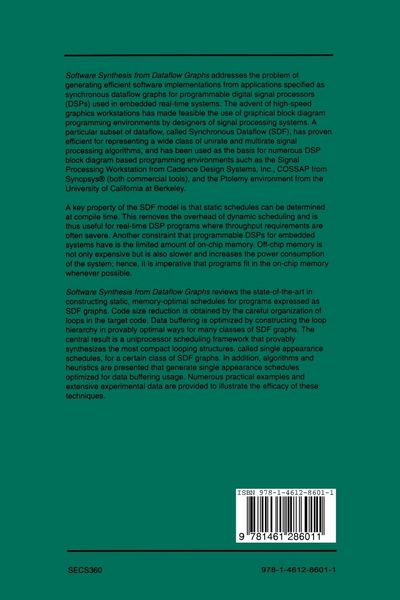
addresses the problem of generating efficient software implementations from applications specified as synchronous dataflow graphs for programmable digital signal processors (DSPs) used in embedded real- time systems. The advent of high-speed graphics workstations has made feasible the use of graphical block diagram programming environments by designers of signal processing systems. A particular subset of dataflow, called Synchronous Dataflow (SDF), has proven efficient for representing a wide class of unirate and multirate signal processing algorithms, and has been used as the basis for numerous DSP block diagram-based programming environments such as the Signal Processing Workstation from Cadence Design Systems, Inc., COSSAP from Synopsys
®
(both commercial tools), and the Ptolemy environment from the University of California at Berkeley.
A key property of the SDF model is that static schedules can be determined at compile time. This removes the overhead of dynamic scheduling and is thus useful for real-time DSP programs where throughput requirements are often severe. Another constraint that programmable DSPs for embedded systems have is the limited amount of on-chip memory. Off-chip memory is not only expensive but is also slower and increases the power consumption of the system; hence, it is imperative that programs fit in the on-chip memory whenever possible.
Software Synthesis from Dataflow Graphs
reviews the state-of-the-art in constructing static, memory-optimal schedules for programs expressed as SDF graphs. Code size reduction is obtained by the careful organization of loops in the target code. Data buffering is optimized by constructing the loop hierarchy in provably optimal ways for many classes of SDF graphs. The central result is a uniprocessor scheduling framework that provably synthesizes the most compact looping structures, called singleappearance schedules, for a certain class of SDF graphs. In addition, algorithms and heuristics are presented that generate single appearance schedules optimized for data buffering usage. Numerous practical examples and extensive experimental data are provided to illustrate the efficacy of these techniques.
Noch keine Bewertungen vorhanden
Verfassen Sie die erste Bewertung zu diesem Artikel
Helfen Sie anderen Kundinnen und Kunden durch Ihre Meinung.
Kurze Frage zu unserer Seite
Vielen Dank für Ihr Feedback
Wir nutzen Ihr Feedback, um unsere Produktseiten zu verbessern. Bitte haben Sie Verständnis, dass wir Ihnen keine Rückmeldung geben können. Falls Sie Kontakt mit uns aufnehmen möchten, können Sie sich aber gerne an unseren Kund*innenservice wenden.
zum Kundenservice