
• Produktbild: Non-Homogeneous Boundary Value Problems and Applications
  • Produktbild: Non-Homogeneous Boundary Value Problems and Applications
Band 182

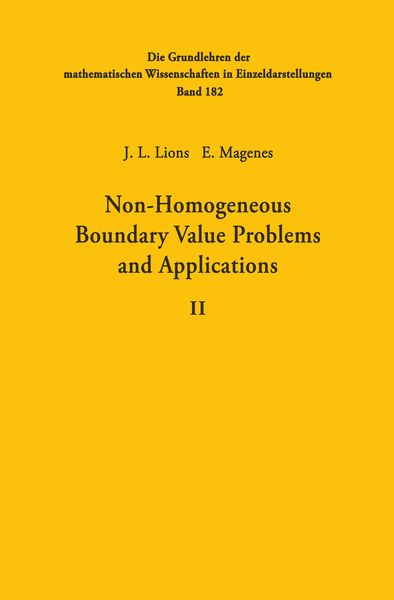
Non-Homogeneous Boundary Value Problems and Applications Volume II

119,99 €

inkl. gesetzl. MwSt., Versandkostenfrei


Beschreibung

Produktdetails

Einband

Taschenbuch

Erscheinungsdatum

12.11.2011

Verlag

Springer Berlin

Seitenzahl

244

Maße (L/B/H)

23,5/15,5/1,5 cm

Gewicht

399 g

Auflage

Softcover reprint of the original 1st ed. 1972

Übersetzt von

P. Kenneth

Sprache

Englisch

ISBN

978-3-642-65219-6

Beschreibung

Produktdetails

Einband

Taschenbuch

Erscheinungsdatum

12.11.2011

Verlag

Springer Berlin

Seitenzahl

244

Maße (L/B/H)

23,5/15,5/1,5 cm

Gewicht

399 g

Auflage

Softcover reprint of the original 1st ed. 1972

Übersetzt von

P. Kenneth

Sprache

Englisch

ISBN

978-3-642-65219-6

Herstelleradresse

Springer-Verlag KG
Sachsenplatz 4-6
1201 Wien
AT

Email: ProductSafety@springernature.com

Kundinnen und Kunden meinen

0 Bewertungen

Informationen zu Bewertungen

Zur Abgabe einer Bewertung ist eine Anmeldung im Konto notwendig. Die Authentizität der Bewertungen wird von uns nicht überprüft. Wir behalten uns vor, Bewertungstexte, die unseren Richtlinien widersprechen, entsprechend zu kürzen oder zu löschen.

Die Bewertungen sind nach Format, Anzahl Sterne und Datum sortiert.

Verfassen Sie die erste Bewertung zu diesem Artikel

Helfen Sie anderen Kund*innen durch Ihre Meinung

Kundinnen und Kunden meinen

0 Bewertungen filtern

  • Produktbild: Non-Homogeneous Boundary Value Problems and Applications
  • Produktbild: Non-Homogeneous Boundary Value Problems and Applications
  • 4 Parabolic Evolution Operators. Hilbert Theory.- 1. Notation and Hypotheses. First Regularity Theorem.- 1.1 Notation.- 1.2 Statement of the Problems.- 1.3 (Formal) Green’s Formulas.- 1.4 First Existence and Uniqueness Theorem (Statement).- 1.5 Orientation.- 2. The Spaces Hr, s(Q). Trace Theorems. Compatibility Relations.- 2.1 Hr, s-Spaces.- 2.2 First Trace Theorem.- 2.3 Local Compatibility Relations.- 2.4 Global Compatibility Relations for a Particular Case.- 2.5 General Compatibility Relations.- 3. Evolution Equations and the Laplace Transform.- 3.1 Vector Distribution Solutions.- 3.2 L2-Solutions.- 4. The Case of Operators Independent of t.- 4.1 Hypotheses.- 4.2 Basic Inequalities.- 4.3 Solution of the Problem.- 5. Regularity.- 5.1 Preliminaries.- 5.2 Basic Inequalities.- 5.3 An Abstract Result.- 5.4 Solution of the Boundary Value Problem.- 6. Case of Time-Dependent Operators. Existence of Solutions in the Spaces H2r m, m(Q), Real r ? 1.- 6.1 Hypotheses. Statement of the Result.- 6.2 Local Result in t.- 6.3 Proof of Theorem 6.1.- 6.4 Regular Non-Homogeneous Problems.- Adjoint Isomorphism of Order r.- 7.1 The Adjoint Problem.- 7.2 Adjoint Isomorphism of Order r.- 8. Transposition of the Adjoint Isomorphism of Order r. (I): Generalities.- 8.1 Transposition.- 8.2 Orientation.- 8.3 The Spaces H??, ??(Q), H??, ??(?), ?, ? ? 0.- 8.4 (Formal) Choice of L.- 9. Choice of f. The Spaces ?2rm,r(Q).- 9.1 The Space ?2rm,r(Q).- 9.2 The Space ??2rm,?r(Q).- 9.3 Choice of f. The Space D?(r?1)(P)(Q).- 10. Trace Theorems for the Spaces D?(r?1)(P)(Q), r ? 1.- 10.1 Density Theorem.- 10.2 Trace Theorem on ?.- 10.3 Continuity of the Trace on Surfaces Neighbouring ?.- 10.4 Trace Theorem on ?0.- 10.5 Continuity of the Trace on Sections Neighbouring ?.- 11. Choice of gj and uo. The Spaces H2?m ??(?).- 11.1 The Spaces H2?m ??(?).- 11.2 Choice of gj.- 11.3 Choice of uo.- 12. Transposition of the Adjoint Isomorphism of Order ?. (II): Results; Existence of Solutions in H2mr,r(Q)-Spaces, Real r ? 0.- 12.1 Final Choice of L.- 12.2 Results.- 12.3 Complements.- 13. State of the Problem. Complements on the Transposition of the Adjoint Isomorphism of Order 1.- 13.1 State of the Problem.- 13.2 Complements on the Transposition of the Adjoint Isomorphism of Order 1.- 13.3 Orientation.- 14. Some Interpolation Theorems.- 14.1 Notation. Statement of the Main Result.- 14.2 Outline of the Proof.- 14.3 First Auxiliary Interpolation Theorem.- 14.4 Second Auxiliary Interpolation Theorem.- 14.5 Third Auxiliary Interpolation Theorem.- 14.6 Proof of Theorem 14.1.- 15. Final Results; Existence of Solutions in the Spaces H2mr,r(Q), 0 < r < 1. Applications.- 15.1 Application of the Results of Section 14.- 15.2 Examples; Generalities.- 15.3 Examples (I).- 15.4 Examples (II).- 15.5 Some Complements on the Dirichlet Problem.- 16. Comments.- 17. Problems.- 5 Hyperbolic Evolution Operators, of Petrowski and of Schroedinger. Hilbert Theory.- 1. Application of the Results of Chapter 3 and General Remarks.- 1.1 Notation. Hypotheses.- 1.2 Application of the Results of Chapter 3.- 1.3 A Counter-Example.- 2. A Regularity Theorem (I).- 3. Regular Non-Homogeneous Problems.- 3.1 Statement of the Problem.- 3.2 The Compatibility Relations.- 3.3 The Case of the Dirichlet Problem.- 4. Transposition.- 4.1 Adjoint Isomorphism.- 4.2 Transposition.- 4.3 Choice of L.- 4.4 Conclusion.- 5. Interpolation.- 5.1 Statement of the Problem.- 5.2 Some Interpolation Results.- 5.3 Consequences.- 5.4 The Case of the Dirichlet Problem.- 6. Applications and Examples.- 6.1 General Results.- 6.2 Examples.- 7. Regularity Theorem (II).- 7.1 Statement.- 7.2 Proof of Theorem 7.1.- 8. Non-Integer Order Regularity Theorem.- 8.1 Orientation.- 8.2 Interpolation in r.- 8.3 Interpretation of the Space V(2r?1)m,2r(Q), r ? 1.- 9. Adjoint Isomorphism of Order r and Transposition.- 9.1 Adjoint Isomorphism of Order r.- 9.2 Transposition.- 9.3 Formal Choice of L.- 10. Choice of f, $$
    \vec g
    $$, u0, u1.- 10.1 Choice of f.- 10.2 The Space $$
    D_{A + D_t^2}^{ - \left( {2r - 1} \right)}\left( Q \right)
    $$.- 10.3 Choice of gj.- 10.4 Choice of u0, u1.- 10.5 Conclusion.- 11. Trace Theorems in the Space $$
    D_{A + D_t^2}^{ - \left( {2r - 1} \right)}\left( Q \right)
    $$.- 11.1 Density Theorem.- 11.2 Traces on ?.- 11.3 Continuity of the Trace on Neighbouring Surfaces.- 11.4 Traces on ?0.- 11.5 Continuity of the Trace on Sections Neighbouring ?0.- 11.6 Remark.- 12. Schroedinger Type Equations.- 12.1 Notation.- 12.2 First Regularity Theorem. Parabolic Regularization.- 12.3 Second Regularity Theorem.- 12.4 r-Isomorphism Theorem.- 12.5 Choice of L.- 12.6 Trace Theorem.- 13. Comments.- 14. Problems.- 6 Applications to Optimal Control Problems.- 1. Statement of the Problems for the Linear Parabolic Case.- 1.1 Notation.- 1.2 Optimization Problems.- 2. Choice of the Norms in the Cost Function.- 2.1 Reminder. Condition on K1(Q).- 2.2 Space Described by $$
    \vec S\,y
    $$. Conditions on K2(?).- 2.3 Space Described by y(x, T; u). Condition on K3(?).- 3. Optimality Condition for Quadratic Cost Functions.- 3.1 Notation.- 3.2 Optimality Condition.- 4. Optimality Condition and Green’s Formula.- 4.1 Optimality Condition. Application of Section 3.2.- 4.2 The Isomorphisms ?i.- 4.3 The “Adjoint” Problem.- 4.4 New Form of the Optimality Condition.- 5. The Particular Case $$
    \mu \,\, = \,\,m\,\, + \,\,\frac{1}{2}
    $$, E3 ? 0.- 5.1 Properties of y.- 5.2 Choice of K1(Q).- 5.3 Choice of K2(?) and K3(?).- 5.4 Adjoint Problem and Optimality Condition.- 6. Consequences of the Optimality Condition (I).- 6.1 Generalities.- 6.2 Consequences of Theorem 6.1.- 7. Consequences of the Optimality Condition (II).- 7.1 Additional Hypotheses.- 7.2 Optimality Condition.- 8. Complements on the Choice of the Spaces Ki.- 8.1 Orientation.- 8.2 Choice of K1(Q).- 8.3 Choice of K2(?).- 8.4 Choice of K3(?).- 9. Examples.- 10. Non-Parabolic Cases. Statement of the Problems. Generalities.- 10.1 Notation.- 10.2 Cost Function.- 10.3 Optimality Condition (I).- 10.4 Adjoint Problem.- 10.5 Green’s Formula.- 10.6 Optimality Condition (II).- 10.7 Consequences.- 11. Applications. Examples.- 11.1 Control in the Boundary Conditions.- 11.2 Choice of K1.- 11.3 Choice of K2.- 11.4 Examples.- 12. Comments.- 13. Problems.- Boundary Value Problems and Operator Extensions.- 1. Statement of the Problem. Well-Posed Spaces.- 1.1 Notation.- 2. Abstract Boundary Conditions.- 2.1 Boundary Spaces and Operators.- 2.2 Characterization of Well-Posed Spaces.- 3. Example 1. Elliptic Operators.- 3.1 Notation.- 3.2 The Boundary Operators and Spaces.- 3.3 Consequences.- 3.4 Various Remarks.- 4. Example 2. Parabolic Operators.- 4.1 Notation.- 4.2 The Boundary Operators and Spaces.- 4.3 Consequences.- 5.1 Notation.- 5.2 Formal Results.- 6. Comments and Problems.