Gutscheinbedingungen

**Gültig nur für Bestellungen an die Wunsch-Poststation bis 10.06.2026 auf Spielzeug, Schreibwaren, Filme, Geschenke & Trends, Musik, tolino eReader & Zubehör, Hörbücher und Hörbuch-Downloads (außer Abo), nicht preisgebundene Bücher und Kalender online auf thalia.at und in der Thalia App. Einzelne Artikel können ausgeschlossen sein. Aufgrund der Buchpreisbindung sind deutschsprachige Bücher und eBooks ausgenommen. Zusätzlich ausgenommen sind preisgebundene Artikel, Abos & Flatrates, eBooks, Games, Geschenkkarten/-boxen, Shelfies, Software, Zeitschriften sowie einzelne Artikel von tonies®. Pro Einkauf einmal einlösbar. Kein Click & Collect möglich. Keine Barauszahlung. Nicht kombinierbar mit anderen Aktionen und Gutscheinen. Gutschein wird auf max. 500€ Bestellwert angerechnet. Nicht gültig für Versandkosten und Services.

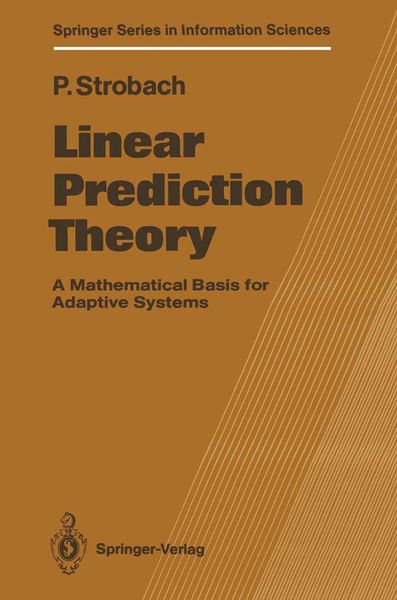
  • Produktbild: Linear Prediction Theory
  • Produktbild: Linear Prediction Theory
Band 21

Linear Prediction Theory A Mathematical Basis for Adaptive Systems

51,99 €

inkl. gesetzl. MwSt., Versandkostenfrei


Beschreibung

Produktdetails

Einband

Taschenbuch

Erscheinungsdatum

27.12.2011

Verlag

Springer Berlin

Seitenzahl

422

Maße (L/B/H)

23,5/15,5/2,4 cm

Gewicht

668 g

Auflage

Softcover reprint of the original 1st ed. 1990

Sprache

Englisch

ISBN

978-3-642-75208-7

Beschreibung

Produktdetails

Einband

Taschenbuch

Erscheinungsdatum

27.12.2011

Verlag

Springer Berlin

Seitenzahl

422

Maße (L/B/H)

23,5/15,5/2,4 cm

Gewicht

668 g

Auflage

Softcover reprint of the original 1st ed. 1990

Sprache

Englisch

ISBN

978-3-642-75208-7

Herstelleradresse

Springer-Verlag GmbH
Tiergartenstr. 17
69121 Heidelberg
DE

Email: ProductSafety@springernature.com

Kundinnen und Kunden meinen

0 Bewertungen

Informationen zu Bewertungen

Zur Abgabe einer Bewertung ist eine Anmeldung im Konto notwendig. Die Authentizität der Bewertungen wird von uns nicht überprüft. Wir behalten uns vor, Bewertungstexte, die unseren Richtlinien widersprechen, entsprechend zu kürzen oder zu löschen.

Die Bewertungen sind nach Format, Anzahl Sterne und Datum sortiert.

Verfassen Sie die erste Bewertung zu diesem Artikel

Helfen Sie anderen Kund*innen durch Ihre Meinung

Kundinnen und Kunden meinen

0 Bewertungen filtern

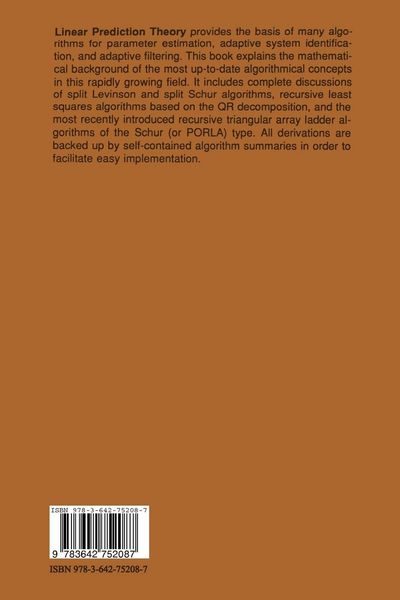
  • Produktbild: Linear Prediction Theory
  • Produktbild: Linear Prediction Theory
  • 1. Introduction.- 2. The Linear Prediction Model.- 2.1 The Normal Equations of Linear Prediction.- 2.2 Geometrical Interpretation of the Normal Equations.- 2.3 Statistical Interpretation of the Normal Equations.- 2.4 The Problem of Signal Observation.- 2.5 Recursion Laws of the Normal Equations.- 2.6 Stationarity — A Special Case of Linear Prediction.- 2.7 Covariance Method and Autocorrelation Method.- 2.8 Recursive Windowing Algorithms.- 2.9 Backward Linear Prediction.- 2.10 Chapter Summary.- 3. Classical Algorithms for Symmetric Linear Systems.- 3.1 The Cholesky Decomposition.- 3.2 The QR Decomposition.- 3.2.1 The Givens Reduction.- 3.2.2 The Householder Reduction.- 3.2.3 Calculation of Prediction Error Energy.- 3.3 Some More Principles for Matrix Computations.- 3.3.1 The Singular Value Decomposition.- 3.3.2 Solving the Normal Equations by Singular Value Decomposition.- 3.3.3 The Penrose Pseudoinverse.- 3.3.4 The Problem of Computing X?1Y.- 3.4 Chapter Summary.- 4. Recursive Least-Squares Using the QR Decomposition.- 4.1 Formulation of the Growing-Window Recursive Least-Squares Problem.- 4.2 Recursive Least Squares Based on the Givens Reduction.- 4.3 Systolic Array Implementation.- 4.4 Iterative Vector Rotations — The CORDIC Algorithm.- 4.5 Recursive QR Decomposition Using a Second-Order Window.- 4.6 Alternative Formulations of the QRLS Problem.- 4.7 Implicit Error Computation.- 4.8 Chapter Summary.- 5. Recursive Least-Squares Transversal Algorithms.- 5.1 The Recursive Least-Squares Algorithm.- 5.2 Potter’s Square-Root Normalized RLS Algorithm.- 5.3 Update Properties of the RLS Algorithm.- 5.4 Kubin’s Selective Memory RLS Algorithms.- 5.5 Fast RLS Transversal Algorithms.- 5.5.1 The Sherman-Morrison Identity for Partitioned Matrices.- 5.5.2 The Fast Kalman Algorithm.- 5.5.3 The FAEST Algorithm.- 5.6 Descent Transversal Algorithms.- 5.6.1 The Newton Algorithm.- 5.6.2 The Steepest Descent Algorithm.- 5.6.3 Stability of the Steepest Descent Algorithm.- 5.6.4 Convergence of the Steepest Descent Algorithm.- 5.6.5 The Least Mean Squares Algorithm.- 5.7 Chapter Summary.- 6. The Ladder Form.- 6.1 The Recursion Formula for Orthogonal Projections.- 6.1.1 Solving the Normal Equations with the Recursion Formula for Orthogonal Projections.- 6.1.2 The Feed-Forward Ladder Form.- 6.2 Computing Time-Varying Transversal Predictor Parameters from the Ladder Reflection Coefficients.- 6.3 Stationary Case — The PARCOR Ladder Form.- 6.4 Relationships Between PARCOR Ladder Form and Transversal Predictor.- 6.4.1 Computing Transversal Predictor Parameters from PARCOR Coefficients — The Levinson Recursion.- 6.4.2 Computing PARCOR Coefficients from Transversal Predictor Parameters — The Inverse Levinson Recursion.- 6.5 The Feed-Back PARCOR Ladder Form.- 6.6 Frequency Domain Description of PARCOR Ladder Forms.- 6.6.1 Transfer Function of the Feed-Forward PARCOR Ladder Form.- 6.6.2 Transfer Function of the Feed-Back PARCOR Ladder Form.- 6.6.3 Relationships Between Forward and Backward Predictor Transfer Functions.- 6.7 Stability of the Feed-Back PARCOR Ladder Form.- 6.8 Burg’s Harmonic Mean PARCOR Ladder Algorithm.- 6.9 Determination of Model Order.- 6.10 Chapter Summary.- 7. Levinson-Type Ladder Algorithms.- 7.1 The Levinson-Durbin Algorithm.- 7.2 Computing the Autocorrelation Coefficients from the PARCOR Ladder Reflection Coefficients — The “Inverse” Levinson-Durbin Algorithm.- 7.3 Some More Properties of Toeplitz Systems and the Levinson-Durbin Algorithm.- 7.4 Split Levinson Algorithms.- 7.4.1 Delsarte’s Algorithm.- 7.4.2 Krishna’s Algorithm.- 7.4.3 Relationships Between Krishna’s Algorithm and Delsarte’s Algorithm (Symmetric Case).- 7.4.4 Relationships Between Krishna’s Algorithm and Delsarte’s Algorithm (Antisymmetric Case).- 7.5 A Levinson-Type Least-Squares Ladder Estimation Algorithm.- 7.6 The Makhoul Covariance Ladder Algorithm.- 7.7 Chapter Summary.- 8 Covariance Ladder Algorithms.- 8.1 The LeRoux-Gueguen Algorithm.- 8.1.1 Bounds on GREs.- 8.2 The Cumani Covariance Ladder Algorithm.- 8.3 Recursive Covariance Ladder Algorithms.- 8.3.1 Recursive Least-Squares Using Generalized Residual Energies.- 8.3.2 Strobach’s Algorithm.- 8.3.3 Approximate PORLA Computation Schemes.- 8.3.4 Sokat’s Algorithm — An Extension of the LeRoux-Gueguen Algorithm.- 8.3.5 Additional Notes on Sokat’s PORLA Method.- 8.4 Split Schur Algorithms.- 8.4.1 A Split Schur Formulation of Krishna’s Algorithm.- 8.4.2 Bounds on Recursion Variables.- 8.4.3 A Split Schur Formulation of Delsarte’s Algorithm.- 8.5 Chapter Summary.- 9. Fast Recursive Least-Squares Ladder Algorithms.- 9.1 The Exact Time-Update Theorem of Projection Operators.- 9.2 The Algorithm of Lee and Morf.- 9.3 Other Forms of Lee’s Algorithm.- 9.3.1 A Pure Time Recursive Ladder Algorithm.- 9.3.2 Direct Updating of Reflection Coefficients.- 9.4 Gradient Adaptive Ladder Algorithms.- 9.4.1 Gradient Adaptive Ladder Algorithm GAL 2.- 9.4.2 Gradient Adaptive Ladder Algorithm GAL 1.- 9.5 Lee’s Normalized RLS Ladder Algorithm.- 9.5.1 Power Normalization.- 9.5.2 Angle Normalization.- 9.6 Chapter Summary.- 10. Special Signal Models and Extensions.- 10.1 Joint Process Estimation.- 10.1.1 Ladder Formulation of the Joint Process Problem.- 10.1.2 The Joint Process Model.- 10.1.3 FIR System Identification.- 10.1.4 Noise Cancelling.- 10.2 ARMA System Identification.- 10.2.1 The ARMA Normal Equations.- 10.2.2 ARMA Embedding.- 10.2.3 Ladder Formulation of the ARMA System Identification Problem.- 10.2.4 The PORLA Method for ARMA System Identification.- 10.2.5 Computing the ARMA Parameters from the Ladder Reflection Matrices.- 10.3 Identification of Vector Autoregressive Processes.- 10.4 Parametric Spectral Estimation.- 10.5 Relationships Between Parameter Estimation and Kalman Filter Theory.- 10.6 Chapter Summary.- 11. Concluding Remarks and Applications.- A.1 Summary of the Most Important Forward/Backward Linear Prediction Relationships.- A.2 New PORLA Algorithms and Their Systolic Array Implementation.- A.2.1 Triangular Array Ladder Algorithm ARRAYLAD 1.- A.2.2 Triangular Array Ladder Algorithm ARRAYLAD 2.- A.2.3 Systolic Array Implementation.- A.2.4 Comparison of Ladder and Givens Rotors.- A.2.5 A Square-Root PORLA Algorithm.- A.2.6 A Step Towards Toeplitz Systems.- A.3 Vector Case of New PORLA Algorithms.- A.3.1 Vector Case of ARRAYLAD 1.- A.3.2 Computation of Reflection Matrices.- A.3.3 Multichannel Prediction Error Filters.- A.3.4 Vector Case of ARRAYLAD 2.- A.3.5 Stationary Case — Block Processing Algorithms.- A.3.6 Concluding Remarks.