KI-Beratung Beta

Gutscheinbedingungen

**Gültig bis 18.11.2026 auf englischsprachige Klassiker (klassiker-32728) online auf thalia.at und in der Thalia App. Einzelne Artikel können ausgeschlossen sein. Ausgenommen sind preisgebundene Artikel & eBooks. Pro Einkauf einmal einlösbar. Click & Collect nur bei Onlinevorabzahlung möglich. Keine Barauszahlung. Nicht kombinierbar mit anderen Aktionen und Gutscheinen. Gutschein wird auf max. 500€ Bestellwert angerechnet. Nicht gültig für Geschenkkarten, Versandkosten und Services.

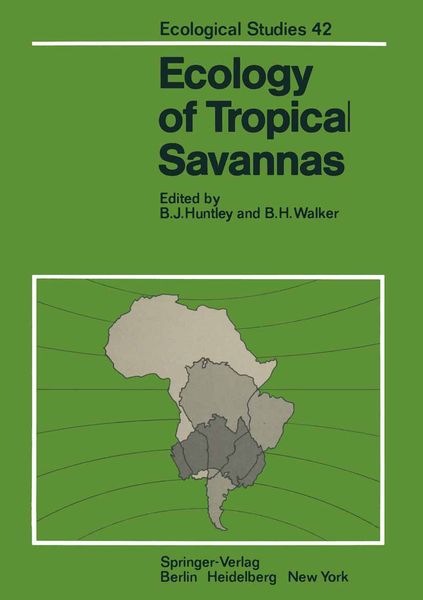
  • Produktbild: Ecology of Tropical Savannas
  • Produktbild: Ecology of Tropical Savannas
Band 42

Ecology of Tropical Savannas

Aus der Reihe Ecological Studies

148,99 €

inkl. gesetzl. MwSt., Versandkostenfrei


Beschreibung

This book examines the ecological characteristics of tropical savanna- most simply defined as those ecosystems which lie between the equatorial rainforests and the deserts and semi-deserts of Africa, Australia and South America. These savannas form a continuum of physiognomic types ranging from closed...

Beschreibung

This book examines the ecological characteristics of tropical savanna- most simply defined as those ecosystems which lie between the equatorial rainforests and the deserts and semi-deserts of Africa, Australia and South America. These savannas form a continuum of physiognomic types ranging from closed woodlands with a heliophytic grass understorey, through open savanna woodlands to treeless edaphic grasslands. In all areas Kranz syndrome or C4 grasses dominate the herbaceous layer while the woody component, at the moist end of the moisture gradient, comprises fire tolerant trees and shrubs. Tropi ca 1 savannas occupy the greater area of the southern conti nent- some 65% of Africa, 60% of Austral ia and 45% of South America. Oespi te their vast area and their present and potential importance in terms of livestock and crop production, they have not enjoyed the intensity of research interest devoted during the last several decades to the deserts, rainforests and mediterranean regions. Indeed they are probably the least well understood of the world's major terrestrial ecosystems. With a few notable exceptions, ecological studies in tropical savannas have been 1 imited to scattered and rather di sparate ventures. The fi rst integrated study of a tropical savanna was probably that undertaken in the Ivory Coast by Lamotte and associates, while Medina and others had conducted important ecophysiological work in the Venezuelan llanos.

Produktdetails

Einband

Taschenbuch

Erscheinungsdatum

07.12.2011

Abbildungen

XII, 672 p.

Herausgeber B. J. Huntley + weitere

Produktdetails

Einband

Taschenbuch

Erscheinungsdatum

07.12.2011

Abbildungen

XII, 672 p.

Herausgeber
Verlag Springer Berlin
Seitenzahl

672

Maße (L/B/H)

24,4/17/3,7 cm

Gewicht

1167 g

Auflage

Softcover reprint of the original 1st ed. 1982

Sprache

Englisch

ISBN

978-3-642-68788-4

Herstelleradresse

Springer-Verlag KG
Sachsenplatz 4-6
1201 Wien
AT

Email: ProductSafety@springernature.com

Noch keine Bewertungen vorhanden

Verfassen Sie die erste Bewertung zu diesem Artikel

Helfen Sie anderen Kundinnen und Kunden durch Ihre Meinung.

Kundinnen und Kunden meinen

Bewertungen (0)

  • Produktbild: Ecology of Tropical Savannas
  • Produktbild: Ecology of Tropical Savannas
  • Section 1. Introduction.- Section 2. Structure.- 1. Australian Savannas.- 2. Brazilian “Savannas”.- 3. Chaco and Caatinga — South American Arid Savannas, Woodlands and Thickets.- 4. The Structure and Dynamics of a West African Savanna.- 5. Southern African Savannas.- 6. Woody Plant Biomass Distribution in Burkea africana Savannas.- Section 3. Determinants.- 7. The Influence of Soils, Geomorphology and Geology on the Distribution of Plant Communities in Savanna Ecosystems.- 8. The Influence of Soil Moisture Balance on Ecosystem Patterns in Southern Africa.- 9. The Effect of Soil Nutrient Availability on Community Structure in African Ecosystems.- 10. The Influence of Large Herbivores on Savanna Structure in Africa.- 11. Fire in Australian Tropical Savannas.- 12. Ecological Effect of Fire in Brazilian Cerrado.- 13. Ecological Effects of Fire in South African Savannas.- Section 4. Function.- 14. Physiological Ecology of Neotropical Savanna Plants.- 15. Water Relations of Southern African Savannas.- 16. Factors Influencing the Consumption of Plant Products by Large Herbivores.- 17. Response of the Humid Subtropical Grassland of South Africa to Defoliation.- 18. Consumption and Decomposition in Tropical Grassland Ecosystems at Lamto, Ivory Coast.- Section 5. Nylsvley, a South African Savanna.- 19. Structure of the Nylsvley Savanna.- 20. Towards the Development of an Energy Budget for a Savanna Ecosystem.- 21. Phytomass, Seasonal Phenology and Photosynthetic Studies.- 22. Nitrogen in the Burkea Savanna.- 23. Trophic Ecology and Plant/Herbivore Energetics.- 24. Litter Decomposition.- Section 6. Dynamics and Management.- 25. Aspects of the Stability and Resilience of Savanna Ecosystems.- 26. Stability of Plant-Herbivore Models and Possible Applications to Savanna.- 27. ADeveloping Computer Model of the Auob River Ecosystem. Kalahari Gemsbok National Park.- 28. Management Strategies for the Utilization of Southern African Savanna.- Section 7. Conclusion: Characteristic Features of Tropical Savannas.