KI-Beratung Beta

Gutscheinbedingungen

**Gültig bis 30.11.2026 auf Spielzeug, Schreibwaren, Filme, Geschenke & Trends, Musik, tolino eReader & Zubehör, Hörbücher und Hörbuch-Downloads, nicht preisgebundene Bücher und Kalender online auf thalia.at und in der Thalia App. Einzelne Artikel können ausgeschlossen sein. Aufgrund der Buchpreisbindung sind deutschsprachige Bücher und eBooks ausgenommen. Zusätzlich ausgenommen sind Abos & Flatrates, Games, Geschenkkarten/-boxen, Shelfies, Software, Zeitschriften sowie einzelne Artikel von tonies®. Pro Einkauf einmal einlösbar. Nur gültig mit im Onlineshop hinterlegter Bonuscard. Click & Collect nur bei Onlinevorabzahlung möglich. Keine Barauszahlung. Nicht kombinierbar mit anderen Aktionen und Gutscheinen. Gutschein wird auf max. 500€ Bestellwert angerechnet. Nicht gültig für Versandkosten und Services.

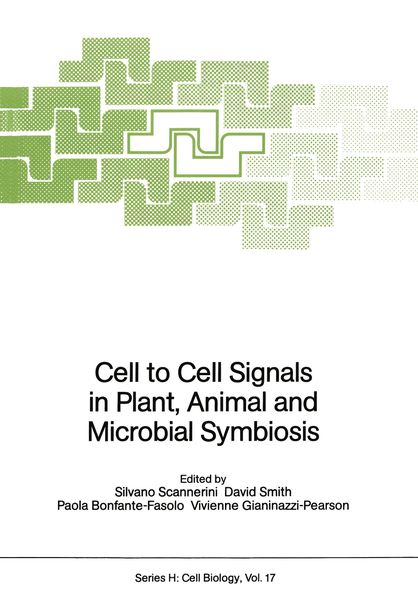
Produktbild: Cell to Cell Signals in Plant, Animal and Microbial Symbiosis
Band 17

Cell to Cell Signals in Plant, Animal and Microbial Symbiosis

Aus der Reihe Nato ASI Subseries H:

99,99 €

inkl. gesetzl. MwSt., Versandkostenfrei


Beschreibung

In symbiosis, different organisms have to recognize each other and exchange material and information. While the functional morphology of symbiont cells has extensively been studied little attention has been paid to mutual interactions and cell-to-cell signals. The main topic of the book is the comparison...

Beschreibung

In symbiosis, different organisms have to recognize each other and exchange material and information. While the functional morphology of symbiont cells has extensively been studied little attention has been paid to mutual interactions and cell-to-cell signals. The main topic of the book is the comparison and discussion of the short-distance signals triggering mutualism in animal and plant cells. Thus it provides a) the basis for a better understanding of various aspects of cell compatibility; b) standardisation of a common vocabulary for animal and plant symbiotic biology; c) optimization of experimental techniques for studying signals in symbiosis. The results show the differences and the general principles in the signalling processes of plant, animal and bacterial cells.

Produktdetails

Einband

Taschenbuch

Erscheinungsdatum

27.12.2011

Abbildungen

XX, 414 p.

Herausgeber Silvano Scannerini + weitere

Produktdetails

Einband

Taschenbuch

Erscheinungsdatum

27.12.2011

Abbildungen

XX, 414 p.

Herausgeber
Verlag Springer Berlin
Seitenzahl

414

Maße (L/B/H)

24,4/17/2,4 cm

Gewicht

748 g

Auflage

Softcover reprint of the original 1st ed. 1988

Sprache

Englisch

ISBN

978-3-642-73156-3

Herstelleradresse

Springer-Verlag KG
Sachsenplatz 4-6
1201 Wien
AT

Email: ProductSafety@springernature.com

Noch keine Bewertungen vorhanden

Verfassen Sie die erste Bewertung zu diesem Artikel

Helfen Sie anderen Kundinnen und Kunden durch Ihre Meinung.

Kundinnen und Kunden meinen

Bewertungen (0)

  • Produktbild: Cell to Cell Signals in Plant, Animal and Microbial Symbiosis
  • I. Physiology and Morphology of Cell-to-Cell Interactions.- Cellular interactions between host and endosymbiont in dinitrogen-fixing root nodules of woody plants.- Recognition mechanisms in the Azolla-Anabaena symbiosis.- The functional morphology of cell-to-cell interactions in lichens.- Host-fungus interactions in ectomycorrhizae.- Morphological integration and functional compatibility between symbionts in vesicular arbuscular endomycorrhizal associations.- Cell to cell interactions in insect endocytobiosis.- Luminescent bacteria: symbionts of nematodes and pathogens of insects.- Cell-to-cell interactions during the establishment of the Hydra-Chlorella symbiosis.- Specificity in the Convoluta roscoffensis/Tetraselmis symbiosis.- The cell structures of plant, animal and microbial symbionts, their differences and similarities.- Symbiosis and evolution: a brief guide to recent literature.- II. Signals in Plants.- Molecular signals in plant cell recognition.- Early recognition signals in the Rhizobium trifolii-white clover symbiosis.- Flavonoid compounds as molecular signals in Rhizobium-legume symbiosis.- Soredia formation of compatible and incompatible lichen symbionts.- The role of the cell wall as a signal in mycorrhizal associations.- III. Signals in Animals.- Peptide and carbohydrate moieties as molecular signals in animal cell recognition.- Genetical and biochemical interactions between the host and its endocytobiotes in the weevils Sitophilus (Coleoptere, Curculionidae) and other related species.- Signals in the Paramecium Bursaria — Chlorella Sp. association.- Nutritional interactions as signals in the green hydra symbiosis.- The establishment of algal/hydra symbioses — A case of recognition or preadaptation?.- Factors produced by symbiotic marineinvertebrates which affect translocation between the symbionts.- Specificity in dinomastigote-marine invertebrate symbioses: an evaluation of hypotheses of mechanisms involved in producing specificity.- IV. Recommendations for Future Research and Applications.- Applications of genetic engineering to “Symbiontology” in agriculture.- The application of monoclonal antibody technology to the study of cell-cell interactions.- The use of monoclonal antibodies to investigate plant-microbe interactions in pea root nodules containing Rhizobium leguminosarum.- Immunocytochemical studies of symbiotic development and metabolism in nitrogen-fixing root nodules.- Concepts leading to an understanding of recognition and signalling between hosts and symbionts.