KI-Beratung Beta

Gutscheinbedingungen

**Gültig bis 18.11.2026 auf englischsprachige Klassiker (klassiker-32728) online auf thalia.at und in der Thalia App. Einzelne Artikel können ausgeschlossen sein. Ausgenommen sind preisgebundene Artikel & eBooks. Pro Einkauf einmal einlösbar. Click & Collect nur bei Onlinevorabzahlung möglich. Keine Barauszahlung. Nicht kombinierbar mit anderen Aktionen und Gutscheinen. Gutschein wird auf max. 500€ Bestellwert angerechnet. Nicht gültig für Geschenkkarten, Versandkosten und Services.

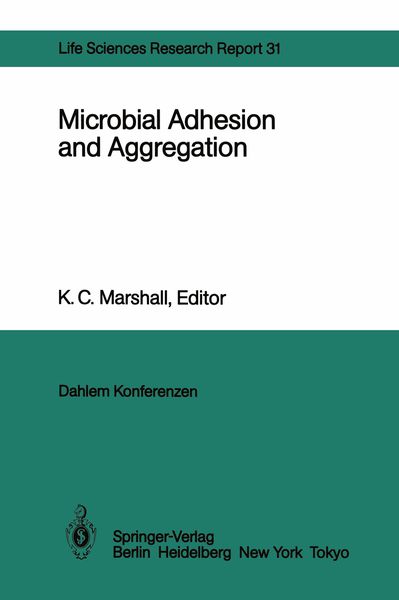
  • Produktbild: Microbial Adhesion and Aggregation
  • Produktbild: Microbial Adhesion and Aggregation
Band 31

Microbial Adhesion and Aggregation Report of the Dahlem Workshop on Microbial Adhesion and Aggregation Berlin 1984, January 15–20

Aus der Reihe Dahlem Workshop Report

99,99 €

inkl. gesetzl. MwSt., Versandkostenfrei


Beschreibung

usage of the terms substrate and substratum. A substrate (pI.: substrates) is a material utilized by microorganisms, generally as a source of energy. A substratum (pI.: substrata) is asolid surface to which a microorganism mayattach. REFERENCES (1) Marshall, K.C. 1976. Interfaces in Microbial Ecology....

Beschreibung

usage of the terms substrate and substratum. A substrate (pI.: substrates) is a material utilized by microorganisms, generally as a source of energy. A substratum (pI.: substrata) is asolid surface to which a microorganism mayattach. REFERENCES (1) Marshall, K.C. 1976. Interfaces in Microbial Ecology. Cambridge, MA: Harvard University Press. (2) ZoBell, C.E. 1943. The effect of solid surfaces upon bacterial activity. J. Bacteriol. 46: 39-56. Standing, left to right: Paul Rutter, Rolf Freter, Mike Silverman, lan Robb, Hinrich Mrozek, Frank Dazzo, David Gingell Seated, left to right: Garth Jones, Stanislawa Tylewska, Staffan Kjelleberg, Ellen Rades-Rohkohl, Kevin Marshall Microbial Adhesion and Aggregation, ed. K.C. Marshall, pp. 5-19. Dahlem Konferenzen 1984. Berlin, Heidelberg, New York, Tokyo: Springer-Verlag. Mechanisms of Adhesion Group Report P.R. Rutter, Rapporteur F.B. Dazzo H. Mrozek R. Freter E. Rades-Rohkohl D. GingeIl I.D. Robb G.W. Jones M. Silverman 8. Kjelleberg 8. Tylewska K.C. Marshall INTRODUCTION The subject, Mechanisms of Microbial Attachment, has proved to be a fertile sour ce of argument between both microbiologists and physical chemists. In order to find common ground for discussion, the group endeavored to come to a consensus regarding a number of definitions pertinent to the subject. Some of these are described in the text and others will be found at the end of this report.

Produktdetails

Einband

Taschenbuch

Erscheinungsdatum

06.12.2011

Abbildungen

X, 426 p.

Herausgeber K.C. Marshall + weitere

Produktdetails

Einband

Taschenbuch

Erscheinungsdatum

06.12.2011

Abbildungen

X, 426 p.

Herausgeber
Verlag Springer Berlin
Seitenzahl

426

Maße (L/B/H)

22,9/15,2/2,4 cm

Gewicht

633 g

Auflage

Softcover reprint of the original 1st ed. 1984

Sprache

Englisch

ISBN

978-3-642-70139-9

Herstelleradresse

Springer-Verlag KG
Sachsenplatz 4-6
1201 Wien
AT

Email: ProductSafety@springernature.com

Noch keine Bewertungen vorhanden

Verfassen Sie die erste Bewertung zu diesem Artikel

Helfen Sie anderen Kundinnen und Kunden durch Ihre Meinung.

Kundinnen und Kunden meinen

Bewertungen (0)

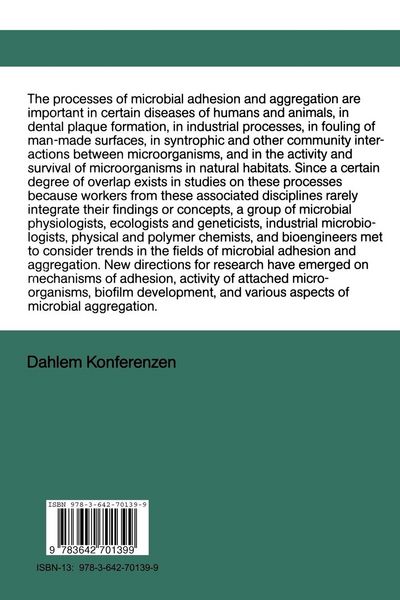
  • Produktbild: Microbial Adhesion and Aggregation
  • Produktbild: Microbial Adhesion and Aggregation
  • Mechanisms of Adhesion.- Physicochemical Interactions of the Substratum, Microorganisms, and the Fluid Phase.- Stereo-biochemistry and Function of Polymers.- Adhesion to Inanimate Surfaces.- Adhesion to Animal Surfaces.- Bacterial Adhesion to Plant Root Surfaces.- Genetic Control of Bacterial Adhesion.- Biofilm Development and Its Consequences.- Surface Colonization Parameters from Cell Density and Distribution.- Biofilm Development: A Process Analysis.- Chemical Characterization of Films.- Effects of Network Structure on the Phase Transition of Acrylamide-Sodium Acrylate Copolymer Gels.- Colonization by Higher Organisms.- Activity on Surfaces.- Comparative Physiology of Attached and Free-living Bacteria.- Activities of Microorganisms Attached to Living Surfaces.- Utilization of Substrates and Transformation of Solid Substrata.- Attachment of Bacteria: Advantage or Disadvantage for Survival in the Aquatic Environment.- Aggregation.- Physiology of Cell Aggregation: Flocculation by Saccharom yces cerevisiae As a Model System.- Aggregation, Cohesion, Adhesion, Phagocytosis, and Morphogenesis in Dictyostelium — Mechanisms and Implications.- Consequences of Aggregation.- Microcolony Formation and Consortia.- Epilogue.- List of Participants with Fields of Research.- Author Index.