• Produktbild: Discrete Systems
  • Produktbild: Discrete Systems

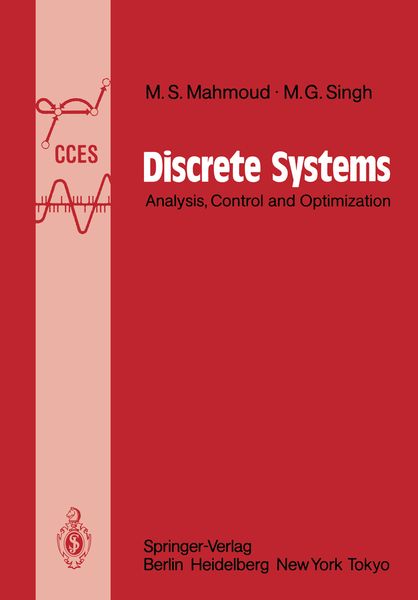
Discrete Systems Analysis, Control and Optimization

99,99 €

inkl. gesetzl. MwSt., Versandkostenfrei


Beschreibung

Produktdetails

Einband

Taschenbuch

Erscheinungsdatum

27.12.2011

Verlag

Springer Berlin

Seitenzahl

670

Maße (L/B/H)

24,4/17/3,7 cm

Gewicht

1173 g

Auflage

Softcover reprint of the original 1st ed. 1984

Sprache

Englisch

ISBN

978-3-642-82329-9

Beschreibung

Produktdetails

Einband

Taschenbuch

Erscheinungsdatum

27.12.2011

Verlag

Springer Berlin

Seitenzahl

670

Maße (L/B/H)

24,4/17/3,7 cm

Gewicht

1173 g

Auflage

Softcover reprint of the original 1st ed. 1984

Sprache

Englisch

ISBN

978-3-642-82329-9

Herstelleradresse

Springer-Verlag KG
Sachsenplatz 4-6
1201 Wien
AT

Email: GPSR Kontakt

Noch keine Bewertungen vorhanden

Verfassen Sie die erste Bewertung zu diesem Artikel

Helfen Sie anderen Kundinnen und Kunden durch Ihre Meinung.

Kundinnen und Kunden meinen

Bewertungen (0)

  • Produktbild: Discrete Systems
  • Produktbild: Discrete Systems
  • 1 Discrete Models in Systems Engineering.- 1.1 Introduction.- 1.2 Some Illustrative Examples.- 1.2.1 Direct Digital Control of a Thermal Process.- 1.2.2 An Inventory Holding Problem.- 1.2.3 Measurement and Control of Liquid Level.- 1.2.4 An Aggregate National Econometric Model.- 1.3 Objectives and Outline of the Book.- 1.4 References.- 2 Representation of Discrete Control Systems.- 2.1 Introduction.- 2.2 Transfer Functions.- 2.2.1 Review of Z-Transforms.- 2.2.2 Effect of Pole Locations.- 2.2.3 Stability Analysis.- 2.2.4 Simplification by Continued-Fraction Expansions.- 2.2.5 Examples.- 2.3 Difference Equations.- 2.3.1 The Nature of Solutions.- 2.3.2 The Free Response.- 2.3.3 The Forced Response.- 2.3.4 Examples.- 2.3.5 Relationship to Transfer Functions.- 2.4. Discrete State Equations.- 2.4.1 Introduction.- 2.4.2 Obtaining the State Equations.- A. From Difference Equations.- B. From Transfer Functions.- 2.4.3 Solution Procedure.- 2.4.4 Examples.- 2.5 Modal Decomposition.- 2.5.1 Eigen-Structure.- 2.5.2 System Modes.- 2.5.3 Some Important Properties.- 2.5.4 Examples.- 2.6 Concluding Remarks.- 2.7 Problems.- 2.8 References.- 3 Structural Properties.- 3.1 Introduction.- 3.2 Controllability.- 3.2.1 Basic Definitions.- 3.2.2 Mode-Controllability Structure.- 3.2.3 Modal Analysis of State-Reachability.- 3.2.4 Some Geometrical Aspects.- 3.2.5 Examples.- 3.3 Observability.- 3.3.1 Basic Definitions.- 3.3.2 Principle of Duality.- 3.3.3 Mode-Observability Structure.- 3.3.4 Concept of Detectability.- 3.3.5 Examples.- 3.4. Stability.- 3.4.1 Introduction.- 3.4.2 Definitions of Stability.- 3.4.3 Linear System Stability.- 3.4.4 Lyapunov Analysis.- 3.4.5 Solution and Properties of the Lyapunov Equation.- 3.4.6 Examples.- 3.5 Remarks.- 3.6 Problems.- 3.7 References.- 4 Design of Feedback Systems.- 4.1 Introduction.- 4.2 The Concept of Linear Feedback.- 4.2.1 State Feedback.- 4.2.2 Output Feedback.- 4.2.3 Computational Algorithms.- 4.2.4 Eigen-Structure Assignment.- 4.2.5 Remarks.- 4.2.6 Example.- 4.3 Deadbeat Controllers.- 4.3.1 Preliminaries.- 4.3.2 The Multi-Input Deadbeat Controller.- 4.3.3 Basic Properties.- 4.3.4 Other Approaches.- 4.3.5 Examples.- 4.4 Development of Reduced-Order Models.- 4.4.1 Analysis.- 4.4.2 Two Simplification Schemes.- 4.4.3 Output Modelling Approach.- 4.4.4 Control Design.- 4.4.5 Examples.- 4.5 Control Systems with Slow and Fast Modes.- 4.5.1 Time-Separation Property.- 4.5.2 Fast and Slow Subsystems.- 4.5.3 A Frequency Domain Interpretation.- 4.5.4 Two-Stage Control Design.- 4.5.5 Examples.- 4.6 Concluding Remarks.- 4.7 Problems.- 4.8 References.- 5 Control of Systems with Inaccessible States.- 5.1 Introduction.- 5.2 State Reconstruction Schemes.- 5.2.1 Full-Order State Reconstructors.- 5.2.2 Reduced-Order State Reconstructors.- 5.2.3 Discussion.- 5.2.4 Deadbeat State Reconstructors.- 5.2.5 Examples.- 5.3 Observer-Based Controllers.- 5.3.1 Structure of Closed-Loop Systems.- 5.3.2 The Separation Principle.- 5.3.3 Deadbeat Type Controllers.- 5.3.4 Example.- 5.4 Two-Level Observation Structures.- 5.4.1 Full-Order Local State Reconstructors.- 5.4.2 Modifications to Ensure Overall Asymptotic Reconstruction.- 5.4.3 Examples.- 5.5 Discrete Two-Time-Scale Systems.- 5.5.1 Introduction.- 5.5.2 Two-Stage Observer Design.- 5.5.3 Dynamic State Feedback Control.- 5.5.4 Example.- 5.6 Concluding Remarks.- 5.7 Problems.- 5.8 References.- 6 State and Parameter Estimation.- 6.1 Introduction.- 6.2 Random Variables and Gauss-Markov Processes.- 6.2.1 Basic Concepts of Probability Theory.- 6.2.2 Mathematical Properties of Random Variables.- A. Distribution Functions.- B. Mathematical Expectation.- C. Two Random Variables.- 6.2.3 Stochastic Processes.- A. Definitions and Properties.- B. Gauss and Markov Processes.- 6.3 Linear Discrete Models with Random Inputs.- 6.3.1 Model Description.- 6.3.2 Some Useful Properties.- 6.3.3 Propagation of Means and Covariances.- 6.3.4 Examples.- 6.4 The Kalman Filter.- 6.4.1 The Estimation Problem.- A. The Filtering Problem.- B. The Smoothing Problem.- C. The Prediction Problem.- 6.4.2 Principal Methods of Obtaining Estimates.- A. Minimum Variance Estimate.- B. Maximum Likelihood Estimate.- C. Maximum A Posteriori Estimate.- 6.4.3 Development of the Kalman Filter Equations.- A. The Optimal Filtering Problem.- B. Solution Procedure.- C. Some Important Properties.- 6.4.4 Examples.- 6.5 Decentralised Computation of the Kalman Fikter.- 6.5.1 Linear Interconnected Dynamical Systems.- 6.5.2 The Basis of the Decentralised Filter Structure.- 6.5.3 The Recursive Equations of the Filter.- 6.5.4 A Computation Comparison.- 6.5.5 Example.- 6.6 Parameter Estimation.- 6.6.1 Least Squares Estimation.- A. Linear Static Models.- B. Standard Least Squares Method and Properties.- C. Application to Parameter Estimation of Dynamic Models.- D. Recursive Least Squares.- E. The Generalised Least Squares Method.- 6.6.2 Two-Level Computational Algorithms.- A. Linear Static Models.- B. A Two-Level Multiple Projection Algorithm.- C. The Recursive Version.- D. Linear Dynamical Models.- E. The Maximum A Posteriori Approach.- F. A Two-Level Structure.- 6.6.3 Examples.- 6.7 Problems.- 6.8 References.- 7 Adaptive Control Systems.- 7.1 Introduction.- 7.2 Basic Concepts of Model Reference Adaptive Systems.- 7.2.1 The Reference Model.- 7.2.2 The Adaptation Mechanism.- 7.2.3 Notations and Some Definitions.- 7.2.4 Design Considerations.- 7.3 Design Techniques.- 7.3.1 Techniques Based on Lyapunov Analysis.- 7.3.2 Techniques Based on Hyperstability and Positivity Concepts.- A. Popov Inequality and Related Results.- B. Systematic Procedure.- C. Parametric Adaptation Schemes.- D. Adaptive Model-Following Schemes.- 7.3.3 Examples.- 7.4 Self-Tuning Regulators.- 7.4.1 Introduction.- 7.4.2 Description of the System.- 7.4.3 Parameter Estimators.- A. The Least Squares Method.- B. The Extended Least Squares Method.- 7.4.4 Control Strategies.- A. Controllers Based on Linear Quadratic Theory.- B. Controllers Based on Minimum Variance Criteria.- 7.4.5 Other Approaches.- A. Pole/Zero Placement Approach.- B. Implicit Identification Approach.- C. State Space Approach.- D. Multivariable Approach.- 7.4.6 Discussion.- 7.4.7 Examples.- 7.5 Concluding Remarks.- 7.6 Problems.- 7.7 References.- 8 Dynamic Optimisation.- 8.1 Introduction.- 8.2 The Dynamic Optimisation Problem.- 8.2.1 Formulation of the Problem.- 8.2.2 Conditions of Optimality.- 8.2.3 The Optimal Return Function.- 8.3 Linear-Quadratic Discrete Regulators.- 8.3.1 Derivation of the Optimal Sequences.- 8.3.2 Steady-State Solution.- 8.3.3 Asymptotic Properties of Optimal Control.- 8.4 Numerical Algorithms for the Discrete Riccati Equation.- 8.4.1 Successive Approximation Methods.- 8.4.2 Hamiltonian Methods.- 8.4.3 Discussion.- 8.4.4 Examples.- 8.5 Hierarchical Optimization Methodology.- 8.5.1 Problem Decomposition.- 8.5.2 Open-Loop Computation Structures.- A. The Goal Coordination Method.- B. The Method of Tamura.- C. The Interaction Prediction Method.- 8.5.3 Closed-Loop Control Structures.- 8.5.4 Examples.- 8.6 Decomposition-Decentralisation Approach.- 8.6.1 Statement of the Problem.- 8.6.2 The Decoupled Subsystems.- 8.6.3 Multi-Controller Structure.- 8.6.4 Examples.- 8.7 Concluding Remarks.- 8.8 Problems.- 8.9 References.