Gutscheinbedingungen

**Gültig nur für Bestellungen an die Wunsch-Poststation bis 10.06.2026 auf Spielzeug, Schreibwaren, Filme, Geschenke & Trends, Musik, tolino eReader & Zubehör, Hörbücher und Hörbuch-Downloads (außer Abo), nicht preisgebundene Bücher und Kalender online auf thalia.at und in der Thalia App. Einzelne Artikel können ausgeschlossen sein. Aufgrund der Buchpreisbindung sind deutschsprachige Bücher und eBooks ausgenommen. Zusätzlich ausgenommen sind preisgebundene Artikel, Abos & Flatrates, eBooks, Games, Geschenkkarten/-boxen, Shelfies, Software, Zeitschriften sowie einzelne Artikel von tonies®. Pro Einkauf einmal einlösbar. Kein Click & Collect möglich. Keine Barauszahlung. Nicht kombinierbar mit anderen Aktionen und Gutscheinen. Gutschein wird auf max. 500€ Bestellwert angerechnet. Nicht gültig für Versandkosten und Services.

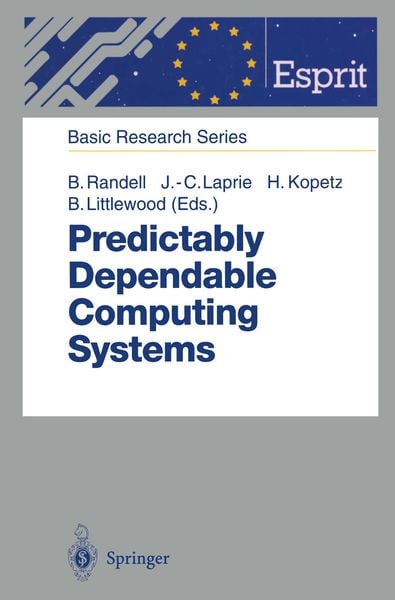
  • Produktbild: Predictably Dependable Computing Systems
  • Produktbild: Predictably Dependable Computing Systems

Predictably Dependable Computing Systems

99,99 €

inkl. gesetzl. MwSt., Versandkostenfrei


Beschreibung

Produktdetails

Einband

Taschenbuch

Erscheinungsdatum

08.12.2011

Herausgeber

Brian Randell + weitere

Verlag

Springer Berlin

Seitenzahl

588

Maße (L/B/H)

23,5/15,5/3,3 cm

Gewicht

914 g

Auflage

Softcover reprint of the original 1st ed. 1995

Sprache

Englisch

ISBN

978-3-642-79791-0

Beschreibung

Produktdetails

Einband

Taschenbuch

Erscheinungsdatum

08.12.2011

Herausgeber

Verlag

Springer Berlin

Seitenzahl

588

Maße (L/B/H)

23,5/15,5/3,3 cm

Gewicht

914 g

Auflage

Softcover reprint of the original 1st ed. 1995

Sprache

Englisch

ISBN

978-3-642-79791-0

Herstelleradresse

Springer-Verlag GmbH
Tiergartenstr. 17
69121 Heidelberg
DE

Email: ProductSafety@springernature.com

Kundinnen und Kunden meinen

0 Bewertungen

Informationen zu Bewertungen

Zur Abgabe einer Bewertung ist eine Anmeldung im Konto notwendig. Die Authentizität der Bewertungen wird von uns nicht überprüft. Wir behalten uns vor, Bewertungstexte, die unseren Richtlinien widersprechen, entsprechend zu kürzen oder zu löschen.

Die Bewertungen sind nach Format, Anzahl Sterne und Datum sortiert.

Verfassen Sie die erste Bewertung zu diesem Artikel

Helfen Sie anderen Kund*innen durch Ihre Meinung

Kundinnen und Kunden meinen

0 Bewertungen filtern

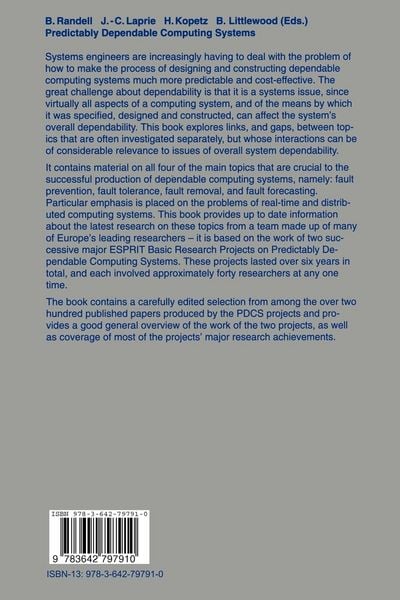
  • Produktbild: Predictably Dependable Computing Systems
  • Produktbild: Predictably Dependable Computing Systems
  • I. Basic Concepts.- A. Dependability — Its Attributes, Impairments and Means.- 1 Introduction.- 2 Basic Definitions.- 3 On System Function, Behavior, and Structure.- 4 The Attributes of Dependability.- 5 The Impairments to Dependability.- 6 The Means for Dependability.- 7 Summary and Conclusion.- Acknowledgements.- References for Chapter 1.- II. Fault Prevention.- A. Analysis of Safety Requirements for Process Control Systems.- 1 Introduction.- 2 Modelling.- 3 Analysis.- 4 Safety Specification Graph.- 5 Requirements Analysis.- 6 Safety Analysis.- 7 Conclusions.- Acknowledgements.- B. Real-Time System Scheduling.- 1Introduction.- 2 Safe and Predictable Kernels.- 3 An Extendible Model.- 6 Conclusions.- Acknowledgements.- C. The Time-Triggered Approach to Real-Time System Design.- 1 Introduction.- 2 A Real-Time System Model.- 3 The Time-Triggered Design Approach.- 4 The Time-Triggered Communication Protocol.- 5 Conclusions.- D. Software Measurement: A Necessary Scientific Basis.- 1 Introduction.- 2 Measurement Fundamentals.- 3 Measuring software ‘complexity’.- 4 Unifying framework for software measurement.- 5 Summary.- Acknowledgements.- References for Chapter II.- III. Fault Tolerance.- A. From Recovery Blocks to Concurrent Atomic Actions.- 1 Introduction.- 2 System Structuring.- 3 Basic Recovery Blocks.- 4 Extensions and Applications of Basic Recovery Blocks.- 5 Concurrent Programs.- 6 Error Recovery in Concurrent Object-Oriented Systems.- 7 Concluding Remarks.- Acknowledgements.- B. Definition and Analysis of Hardware-and-Software Fault-Tolerant Architectures.- 1 Introduction.- 2 Methods for Software-Fault Tolerance.- 3 Definition of Hardware-and-Software Architectures.- 4 Analysis and Evaluation of Hardware- and-Software Fault-Tolerant Architectures.- 5 Conclusion.- Acknowledgements.- C. Failure Mode Assumptions and Assumption Coverage.- 1Introduction and Overview.- 2 Types of Errors.- 3 Failure Mode Assumptions.- 4 Assumption Coverage.- 5 Influence of Assumption Coverage on System Dependability: a Case Study.- 6 Conclusions and Future Directions.- Acknowledgments.- D. Rational Design of Multiple-Redundant Systems: Adjudication and Fault Treatment.- 1 Introduction.- 2 The Adjudication Problem.- 3 Evaluation and Optimisation of Adjudication Functions.- 4 Extensions and Discussion.- 5 Diagnosis with Dynamic Error Processing: System Description and Fault Assumptions.- 6 The Complete Fault Tolerance Strategy.- 7 Evaluation.- 8 Conclusions.- E. Dynamic Adjustment of Dependability and Efficiency in Fault-Tolerant Software.- 1 Introduction.- 2 Tradeoff between Software Dependability and Efficiency.- 3 Self-Configuring Optimal Programming.- 4 Design Methodology for SCOP.- 5 Evaluation.- 6 Conclusions.- F. Designing Secure and Reliable Applications using FragmentationRedundancy-Scattering: an Object Oriented Approach.- 1 Introduction.- 2 Distributed system architecture and assumptions.- 3 FRS data processing.- 4 Notion of confidential information.- 5 Object-oriented FRS.- 6 Implementation issues.- 7 Experimentation.- 8 Conclusions and future work.- G. Implementing Fault Tolerant Applications Using Reflective Object-Oriented Programming.- 1 Introduction.- 2 Approaches to programming fault tolerance.- 3 Reflection and object-oriented programming.- 4 Using meta-objects to support replication.- 5 Implementation issues.- 6 Conclusion.- Acknowledgements.- H. The PDCS Implementation of MARS Hardware and Software.- 1 Introduction.- 2 Overall System Structure.- 3 The Processing Node.- 4 Supporting Deterministic Timing Behaviour.- 5 Achieving Fail-Silent Behaviour.- 6 Conclusions.- Acknowledgement.- References for Chapter III.- IV. Fault Removal.- A. Advantages and Limits of Formal Approaches for Ultra-High Dependability.- 1 Introduction.- 2 Impact of Formal Specifications on the Specification and Validation Activities.- 3 Impact of Formal Specifications on Design and Coding, and Verification.- 4 Conclusions.- Acknowledgements.- B. Software Statistical Testing.- 1 Introduction.- 2 Statistical Testing.- 3 Case Study for Safety Critical Software.- 4 Statistical Structural Testing.- 5 Statistical Functional Testing.- 6 Summary and Conclusion.- C. An Experimental Evaluation of Formal Testing and Statistical Testing.- 1 Introduction.- 2 Comparison of Formal and Statistical Testing.- 3 Experimental Framework.- 4 Experimental Results.- 5 Conclusion and Future Work.- Acknowledgements.- D. Testing Distributed Real-Time Systems: An Overview.- 1Introduction.- 2 Definitions.- 3 The Fundamental Test Problems.- 4 Advantages of Time-Triggered over Event-Triggered Systems.- 5 A Test Methodology for MARS.- 6 Conclusions.- References for Chapter IV.- V. Fault Forecasting — Fault Injection.- A. Integration and Comparison of Three Physical Fault Injection Techniques.- 1 Introduction.- 2 The Fault Injection Techniques.- 3 Error Detection Mechanisms of the MARS System.- 4 Measurements.- 5 Common Experimental Set-up.- 6 Results.- 7 Conclusion.- B. Fault Injection into VHDL Models: The MEFISTO Tool.- 1 Introduction.- 2 Fault injection into VHDL models.- 3 Overview of MEFISTO.- 4 Main User Interactions in the Setup Phase.- 5 A Case Study: The DP32 Processor.- 6 Summary and Concluding Remarks.- Acknowledgements.- C. Estimators for Fault Tolerance Coverage Evaluation.- 1 Introduction.- 2 Definitions.- 3 Coverage Estimation.- 4 Early Estimations.- 5 The No-Reply Problem.- 6 Discussion and Conclusions.- References for Chapter V.- VI. Fault Forecasting — Software Reliability.- A. Software Reliability Trend Analyses: From Theoretical to Practical Considerations.- 1 Introduction.- 2 Reliability Growth Characterization.- 3 Trend Analysis.- 4 Application to Real-life Systems.- 5 Conclusion.- Acknowledgements.- B. The Transformation Approach to the Modeling and Evaluation of Reliability and Availability Growth.- 1 Introduction.- 2 Characterization of System Behavior.- 3 The Hyperexponential Model for Reliability and Availability Growth.- 4 Modeling of Reliability and Availability Growth of Multi-Component Systems.- 5 Conclusion.- Acknowledgements.- C. New Ways to Get Accurate Reliability Measures.- 1 Introduction.- 2 The New Approach.- 3 Example.- 4 Discussion.- Appendix 1.- Appendix 2.- D. Combination of Predictions Obtained from Different Software Reliability Growth Models.- 1 Introduction.- 2 Raw Reliability Growth Models.- 3 Techniques for Analysing Predictive Quality and Recalibration.- 4 Combined Prediction Methods.- 5 Analysis of Combined Predictions.- 6 Conclusions.- E. Dependability Modelling and Evaluation of Software Fault-Tolerant Systems.- 1 Introduction.- 2 Recovery Blocks.- 3 N-Version Programming.- 4 RB and NVP Comparison.- 5 Conclusion.- F. Dependability Analysis of Iterative Fault-Tolerant Software Considering Correlation.- 1 Introduction.- 2 System and Hypotheses.- 3 Models with Independence Among Successive Inputs.- 4 Limits of These Models and Possible Improvements.- 5 Correlation Between Successive Iterations, Allowing Mission Failures from Repeated Benign Failures.- 6 Conclusions.- G. Validation of Ultra-High Dependability for Software-based Systems.- 1 Introduction.- 2 Specification of Dependability Requirements.- 3 Reliability Growth Modelling.- 4 Inferences to be Drawn from Perfect Working.- 5 Other Sources of Evidence for Validation.- 6 Discussion.- Acknowledgments.- References for Chapter VI.- VII. Fault Forecasting — Large State Space Modelling.- A. Computable Dependability Bounds for Large Markov Chains.- 1 Introduction.- 2 An Example.- 3 A Useful Polyhedron.- 4 The Method.- 5 Iterative Procedure.- 6 Tridiagonal Matrices.- 7 Bounding The Marginal Distribution.- 8 Complexity.- 9 The Example Revisited.- 10 Conclusions.- B. Fast Numerical Solution for a Class of Markov Models.- 1 Introduction.- 2 The Model.- 3 Spectral Expansion Solution.- 4 Comparison with the Matrix-Geometric Solution.- 5 Conclusions.- Acknowledgements.- References for Chapter VII.- VIII. Fault Forecasting — Security Modelling.- A. Towards Operational Measures of Computer Security: Concepts.- 1 Introduction.- 2 Terminological Analogies Between Security and Reliability.- 3 Difficulties and Deficiencies of the Analogies.- 4 Probabilistic Requirements for an Operational Security Model.- 5 Conclusions.- Acknowledgements.- B. Towards Operational Measures of Computer Security: Experimentation and Modelling.- 1 Background.- 2 Conditions for the Experimentation.- 3 The Pilot Experiment.- 4 The Full-scale Experiment.- 5 Lessons for Quantitative Assessment.- 6 Conclusions.- References for Chapter VIII.- Pdcs Publications.