• Produktbild: Superconductivity in Ternary Compounds I
  • Produktbild: Superconductivity in Ternary Compounds I
Band 32

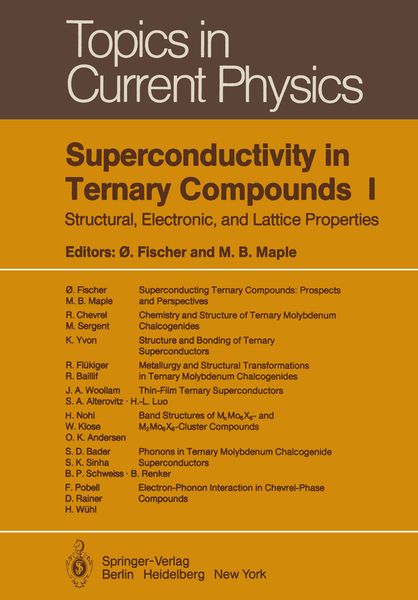
Superconductivity in Ternary Compounds I Structural, Electronic, and Lattice Properties

51,99 €

inkl. gesetzl. MwSt., Versandkostenfrei


Beschreibung

Produktdetails

Einband

Taschenbuch

Erscheinungsdatum

05.12.2011

Herausgeber

O. Fischer + weitere

Verlag

Springer Berlin

Seitenzahl

286

Maße (L/B/H)

24,4/17/1,7 cm

Gewicht

535 g

Auflage

Softcover reprint of the original 1st ed. 1982

Sprache

Englisch

ISBN

978-3-642-81870-7

Beschreibung

Produktdetails

Einband

Taschenbuch

Erscheinungsdatum

05.12.2011

Herausgeber

Verlag

Springer Berlin

Seitenzahl

286

Maße (L/B/H)

24,4/17/1,7 cm

Gewicht

535 g

Auflage

Softcover reprint of the original 1st ed. 1982

Sprache

Englisch

ISBN

978-3-642-81870-7

Herstelleradresse

Springer-Verlag KG
Sachsenplatz 4-6
1201 Wien
AT

Email: ProductSafety@springernature.com

Kundinnen und Kunden meinen

0 Bewertungen

Informationen zu Bewertungen

Zur Abgabe einer Bewertung ist eine Anmeldung im Konto notwendig. Die Authentizität der Bewertungen wird von uns nicht überprüft. Wir behalten uns vor, Bewertungstexte, die unseren Richtlinien widersprechen, entsprechend zu kürzen oder zu löschen.

Die Bewertungen sind nach Format, Anzahl Sterne und Datum sortiert.

Verfassen Sie die erste Bewertung zu diesem Artikel

Helfen Sie anderen Kund*innen durch Ihre Meinung

Kundinnen und Kunden meinen

0 Bewertungen filtern

  • Produktbild: Superconductivity in Ternary Compounds I
  • Produktbild: Superconductivity in Ternary Compounds I
  • 1. Superconducting Ternary Compounds: Prospects and Perspectives.- 1.1 Introduction.- 1.2 The Ternary Materials.- 1.2.1 The Ternary Molybdenum Chalcogenides (Chevrel Phases).- 1.2.2 The Ternary Rhodium Borides.- 1.2.3 Other Ternary Compounds.- 1.3 Concluding Remarks.- References.- 2. Chemistry and Structure of Ternary Molybdenum Chalcogenides.- 2.1 Overview.- 2.2 Preparation and Characterization.- 2.2.1 Preparation.- 2.2.2 Characterization: Chalcogenides MxMo6X8.- 2.3 Crystal Structure.- 2.3.1 Structural Parameters of MxMo6X8 Compounds.- 2.3.2 Crystal Structure.- 2.3.3 The Triclinic Phase.- 2.4 Relations Between Structure and Properties.- 2.4.1 Stabilization of Mo6S8.- 2.4.2 Mixed Anion: Substitution of Halogen for Chalcogen.- 2.4.3 Substitution on the Octahedral Cluster (Mo, Me)6 (Me = Nb, Ta, Re, Ru, Rh).- 2.4.4 Chalcogen-Chalcogen Substitution (S, Se, Te).- 2.4.5 Substitution of Oxygen for Sulphur.- 2.4.6 Addition of MMx? and Substitution of (M, M?) on an Element in the Channels.- 2.5 New Ternary Compounds Resulting from Linear Condensation of the Octahedral Mo6 Clusters.- 2.5.1 A New Cluster Mo9 in a Mo9X11 Unit (X = S, Se).- 2.5.2 A New Cluster Mo12 in a Mo12X14 Unit (X = S).- 2.5.3 New One-Dimensional Cluster (Mo6/2)?1 in the (Mo6/2X6/2)?1 Unit (X = S, Se, Te).- 2.6 Conclusion.- Appendix: Tables.- References.- 3. Structure and Bonding of Ternary Superconductors.- 3.1 Introductory Comments.- 3.2 Ternary Molybdenum Chalcogenides MMo6X8 (M: Metal, X: Chalcogen).- 3.2.1 Structure.- 3.2.2 Occurrence.- 3.2.3 Bonding.- 3.3 Ternary Molybdenum Chalcogenides Built Up by Condensed Mo3nX3n+2 Units (X = S, Se, Te).- 3.3.1 Structure.- 3.3.2 Occurrence.- 3.3.3 Bonding.- 3.4 Ternary Borides MT4B4 (M: Metal, T: Transition Element).- 3.4.1 CeCo4B4 Type (tP18, Tcmax = 12 k)3.- 3.4.2 LuRu4B4 Type (tI72, Tcmax = 11 K).- 3.4.3 LuRh4B4 Type (oC108, Tcmax = 6.3 K).- 3.4.4 NdCo4B4 Type (tP18, Tc < 4 K).- 3.4.5 Bonding of the MT4B4 Borides.- References.- 4. Metallurgy and Structural Transformations in Ternary Molybdenum Chalcogenides.- 4.1 Preparation Methods and Stoichiometry.- 4.1.1 Sintering.- 4.1.2 RF Melting Under High-Pressure Argon.- 4.1.3 Stoichiometry.- 4.2 High-Temperature Phase Fields in Some Selected Systems.- 4.2.1 The Binary System Mo-S.- 4.2.2 The System CuxMo6S8.- 4.2.3 The System CuxMo6Se8.- 4.2.4 The System Pb-Mo-S: PbxMo6S8?y or PbxMo6S8?.- 4.2.5 The Systems Ag-Mo-S, Ag-Mo-Se, Pb-Mo-Se, Sn-Mo-Se.- 4.3 Low-Temperature Relationships in CuxMo6S8 and CuxMo6Se8.- 4.3.1 Experimental Methods.- 4.3.2 The System CuxMo6S8.- 4.3.3 CuxMo6Se8.- 4.4 The Type of Formation of the Triclinic Phase in Ternary Molybdenum Chalcogenides.- 4.4.1 Existence of a Miscibility Gap in the Rhombohedral Phase.- 4.4.2 “Small” M Atoms: M = Ni, Zn, Co, Cr, Mn, Ti, V, Fe.- a) The Systems NixMo6Se8 and NixMo6S8.- b) The Systems ZnxMo6Se8 and ZnxMo6S8.- c) Ternary Molybdenum Chalcogenides with M = Co, Cr, Mn, Ti, V and Fe.- 4.4.3 “Large” M Atoms.- 4.5 Mechanism of Structural Transformations in Ternary Molybdenum Chalcogenides.- 4.5.1 The Delocalization of the M Atom.- 4.5.2 The Mechanism of Structural Transformations in MxMo6S8 Compounds (M = Cu, Fe,...).- a) Intrasite Mobility.- b) Metallurgical Arguments: Intersite Mobility.- 4.5.3 The Mechanism of Structural Transformations in Compounds with “Large” M Atoms.- 4.6 Superconductivity and Structural Transformations in Ternary Rhombohedral Compounds.- References.- 5. Thin-Film Ternary Superconductors.- 5.1 Preliminary Comments.- 5.2 Preparation and Structure.- 5.3 Critical Fields.- 5.4 Critical Currents.- 5.5 Electronic Properties.- 5.6 Final Statements and Conclusions.- References.- 6. Band Structures of MxMo6X8 — and M2Mo6X6-Cluster Compounds.- 6.1 General Considerations.- 6.2 Input to the Band-Structure Calculations.- 6.2.1 Crystal Structure.- 6.2.2 Atomic-Sphere Potentials.- 6.3 One-Electron States of a Single Mo6X8 Cluster.- 6.3.1 The X p States of a Regular Cube.- 6.3.2 The Mo d States of a Regular Octahedron.- 6.3.3 The d Bond Orbital of a Regular Octahedron.- 6.3.4 Mo-X Hybridization.- 6.3.5 Real Clusters.- 6.4 Energy Bands of Chevrel Phases.- 6.4.1 Gross Features of the Densities of States.- 6.4.2 Energy Bands Along the $$\bar 3$$-Axis from ? to R.- 6.4.3 The t1u and egd Levels at ?.- 6.4.4 The t2gd and egd Levels at R.- 6.4.5 The Conduction Band.- 6.4.6 Relation to Structural Properties.- 6.5 Energy Bands of Chain Compounds.- 6.5.1 General Features of the Energy Bands.- 6.5.2 Interpretation of the d-Band Structure.- 6.5.3 Physical Properties.- References.- 7. Phonons in Ternary Molybdenum Chalcogenide Superconductors.- 7.1 Preliminary Comments.- 7.2 The Molecular-Crystal Model and Lattice Heat Capacity.- 7.3 Phonon Spectra from Inelastic Neutron Scattering.- 7.3.1 The Theory of the Technique for Polycrystalline Samples.- 7.3.2 Experimental Neutron Scattering Results.- 7.4 A Simple Force-Constant Model for the Lattice Dynamics of Chevrel-Phase Compounds.- 7.4.1 Theoretical Considerations.- 7.4.2 Calculated Dispersion Curves.- 7.4.3 Calculated Phonon Densities of States.- 7.4.4 Calculated Neutron-Weighted Densities of States Comparisons.- 7.4.5 Relationship to Mössbauer Effect.- 7.4.6 Calculated Moments of the Phonon Spectrum.- 7.4.7 Calculated Lattice Entropy and Heat Capacity.- 7.5 Inelastic Neutron Scattering Experiments on Single Crystals.- 7.6 Relationship of the Phonon Spectrum to the Electron-Phonon Interaction.- 7.7 Summary.- References.- 8. Electron-Phonon Interaction in Chevrel-Phase Compounds.- 8.1 Introductory Remarks.- 8.2 Experiments on the Electron-Phonon Coupling.- 8.3 Theoretical Models for the Electron-Phonon Coupling.- 8.4 Isotope Effect of Tc in Mo6Se8 and SnMo6S8.- 8.4.1 The Isotope Effect.- 8.4.2 Sample Preparation.- 8.4.3 Results for the Isotope Effect Exponent.- 8.4.4 Discussion of the Measured Isotope Effect.- a) Mo6Se8.- b) SnMo6S8.- 8.5 Tunneling Spectroscopy on Cu1.8Mo6S8 and PbMo6S8.- 8.5.1 Tunneling Experiment.- 8.5.2 Junction Preparation.- 8.5.3 Results and Discussions.- 8.6 Conclusion.- References.