Gutscheinbedingungen

**Gültig nur für Bestellungen an die Wunsch-Poststation bis 10.06.2026 auf Spielzeug, Schreibwaren, Filme, Geschenke & Trends, Musik, tolino eReader & Zubehör, Hörbücher und Hörbuch-Downloads (außer Abo), nicht preisgebundene Bücher und Kalender online auf thalia.at und in der Thalia App. Einzelne Artikel können ausgeschlossen sein. Aufgrund der Buchpreisbindung sind deutschsprachige Bücher und eBooks ausgenommen. Zusätzlich ausgenommen sind preisgebundene Artikel, Abos & Flatrates, eBooks, Games, Geschenkkarten/-boxen, Shelfies, Software, Zeitschriften sowie einzelne Artikel von tonies®. Pro Einkauf einmal einlösbar. Kein Click & Collect möglich. Keine Barauszahlung. Nicht kombinierbar mit anderen Aktionen und Gutscheinen. Gutschein wird auf max. 500€ Bestellwert angerechnet. Nicht gültig für Versandkosten und Services.

  • Produktbild: Quantitation of mRNA by Polymerase Chain Reaction
  • Produktbild: Quantitation of mRNA by Polymerase Chain Reaction

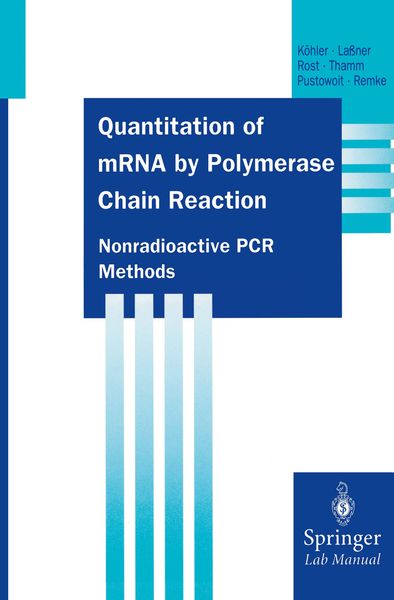
Quantitation of mRNA by Polymerase Chain Reaction Nonradioactive PCR Methods

Aus der Reihe Springer Lab Manuals

49,99 €

inkl. gesetzl. MwSt., Versandkostenfrei


Beschreibung

Produktdetails

Einband

Taschenbuch

Erscheinungsdatum

29.12.2011

Verlag

Springer Berlin

Seitenzahl

166

Maße (L/B/H)

23,5/15,5/1,1 cm

Gewicht

306 g

Auflage

1995

Sprache

Englisch

ISBN

978-3-642-79714-9

Beschreibung

Rezension

"...this technical book will be very useful for all customers of PCR. And they are numerous!... Summarizing: an excellent booklet, which we recommend highly and absolutely necessary to all practicians of PCR products and their applications." Cellular and Molecular Biology

Produktdetails

Einband

Taschenbuch

Erscheinungsdatum

29.12.2011

Verlag

Springer Berlin

Seitenzahl

166

Maße (L/B/H)

23,5/15,5/1,1 cm

Gewicht

306 g

Auflage

1995

Sprache

Englisch

ISBN

978-3-642-79714-9

Herstelleradresse

Springer-Verlag GmbH
Tiergartenstr. 17
69121 Heidelberg
DE

Email: ProductSafety@springernature.com

Kundinnen und Kunden meinen

0 Bewertungen

Informationen zu Bewertungen

Zur Abgabe einer Bewertung ist eine Anmeldung im Konto notwendig. Die Authentizität der Bewertungen wird von uns nicht überprüft. Wir behalten uns vor, Bewertungstexte, die unseren Richtlinien widersprechen, entsprechend zu kürzen oder zu löschen.

Die Bewertungen sind nach Format, Anzahl Sterne und Datum sortiert.

Verfassen Sie die erste Bewertung zu diesem Artikel

Helfen Sie anderen Kund*innen durch Ihre Meinung

Kundinnen und Kunden meinen

0 Bewertungen filtern

  • Produktbild: Quantitation of mRNA by Polymerase Chain Reaction
  • Produktbild: Quantitation of mRNA by Polymerase Chain Reaction
  • I Theoretical and Methodical Prerequisites for Using PCR to Quantitate Nucleic Acids.- 1.1 General Aspects and Chances of Nucleic Acid Quantitation by PCR.- 1.1.1 Theory of Template Amplification by PCR.- 1.1.1.1 Mathematical Description of the PCR Reaction.- 1.1.1.2 The Plateau Phase of Reaction.- 1.1.2 Experimental Approaches to Using PCR for Quantitation of mRNA.- 1.1.2.1 Quantitative PCR Using External Standards.- Titration Analysis.- Kinetic Analysis.- 1.1.2.2 Quantitative PCR Using Internal Standards.- Endogenous mRNA as Internal Control.- Competitive PCR Using Exogenous Added RNA/DNA as Internal Control.- 1.1.3 Sensitivity and Reproducibility of Quantitative RT-PCR Assays.- 1.1.4 Methods for Detection and Quantitation of PCR Products.- 1.1.5 Avoidance of PCR Contamination.- 1.2 Design of Suitable Primers and Competitor Fragments for Quantitative PCR.- 1.2.1 Primer Selection.- 1.2.2 Design and Construction of Synthetic Internal PCR Standards.- 1.2.2.1 Synthetic Genes Serving as Multifunctional Standards (Multistandards).- 1.2.2.2 Construction of Competitors by Site-Directed Mutagenesis.- Methods Using PCR and Subsequent Cloning Strategies.- PCR Products as Internal Controls.- 1.2.3 What Should be the Internal Standard of Choice?.- References.- 1.3 Cloning of Short DNA Fragments and In Vitro Transcription to Generate RNA Standards.- 1.3.1 Theoretical Background.- 1.3.2 Experimental Procedures.- 1.3.2.1 T/A Cloning Procedure.- T/A Cloning Ligation.- T/A Cloning Transformation.- 1.3.2.2 Minipreparation of Plasmid DNA.- 1.3.2.3 Digestion of Isolated Plasmid DNA with Restriction Endonucleases.- 1.3.2.4 In Vitro Transcription of Cloned Fragments by T7 RNA Polymerase.- References.- 1.4 Direct Non-lsotopic Sequencing of PCR Products or Standards.- 1.4.1 Theoretical Aspects.- 1.4.2 Experimental Procedures.- 1.4.2.1 Direct Non-lsotopic Cyclic Sequencing of Double Stranded PCR Products.- 1.4.2.2 Direct Non-lsotopic Solid-Phase Sequencing of Single Stranded PCR Products.- References.- 2Conventional Techniques for mRNA Analysis.- 2.1 Isolation of mRNA.- 2.1.1 Theoretical Background.- 2.1.2 Precautions in RNA Isolation.- 2.1.3 Methods of mRNA Isolation.- 2.1.4 Experimental Procedures.- 2.1.4.1 Isolation of Total-RNA by RNAzol B.- 2.1.4.2 mRNA Purification by Dynabeads Oligo (dT)25.- 2.1.5 Quantitation of Purified mRNA.- 2.1.6 Storage of Purified RNA.- References.- 2.2 Synthesis of cDNA.- 2.2.1 Theoretical Background.- 2.2.2 Experimental Procedures.- 2.2.2.1 Reverse Transcriptase Reaction with AMV-RT.- 2.2.2.2 RT Reaction Using rTth DNA Polymerase.- References.- 2.3 Qualitative RT-PCR: Amplification of Synthesized mdr-1 cDNA.- 2.3.1 Theoretical Background.- 2.3.2 Experimental Procedures.- 2.3.2.1 Polymerase Chain Reaction (PCR), Basic Protocol.- 2.3.2.2 Analysis of the PCR Products by Agarose Gel Electrophoresis.- 2.3.2.3 Digesting PCR Products with Restriction Enzymes.- 2.3.2.4 Polyacryl Amide Gel Electrophoresis and Silver Staining of Restriction Fragments.- References.- 2.4 Single-Tube RT-PCR.- 2.4.1 Theoretical Background.- 2.4.2 Experimental Procedures.- 2.4.2.1 Amplification of Single-Stranded cDNA with Taq DNA Polymerase.- 2.4.2.2 Amplification of mdrl cDNA with rTth DNA Polymerase.- References.- 2.5 Nonradioactive Determination of PCR Products by Using a DIG-Labeled DNA Probe (Dot Blot).- 2.5.1 Theoretical Background.- 2.5.2 Experimental Procedures.- 2.5.2.1 Preparation of Dot Blots.- 2.5.2.2 Hybridization of the Blots with a DIG-Labeled Probe.- 2.5.2.3 Detection of DNA-DNA Hybrids.- References.- 2.6 Nonradioactive Northern Blot Hybridization with DIG-Labeled DNA Probes.- 2.6.1 Principle and Application of Nonradioactive Northern Blot Hybridization.- 2.6.2 Preparation of DIG-Labeled DNA Probes by Using PCR-Generated DNA Fragments.- 2.6.2.1 Synthesis of DNA Fragments by PCR.- 2.6.2.2 Purification of DNA Fragments.- 2.6.2.3 DIG-Labeling of DNA Fragments by Random Priming.- 2.6.2.4 Estimating the Yield of DIG-Labeled DNA.- 2.6.3 Preparation of Northern Blots.- 2.6.3.1 RNA Electrophoresis Through Denaturing Agarose Gels Containing Formaldehyde.- 2.6.3.2 Capillary Transfer of Denatured RNA to a Nylon Membrane.- 2.6.4 Northern Blot Hybridization with DIG-Labeled DNA Probes.- 2.6.5 Immunological Detection of the DNA-RNA Hybrids.- Colorimetric Detection.- Chemiluminscent Detection.- 2.6.6 Analysis of Northern Blots.- 2.6.6.1 Evaluation of mRNA Size.- 2.6.6.2 Semiquantitative Evaluation of Steady-State Levels of Specific mRNA.- 2.6.7 Stripping and Reprobing of Northern Blots After Nonradioactive Detection.- References.- 3 Semiquantitative and Quantitative Protocols for Measurement of Nucleic Acids by PCR.- 3.1 Quantitation of mRNA by the ELOSA Technique Using External Standards.- 3.1.1 Principle of the ELOSA Technique.- 3.1.2 Quantitation of mRNAs by PCR-ELOSA with External RNA Standards.- 3.1.3 Experimental Procedures.- 3.1.3.1 Quantitation of mdr-1 mRNA by PCR-ELOSA.- 3.1.3.2 Sensitivity and Reproducibility of the Assay.- References.- 3.2 Semiquantitative Detection of Viral DNA, e.g. for CMV, by Using the DNA Enzyme Immunoassay (DEIA).- 3.2.1 CMV Infection in Human Beings.- 3.2.2 Applications of Quantitative PCR in Cytomegalovirus Pathogenesis.- 3.2.3 Definition of CMV Infection.- 3.2.4 Diagnosis of Cytomegalovirus Infection.- 3.2.5 Experimental Procedures.- 3.2.5.1 Preparation of Samples for PCR — Principal Difficulties.- 3.2.5.2 Detection of Human Cytomegalovirus Using PCR.- 3.2.5.3 DEIA: DNA Enzyme Immunoassay.- 3.2.6 Limitation of PCR for the Diagnosis of CMV Infection.- References.- 3.3 HPLC-Analysis of Nucleic Acids.- 3.3.1 Theoretical Background.- 3.3.2 Experimental Procedures.- 3.3.2.1 Benefits of HPLC Analysis of PCR Products.- 3.3.2.2 Drawbacks of HPLC Analysis.- References.- 3.4 Quantitation of Absolute Numbers of mRNA Copies in a cDNA Sample by Competitive PCR.- 3.4.1 Theoretical Background.- 3.4.2 Experimental Procedures.- 3.4.2.1 Generation of an Internal DNA Standard for Competitive PCR.- 3.4.2.2 Purification and Calibration of the Standard Oligonucleotide.- 3.4.2.3 Quantitation of MRP mRNA by Competitive PCR.- 3.4.2.4 Sensitivity and Reproducibility of the Assay.- References.- Acknowledgment.