Gutscheinbedingungen

**Gültig bis 06.07.2026 auf fremdsprachige Bücher online auf thalia.at, in der Thalia App ab einem Mindestbestellwert von 30€ und in allen Thalia Buchhandlungen in Österreich. In den Buchhandlungen nur gültig auf lagernde Ware. Einzelne Artikel können ausgeschlossen sein. Ausgenommen sind preisgebundene Artikel & eBooks. Pro Einkauf einmal einlösbar. Nur gültig gegen Vorlage oder im Onlineshop hinterlegter Bonuscard. Infos zur Einlösung in der Buchhandlung sind auf der Bonuscard-Vorteilspreisseite zu finden. Click & Collect nur bei Onlinevorabzahlung möglich. Keine Einlösung bei Scan & Go-Bezahlung. Keine Barauszahlung. Nicht kombinierbar mit anderen Aktionen und Gutscheinen. Gutschein wird auf max. 500€ Bestellwert angerechnet. Nicht gültig für Versandkosten und Services.

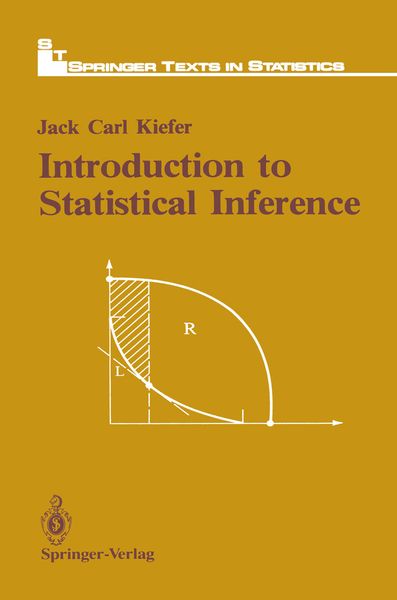
  • Produktbild: Introduction to Statistical Inference
  • Produktbild: Introduction to Statistical Inference

Introduction to Statistical Inference

79,99 €

inkl. gesetzl. MwSt., Versandkostenfrei


Beschreibung

Produktdetails

Einband

Taschenbuch

Erscheinungsdatum

16.12.2011

Herausgeber

Gary Lorden

Verlag

Springer Us

Seitenzahl

334

Maße (L/B/H)

23,5/15,5/1,9 cm

Gewicht

528 g

Auflage

Softcover reprint of the original 1st ed. 1987

Sprache

Englisch

ISBN

978-1-4613-9580-5

Beschreibung

Produktdetails

Einband

Taschenbuch

Erscheinungsdatum

16.12.2011

Herausgeber

Gary Lorden

Verlag

Springer Us

Seitenzahl

334

Maße (L/B/H)

23,5/15,5/1,9 cm

Gewicht

528 g

Auflage

Softcover reprint of the original 1st ed. 1987

Sprache

Englisch

ISBN

978-1-4613-9580-5

Herstelleradresse

Springer-Verlag KG
Sachsenplatz 4-6
1201 Wien
AT

Email: GPSR Kontakt

Noch keine Bewertungen vorhanden

Verfassen Sie die erste Bewertung zu diesem Artikel

Helfen Sie anderen Kundinnen und Kunden durch Ihre Meinung.

Kundinnen und Kunden meinen

Bewertungen (0)

  • Produktbild: Introduction to Statistical Inference
  • Produktbild: Introduction to Statistical Inference
  • 1 Introduction to Statistical Inference.- 2 Specification of a Statistical Problem.- 2.1 Additional Remarks on the Loss Function.- 3 Classifications of Statistical Problems.- 4 Some Criteria for Choosing a Procedure.- 4.1 The Bayes Criterion.- 4.2 Minimax Criterion.- 4.3 Randomized Statistical Procedures.- 4.4 Admissibility: The Geometry of Risk Points.- 4.5 Computation of Minimax Procedures.- 4.6 Unbiased Estimation.- 4.7 The Method of Maximum Likelihood.- 4.8 Sample Functionals: The Method of Moments.- 4.9 Other Criteria.- 5 Linear Unbiased Estimation.- 5.1 Linear Unbiased Estimation in Simple Settings.- 5.2 General Linear Models: The Method of Least Squares.- 5.3 Orthogonalization.- 5.4 Analysis of the General Linear Model.- 6 Sufficiency.- 6.1 On the Meaning of Sufficiency.- 6.2 Recognizing Sufficient Statistics.- 6.3 Reconstruction of the Sample.- 6.4 Sufficiency: “No Loss of Information”.- 6.5 Convex Loss.- 7 Point Estimation.- 7.1 Completeness and Unbiasedness.- 7.2 The “Information Inequality”.- 7.3 Invariance.- 7.4 Computation of Minimax Procedures (Continued).- 7.5 The Method of Maximum Likelihood.- 7.6 Asymptotic Theory.- 8 Hypothesis Testing.- 8.1 Introductory Notions.- 8.2 Testing Between Simple Hypotheses.- 8.3 Composite Hypotheses: UMP Tests; Unbiased Tests.- 8.4 Likelihood Ratio (LR) Tests.- 8.5 Problems Where n Is to Be Found.- 8.6 Invariance.- 8.7 Summary of Common “Normal Theory” Tests.- 9 Confidence Intervals.- Appendix A Some Notation, Terminology, and Background Material.- Appendix B Conditional Probability and Expectation, Bayes Computations.- Appendix C Some Inequalities and Some Minimization Methods.- C.1 Inequalities.- C.2 Methods of Minimization.- References.