KI-Beratung Beta

Gutscheinbedingungen

**Gültig bis 09.11.2026 auf tolino shine color (4016621130473), tolino vision color (4016621130183) und tolino vision color weiß (4016621131456) online auf thalia.at, in der Thalia App und in allen Thalia Buchhandlungen in Österreich. In den Buchhandlungen nur gültig auf lagernde Ware. Pro Einkauf einmal einlösbar. Nur gültig gegen Vorlage oder im Onlineshop hinterlegter Bonuscard. Infos zur Einlösung in der Buchhandlung sind auf der Bonuscard-Vorteilspreisseite zu finden. Click & Collect nur bei Onlinevorabzahlung möglich. Keine Einlösung bei Scan & Go-Bezahlung. Keine Barauszahlung. Nicht kombinierbar mit anderen Aktionen und Gutscheinen. Nicht gültig für Geschenkkarten, Versandkosten und Services. Nur solange der Vorrat reicht.

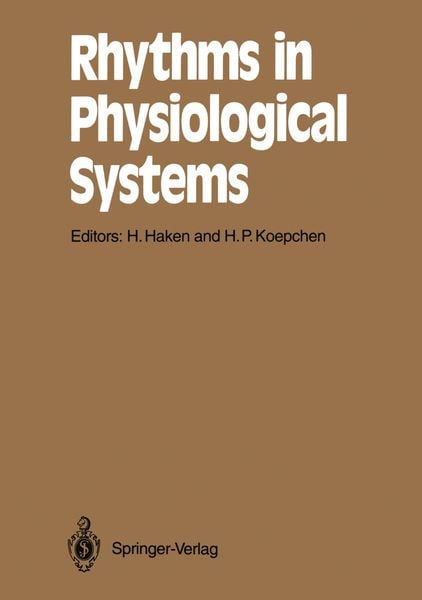
Produktbild: Rhythms in Physiological Systems
Band 55

Rhythms in Physiological Systems Proceedings of the International Symposium at Schloß Elmau, Bavaria, October 22–25, 1990

99,99 €

inkl. gesetzl. MwSt., Versandkostenfrei


Beschreibung

Produktdetails

Einband

Taschenbuch

Erscheinungsdatum

06.12.2011

Abbildungen

IX, 363 p.

Herausgeber

Hermann Haken + weitere

Verlag

Springer Berlin

Seitenzahl

363

Maße (L/B/H)

24,2/17/2,1 cm

Gewicht

643 g

Auflage

Softcover reprint of the original 1st ed. 1991

Sprache

Englisch

ISBN

978-3-642-76879-8

Beschreibung

Produktdetails

Einband

Taschenbuch

Erscheinungsdatum

06.12.2011

Abbildungen

IX, 363 p.

Herausgeber

Verlag

Springer Berlin

Seitenzahl

363

Maße (L/B/H)

24,2/17/2,1 cm

Gewicht

643 g

Auflage

Softcover reprint of the original 1st ed. 1991

Sprache

Englisch

ISBN

978-3-642-76879-8

Herstelleradresse

Springer-Verlag GmbH
Tiergartenstr. 17
69121 Heidelberg
DE

Email: ProductSafety@springernature.com

Noch keine Bewertungen vorhanden

Verfassen Sie die erste Bewertung zu diesem Artikel

Helfen Sie anderen Kundinnen und Kunden durch Ihre Meinung.

Kundinnen und Kunden meinen

Bewertungen (0)

  • Produktbild: Rhythms in Physiological Systems
  • I Physiological Rhythmicity and Synergetics.- Physiology of Rhythms and Control Systems: An Integrative Approach.- Synergetics — Can It Help Physiology?.- II Cardiovascular Rhythms.- Autorhythmicity in Blood Vessels: Its Biophysical and Biochemical Bases.- Role of the Rostroventrolateral Medulla in the Generation of Rhythmicities of the Sympathetic Activity.- Noninvasive Methods for Studying Rhythmic Nervous Control of Human Circulation.- The High Pressure System of the Mammalian Circulation as a Dynamic Self-Organizing System.- Spectral Analysis of Circulatory Rhythms and Baroreflex Sensitivity in Man.- Spectral Analysis of Cardiovascular Variables as a Tool to Quantify Neural Cardiovascular Control in the Laboratory and Real Life Conditions.- Cardiorespiratory Variability: Fractals, White Noise, Nonlinear Oscillators, and Linear Modeling. What’s to Be Learned?.- Spectral Analysis as an Assessment of the Neural Control of the Heart: A Methodological Comparison.- Power Laws, Transients, Attractors, and Entropy: Possible Implications for Cardiovascular Dynamics.- III Respiratory Rhythms.- The Respiratory System — Features of Modulation and Coordination.- Phase Resetting of Respiratory Rhythm — Experiments in Animals and Models.- Rhythmogenesis of Deterministic Breathing Patterns.- IV Motor Coordination.- Synergetic Dynamics of Biological Coordination with Special Reference to Phase Attraction and Intermittency.- Synchronization of Rhythm in Motor Actions.- V Basis of Circadian Rhythmicities.- Interactions Between Human Circadian and (About 90 min) Sleep Rhythms: Problems in the Simulation and the Analysis.- VI Rhythms in Electrical Activity of the Brain.- The Information Content of the Human EEG.- Synergetics of Evoked Alpha and Theta Rhythms in the Brain:Topographic and Modality-Dependent Aspects.- EEG Rhythms — Event-Related Desynchronization and Synchronization.- VII Rhythms in Perception.- Psychological Modification and Synergetic Modelling of Perceptual Oscillations.- VIII Aspects of Systems Theory.- Spatio-Temporal EEG Patterns.- Information Processing by Systems with Chemical Communication.- Criteria for the Relative Degree of Order in Self-Organization Processes.- Index of Contributors.