
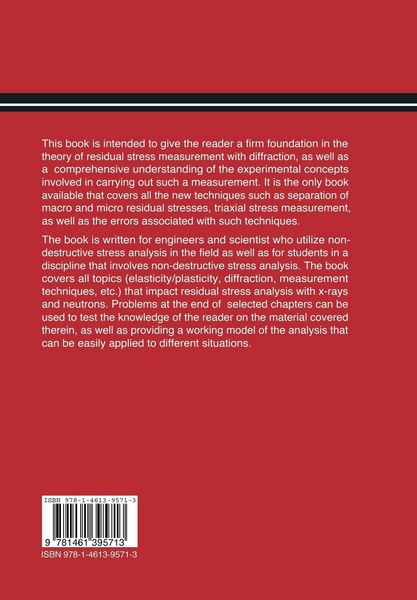
Residual Stress Measurement by Diffraction and Interpretation
-
- Taschenbuch ausgewählt
- eBook
-
Sprache:Englisch
148,99 €
inkl. gesetzl. MwSt.,
Beschreibung
Produktdetails
Einband
Taschenbuch
Erscheinungsdatum
01.07.2012
Verlag
Springer UsSeitenzahl
276
Maße (L/B/H)
24,4/17/1,6 cm
Gewicht
508 g
Auflage
1987
Sprache
Englisch
ISBN
978-1-4613-9571-3
1 Introduction.- 1.1 The Origin of Stresses.- 1.2 Methods of Measuring Residual Stresses.- 1.3 Some Examples of Residual Stresses.- References.- 2 Fundamental Concepts in Stress Analysis.- 2.1 Introduction.- 2.2 Definitions.- 2.3 Stress and Strain.- 2.4 Forces and Stresses.- 2.5 Displacements and Strains.- 2.6 Transformation of Axes and Tensor Notation.- 2.7 Elastic Stress-Strain Relations for Isotropic Materials.- 2.8 Structure of Single Crystals.- 2.9 Elastic Stress-Strain Relations in Single Crystals.- 2.10 Equations of Equilibrium.- 2.11 Conditions of Compatibility.- 2.12 Basic Definitions in Plastic Deformation.- 2.13 Plastic Deformation of Single Crystals.- 2.14 Deformation and Yielding in Inhomogeneous Materials.- Problems.- 3 Analysis of Residual Stress Fields Using Linear Elasticity Theory.- 3.1 Introduction.- 3.2 Macroresidual Stresses.- 3.3 Equations of Equilibrium for Macrostresses.- 3.4 Microstresses.- 3.5 Equations of Equilibrium for Micro- and Pseudo-Macrostresses.- 3.6 Calculation of Micro- and PM Stresses.- 3.7 The Total Stress State in Surface Deformed Multiphase Materials.- 3.8 Macroscopic Averages of Single Crystal Elastic Constants.- 3.9 The Voigt Average.- 3.10 The Reuss Average.- 3.11 Other Approaches to Elastic Constant Determination.- 3.12 Average Diffraction Elastic Constants.- Summary.- References.- 4 Fundamental Concepts in X-ray Diffraction.- 4.1 Introduction.- 4.2 Fundamentals of X-rays.- 4.3 Short-wavelength Limit and the Continuous Spectrum.- 4.4 Characteristic Radiation Lines.- 4.5 X-ray Sources.- 4.6 Absorption of X-rays.- 4.7 Filtering of X-rays.- 4.8 Scattering of X-rays.- 4.9 Scattering from Planes of Atoms.- 4.10 The Structure Factor of a Unit Cell.- 4.11 Experimental Utilization of Bragg's Law.- 4.12 Monochromators.- 4.13Collimators and Slits.- 4.14 Diffraction Patterns from Single Crystals.- 4.15 Diffraction Patterns from Polycrystalline Specimens.- 4.16 Basic Diffractometer Geometry.- 4.17 Intensity of Diffracted Lines for Polycrystals.- 4.18 Multiplicity.- 4.19 Lorentz Factor.- 4.20 Absorption Factor.- 4.21 Temperature Factor.- 4.22 X-ray Detectors.- 4.23 Deadtime Correction for Detection Systems.- 4.24 Total Diffracted Intensity at a Given Angle 20.- 4.25 Depth of Penetration of X-rays.- 4.26 Fundamental Concepts in Neutron Diffraction.- 4.27 Scattering and Absorption of Neutrons.- Problems.- Bibliography and References.- 5 Determination of Strain and Stress Fields by Diffraction Methods.- 5.1 Introduction.- 5.2 Fundamental Equations of X-ray Strain Determination.- 5.3 Analysis of Regular "d" vs. sin2? Data.- 5.4 Determination of Stresses from Diffraction Data.- 5.5 Biaxial Stress Analysis.- 5.6 Triaxial Stress Analysis.- 5.7 Determination of the Unstressed Lattice Spacing.- 5.8 Effect of Homogeneity of the Strain Distribution and Specimen Anisotropy.- 5.9 Average Strain Data from Single Crystal Specimens.- 5.10 Interpretation of the Average X-ray Strain Data Measured from Polycrystalline Specimens.- 5.11 Interpretation of Average Stress States in Polycrystalline Specimens.- 5.12 Effect of Stress Gradients Normal to the Surface on d vs. sin2? Data.- 5.13 Experimental Determination of X-ray Elastic Constants.- 5.14 Determination of Stresses from Oscillatory Data.- 5.15 Stress Measurements with Neutron Diffraction.- 5.16 Effect of Composition Gradients with Depth.- 5.17 X-ray Determination of Yielding.- 5.18 Summary.- Problem.- References.- 6 Experimental Errors Associated with the X-ray Measurement of Residual Stress.- 6.1 Introduction.- 6.2 Selection of the Diffraction Peakfor Stress Measurements.- 6.3 Peak Location.- 6.4 Determination of Peak Position for Asymmetric Peaks.- 6.5 Statistical Errors Associated with the X-ray Measurement of Line Profiles.- 6.6 Statistical Errors in Stress.- 6.7 Instrumental Errors in Residual Stress Analysis.- 6.8 Corrections for Macrostress Gradients.- 6.9 Corrections for Layer Removal.- 6.10 Summary.- Problems.- References.- 7 The Practical Use o
Noch keine Bewertungen vorhanden
Verfassen Sie die erste Bewertung zu diesem Artikel
Helfen Sie anderen Kundinnen und Kunden durch Ihre Meinung.
Kurze Frage zu unserer Seite
Vielen Dank für Ihr Feedback
Wir nutzen Ihr Feedback, um unsere Produktseiten zu verbessern. Bitte haben Sie Verständnis, dass wir Ihnen keine Rückmeldung geben können. Falls Sie Kontakt mit uns aufnehmen möchten, können Sie sich aber gerne an unseren Kund*innenservice wenden.
zum Kundenservice