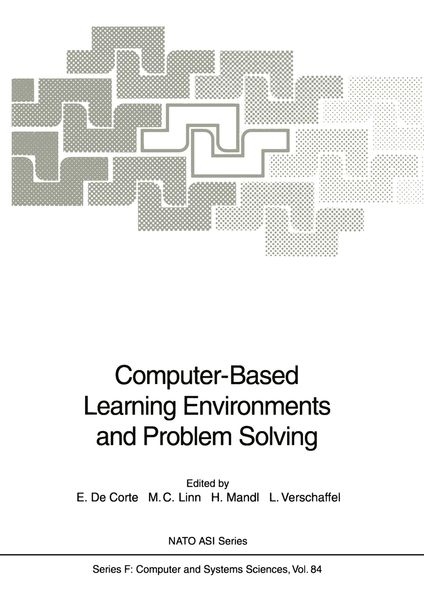
Produktbild: Computer-Based Learning Environments and Problem Solving
Band 84

Computer-Based Learning Environments and Problem Solving

Aus der Reihe NATO ASI Subseries F:

99,99 €

inkl. gesetzl. MwSt., Versandkostenfrei


Beschreibung

Produktdetails

Einband

Taschenbuch

Erscheinungsdatum

21.12.2011

Herausgeber

Erik De Corte + weitere

Verlag

Springer Berlin

Seitenzahl

484

Maße (L/B/H)

24,2/17/2,8 cm

Gewicht

860 g

Auflage

Softcover reprint of the original 1st ed. 1992

Sprache

Englisch

ISBN

978-3-642-77230-6

Beschreibung

Portrait

In this volume a select group of experts present new work on the application of computers in integrated learning environments to enhance higher-order thinking and problem-solving skills. A multidisciplinary confrontation of approaches to the topic is presented.

Produktdetails

Einband

Taschenbuch

Erscheinungsdatum

21.12.2011

Herausgeber

Verlag

Springer Berlin

Seitenzahl

484

Maße (L/B/H)

24,2/17/2,8 cm

Gewicht

860 g

Auflage

Softcover reprint of the original 1st ed. 1992

Sprache

Englisch

ISBN

978-3-642-77230-6

Herstelleradresse

Springer-Verlag KG
Sachsenplatz 4-6
1201 Wien
AT

Email: GPSR Kontakt

Noch keine Bewertungen vorhanden

Verfassen Sie die erste Bewertung zu diesem Artikel

Helfen Sie anderen Kundinnen und Kunden durch Ihre Meinung.

Kundinnen und Kunden meinen

Bewertungen (0)

  • Produktbild: Computer-Based Learning Environments and Problem Solving
  • I. Encouraging Knowledge Construction.- Formal education versus everyday learning.- Images of learning.- An architecture for collaborative knowledge building.- How do Lisp programmers draw on previous experience to solve novel problems?.- Analysis-based learning on multiple levels of mental domain representation.- Modeling active, hypothesis-driven learning from worked-out examples.- Fostering conceptual change: The role of computer-based environments.- Computers in a community of learners.- II. Stimulating Higher-Order Thinking and Problem Solving.- Teaching for transfer of problem-solving skills to computer programming.- Cognitive effects of learning to program in Logo: A one-year study with sixth-graders.- The role of social interaction in the development of higher-order thinking in Logo environments.- Effects with and of computers and the study of computer-based learning environments.- Facilitating domain-general problem solving: Computers, cognitive processes and instruction.- Conceptual fields, problem solving and intelligent computer tools.- III. Creating Learning Environments.- Augmenting the discourse of learning with computer-based learning environments.- Scientific reasoning across different domains.- A rule-based diagnosis system for identifying misconceptions in qualitative reasoning in the physical domain “superposition of motion”.- The provision of tutorial support for learning with computer-based simulations.- Learning and instruction with computer simulations: Learning processes involved.- Two uses of computers in science teaching: Horizontal motion simulation and simulation building.- Direct manipulation of physical concepts in a computerized exploratory laboratory.- Multimedia learning environments designed with organizing principles from non-school settings.