Gutscheinbedingungen

**Gültig bis 14.09.2026 auf Spielzeug, Schreibwaren, Filme, Geschenke & Trends, Musik, tolino eReader & Zubehör, Hörbücher, nicht preisgebundene Bücher und Kalender in der Thalia App. Einzelne Artikel können ausgeschlossen sein. Aufgrund der Buchpreisbindung sind deutschsprachige Bücher und eBooks ausgenommen. Zusätzlich ausgenommen sind Abos & Flatrates, Games, Geschenkkarten/-boxen, Shelfies, Software, Zeitschriften sowie einzelne Artikel von tonies®. Pro Einkauf einmal einlösbar. Nur gültig mit im Onlineshop hinterlegter Bonuscard. Click & Collect nur bei Onlinevorabzahlung möglich. Keine Barauszahlung. Nicht kombinierbar mit anderen Aktionen und Gutscheinen. Gutschein wird auf max. 500€ Bestellwert angerechnet. Nicht gültig für Versandkosten und Services.

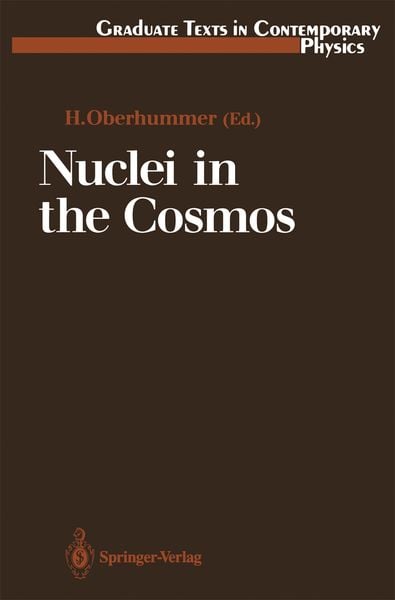
  • Produktbild: Nuclei in the Cosmos
  • Produktbild: Nuclei in the Cosmos

Nuclei in the Cosmos

51,99 €

inkl. gesetzl. MwSt., Versandkostenfrei


Beschreibung

Produktdetails

Einband

Taschenbuch

Erscheinungsdatum

27.06.2012

Abbildungen

XII, 236 p.

Herausgeber

Heinz Oberhummer

Verlag

Springer Berlin

Seitenzahl

236

Maße (L/B/H)

23,5/15,5/1,4 cm

Gewicht

388 g

Auflage

Softcover reprint of the original 1st ed. 1991

Sprache

Englisch

ISBN

978-3-642-48842-9

Beschreibung

Produktdetails

Einband

Taschenbuch

Erscheinungsdatum

27.06.2012

Abbildungen

XII, 236 p.

Herausgeber

Heinz Oberhummer

Verlag

Springer Berlin

Seitenzahl

236

Maße (L/B/H)

23,5/15,5/1,4 cm

Gewicht

388 g

Auflage

Softcover reprint of the original 1st ed. 1991

Sprache

Englisch

ISBN

978-3-642-48842-9

Herstelleradresse

Springer-Verlag KG
Sachsenplatz 4-6
1201 Wien
AT

Email: ProductSafety@springernature.com

Noch keine Bewertungen vorhanden

Verfassen Sie die erste Bewertung zu diesem Artikel

Helfen Sie anderen Kundinnen und Kunden durch Ihre Meinung.

Kundinnen und Kunden meinen

Bewertungen (0)

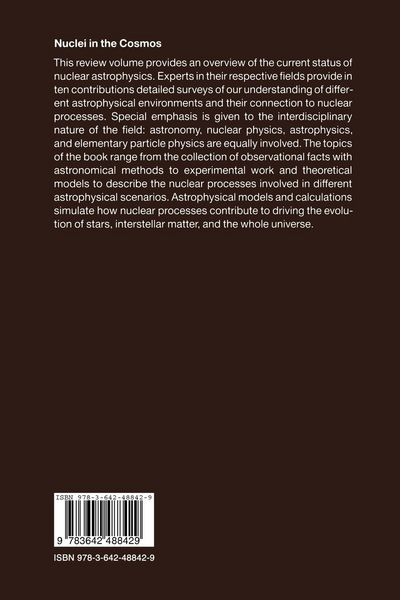
  • Produktbild: Nuclei in the Cosmos
  • Produktbild: Nuclei in the Cosmos
  • Experimental Determination of Stellar Reaction Rates.- 1. Introduction.- 2. Direct Measurements.- 3. Indirect Approaches.- 4. Reactions Involving Radioactive Nuclides.- References.- Radioactive Ion Beams in Nuclear Astrophysics.- 1. Introduction.- 2. Interest of Radioactive Ion Beams in Nuclear Astrophysics.- 3. Production of Radioactive Ion Beams.- 4. Special Experimental Techniques in Nuclear Astrophysics Using Radioactive Ion Beams.- 5. Conclusions.- References.- Direct Reaction Mechanism in Astrophysically Relevant Processes.- 1. Introduction.- 2. Qualitative Features of Nuclear Reaction Mechanisms.- 3. Nuclear Reactions in Astrophysical Scenarios.- 4. Optical Potentials.- 5. Theoretical Descriptions of Direct Reactions.- 6. Examples.- 7. Summary.- Acknowledgements.- References.- Nuclear Reaction Rates — from Laboratory Experiments and in the Stellar Plasma.- 1. Introduction.- 2. Theoretical Models for Extrapolating Measured Data.- 3. Electron Screening in Laboratory Experiments.- 4. Screening Effects in the Plasma.- References.- Abundances in Galaxies.- 1. Introduction.- 2. Big Bang Nucleosynthesis and Light Element Abundances.- 3. Abundance Trends Between and Across Galaxies.- 4. Stellar Populations in Our Galaxy.- 5. Differential Abundance Variations Among Elements.- References.- Nuclei in Cosmic Rays.- 1. Introduction.- 2. Techniques for Measuring Composition from Satellites and Balloons.- 3. Results of Satellite and Balloon Experiments.- 4. How to Measure Cosmic Ray Composition above 1015 eV.- 5. Summary.- References.- Primordial Nucleosynthesis: Beyond the Standard Model.- 1. Introduction.- 2. Standard Primordial Nucleosynthesis.- 3. Observational Tests of the Standard Model.- 4. The QCD Phase Transition.- 5. Neutrinos in the Early Universe.- 6. CosmicStrings.- 7. Conclusions.- References.- Production of Heavy Elements in Inhomogeneous Cosmologies.- 1. Introduction.- 2. The QCD Transition in the Early Universe.- 3. The Standard Big Bang.- 4. Inhomogeneous Big Bang Scenarios.- 5. Computational Method.- 6. Results.- Acknowledgements.- References.- The s-Process: Branchings and Chronometers.- 1. Introduction.- 2. Chronometers — Models and Reality.- 3. s-Process Concepts.- 4. s-Process Time Scales.- 5. Selected Examples.- 6. Conclusions.- References.- Beta Decay Far from Stability and Double Beta Decay, and Consequences for Astrophysics.- 1. Introduction.- 2. Calculations of Beta Decay Properties of Nuclei Far from Stability.- 3. Beta Decay Far from Stability and the Astrophysical r-Process.- 4. The r-Process and the Age of the Universe.- 5. Age of the Universe, Cosmology and Neutrino Mass.- 6. Double Beta Decay and Neutrino Mass.- 7. Conclusion.- References.