Gutscheinbedingungen

**Gültig bis 06.07.2026 auf fremdsprachige Bücher online auf thalia.at, in der Thalia App ab einem Mindestbestellwert von 30€ und in allen Thalia Buchhandlungen in Österreich. In den Buchhandlungen nur gültig auf lagernde Ware. Einzelne Artikel können ausgeschlossen sein. Ausgenommen sind preisgebundene Artikel & eBooks. Pro Einkauf einmal einlösbar. Nur gültig gegen Vorlage oder im Onlineshop hinterlegter Bonuscard. Infos zur Einlösung in der Buchhandlung sind auf der Bonuscard-Vorteilspreisseite zu finden. Click & Collect nur bei Onlinevorabzahlung möglich. Keine Einlösung bei Scan & Go-Bezahlung. Keine Barauszahlung. Nicht kombinierbar mit anderen Aktionen und Gutscheinen. Gutschein wird auf max. 500€ Bestellwert angerechnet. Nicht gültig für Versandkosten und Services.

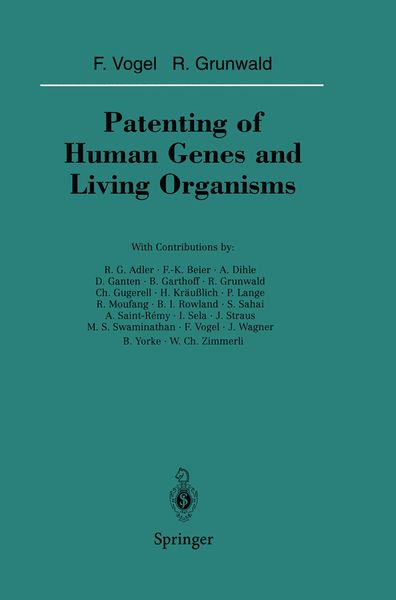
Produktbild: Patenting of Human Genes and Living Organisms

Patenting of Human Genes and Living Organisms

99,99 €

inkl. gesetzl. MwSt., Versandkostenfrei


Beschreibung

Produktdetails

Einband

Taschenbuch

Erscheinungsdatum

19.01.2012

Herausgeber

Friedrich Vogel + weitere

Verlag

Springer Berlin

Seitenzahl

244

Maße (L/B/H)

23,5/15,5/1,5 cm

Gewicht

400 g

Auflage

Softcover reprint of the original 1st ed. 1994

Sprache

Englisch

ISBN

978-3-642-85155-1

Beschreibung

Rezension

"I recommend this book to all scientists concerned about the issues of IPR; ...it gives valuable information in an important and fast-moving field that cannot be gained elsewhere." - Genetical Research

Portrait

The recent results of biological research (molecular biology; plant and animal breeding) - and attempts at getting such results patented - have led to new problems that need to be discussed from the points of view of fields such as biology, medicine, law, and ethics. The contributions and discussions published in this volume may help to clarify these issues.

Produktdetails

Einband

Taschenbuch

Erscheinungsdatum

19.01.2012

Herausgeber

Verlag

Springer Berlin

Seitenzahl

244

Maße (L/B/H)

23,5/15,5/1,5 cm

Gewicht

400 g

Auflage

Softcover reprint of the original 1st ed. 1994

Sprache

Englisch

ISBN

978-3-642-85155-1

Herstelleradresse

Springer-Verlag KG
Sachsenplatz 4-6
1201 Wien
AT

Email: GPSR Kontakt

Noch keine Bewertungen vorhanden

Verfassen Sie die erste Bewertung zu diesem Artikel

Helfen Sie anderen Kundinnen und Kunden durch Ihre Meinung.

Kundinnen und Kunden meinen

Bewertungen (0)

  • Produktbild: Patenting of Human Genes and Living Organisms
  • Session 1.- Begrüßung.- Welcoming Adress.- Patenting of Human Genes and Living Organisms - A Nightmare for the Scientist.- Patenting of Human Genes and Living Organisms - The Legal Situation in Europe.- Remarks on “Technology Transfer and the Genome Program”.- Discussion: Session 1.- Session 2.- Intellectual Property in the Field of Life Sciences.- Discussion: Session 2.- Session 3.- Legal Protection of Living Organisms from the Point of View of Scientists in Animal Breeding.- Legal Protection of Living Organisms from the Point of View of Scientists in Plant Breeding.- “Patenting” of Living Organisms — Patents and Plant Breeders’ Rights — From the Point of View of Plant Breeders.- Genetic Diversity and the Indian Seed Industry.- Patenting Living Organisms and Their Parts: The Point of View of Science Administration.- Patenting of Human Genes and Living Organisms — The Current Practice of the European Patent Office.- Discussion: Session 3.- Session 4.- Patenting of Human Genes and Living Organisms: An Ethical Point of View.- Discussion: Session 4.- Session 5.- The Patenting of Genes and Living Organisms: The South’s View.- Patenting of Human Genes and Living Organisms: The Socio-Political Situation in the United States of America.- Discussion: Session 5.- Session 6.- The Human Renin-Angiotensin-System in Transgenic Rats.- Which Rules of Patenting are Acceptable from the Point of View of Industry?.- Patentability of Human Genes and Living Organisms: Principles of a Possible International Understanding.- What does Pharmaceutical Industry expect of Patenting Human Genes and Living Organisms?.- Discussion: Session 6.- Round Table Discussion.