KI-Beratung Beta

  • Produktbild: Graphite Intercalation Compounds II
  • Produktbild: Graphite Intercalation Compounds II
Band 18

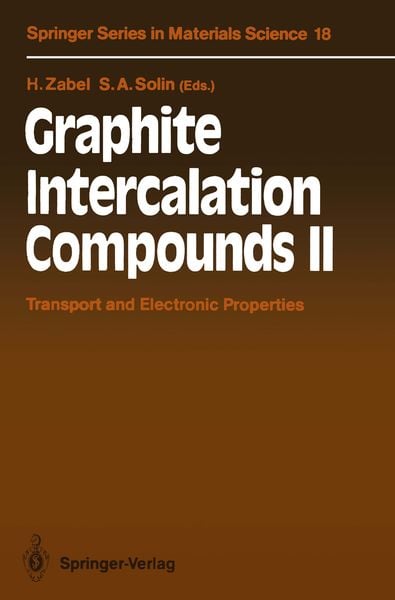
Graphite Intercalation Compounds II Transport and Electronic Properties

51,99 €

inkl. gesetzl. MwSt., Versandkostenfrei


Beschreibung

The research on graphite intercalation compounds often acts as a forerunner for research in other sciences. For instance, the concept of staging, which is fundamental to graphite intercalation compounds, is also relevant to surface science in connection with adsorbates on metal surfaces and to high-temperature...

Beschreibung

The research on graphite intercalation compounds often acts as a forerunner for research in other sciences. For instance, the concept of staging, which is fundamental to graphite intercalation compounds, is also relevant to surface science in connection with adsorbates on metal surfaces and to high-temperature superconducting oxide layer materials. Phonon-folding and mode-splitting effects are not only basic to graphite intercalation compounds but also to polytypical systems such as supercon ductors, superlattices, and metal and semiconductor superlattices. Charge transfer effects playa tremendously important role in many areas, and they can be most easily and fundamentally studied with intercalated graphite. This list could be augmented with many more examples. The important message, however, is that graphite inter calation compounds represent a class of materials that not only can be used for testing a variety of condensed-matter concepts, but also stimulates new ideas and approaches. This volume is the second of a two-volume set. The first volume addressed the structural and dynamical aspects of graphite intercalation compounds, together with the chemistry and intercalation of new compounds. This second volume provides an up-to-date status report from expert researchers on the transport, magnetic, elec tronic and optical properties ofthis unique class of materials. The band-structure cal culations of the various donor and acceptor compounds are discussed in depth, and detailed reviews are provided ofthe experimental verification ofthe electronic struc ture in terms of their photoemission spectra and optical properties.

Portrait

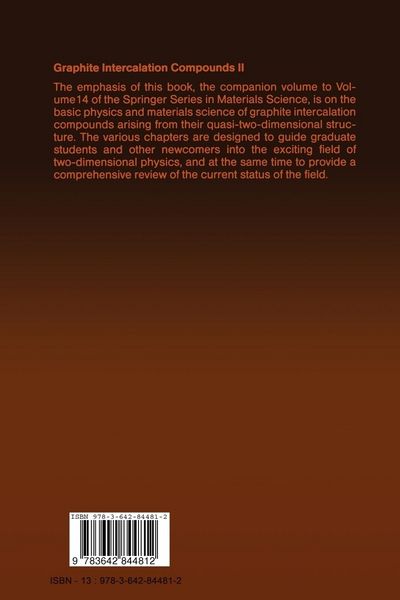
The emphasis of this book, the companion volume to Volume 14 of the Springer Series Materials Science, is on the basic physics and materials science of graphite intercalation compounds arising from their quasi-two-dimensional structure. The various chapters are designed to guide graduate students and other newcomers into the exciting field of two-dimensional physics, and at the same time to provide a comprehensive review of the current status of the field.

Produktdetails

Einband

Taschenbuch

Erscheinungsdatum

16.12.2011

Abbildungen

XIV, 433 p.

Herausgeber Hartmut Zabel + weitere

Produktdetails

Einband

Taschenbuch

Erscheinungsdatum

16.12.2011

Abbildungen

XIV, 433 p.

Herausgeber
Verlag Springer Berlin
Seitenzahl

433

Maße (L/B/H)

23,5/15,5/2,5 cm

Gewicht

680 g

Auflage

Softcover reprint of the original 1st ed. 1992

Sprache

Englisch

ISBN

978-3-642-84481-2

Herstelleradresse

Springer-Verlag KG
Sachsenplatz 4-6
1201 Wien
AT

Email: ProductSafety@springernature.com

Noch keine Bewertungen vorhanden

Verfassen Sie die erste Bewertung zu diesem Artikel

Helfen Sie anderen Kundinnen und Kunden durch Ihre Meinung.

Kundinnen und Kunden meinen

Bewertungen (0)

  • Produktbild: Graphite Intercalation Compounds II
  • Produktbild: Graphite Intercalation Compounds II
  • 1. Introduction.- References.- 2. Electronic Band Structure of Graphite Intercalation Compounds.- 2.1 Methods for Band Structure Calculations.- 2.2 Graphite.- 2.3 Electronic Band Structures of Low-Stage Graphite Intercalation Compounds.- 2.4 Electronic Band Structure of High-Stage Graphite Intercalation Compounds.- 2.5 Summary and Conclusions.- References.- 3. Electron Spectroscopy of Graphite Intercalation Compounds.- 3.1 Essential Concepts.- 3.2 The Situation in the Literature.- 3.3 Principal Results for the Electronic Structure.- 3.4 Photoemission from Acceptor GICs.- 3.5 Summary and Conclusions.- References.- 4. Effects of Charge Transfer on the Optical Properties of Graphite Intercalation Compounds.- 4.1 Experimental Considerations.- 4.2 Deducing Charge Transfer from Optical Studies.- 4.3 Experimental Results and Discussion.- 4.4 Summary and Conclusion.- References.- 5. Superconductivity of Graphite Intercalation Compounds.- 5.1 Superconductivity of C8M (M= K, Rb, Cs).- 5.2 Superconductivity of Binary Intercalants.- 5.3 Theoretical Aspects of the Origin of Superconductivity in GICs.- References.- 6. Transport Properties of Metal Chloride Acceptor Graphite Intercalation Compounds.- 6.1 The In-Plane Electrical Resistivity.- 6.2 The In-Plane Thermal Conductivity.- 6.3 The In-Plane Thermoelectric Power.- 6.4 c Axis Transport and Anisotropy.- 6.5 Transport in Magnetic GICs.- 6.6 Concluding Remarks.- References.- 7. Magnetic Intercalation Compounds of Graphite.- 7.1 Background.- 7.2 Origin of Magnetic Interactions.- 7.3 Experimental Techniques for Studying GICs.- 7.4 Overview of Magnetic GICs.- 7.5 Summary.- References.- 8. Intercalation of Graphite Fibers.- 8.1 Precursor Graphite Fibers.- 8.2 Intercalation.- 8.3 Structure and Staging.- 8.4 Raman Characterization.- 8.5 Transport Properties.- 8.6 Mechanical Properties.- 8.7 Thermal Expansion.- 8.8 Applications of Intercalated Carbon Fibers.- 8.9. Summary and Conclusions.- References.