
Gutscheinbedingungen

**Gültig bis 06.07.2026 auf fremdsprachige Bücher online auf thalia.at, in der Thalia App ab einem Mindestbestellwert von 30€ und in allen Thalia Buchhandlungen in Österreich. In den Buchhandlungen nur gültig auf lagernde Ware. Einzelne Artikel können ausgeschlossen sein. Ausgenommen sind preisgebundene Artikel & eBooks. Pro Einkauf einmal einlösbar. Nur gültig gegen Vorlage oder im Onlineshop hinterlegter Bonuscard. Infos zur Einlösung in der Buchhandlung sind auf der Bonuscard-Vorteilspreisseite zu finden. Click & Collect nur bei Onlinevorabzahlung möglich. Keine Einlösung bei Scan & Go-Bezahlung. Keine Barauszahlung. Nicht kombinierbar mit anderen Aktionen und Gutscheinen. Gutschein wird auf max. 500€ Bestellwert angerechnet. Nicht gültig für Versandkosten und Services.

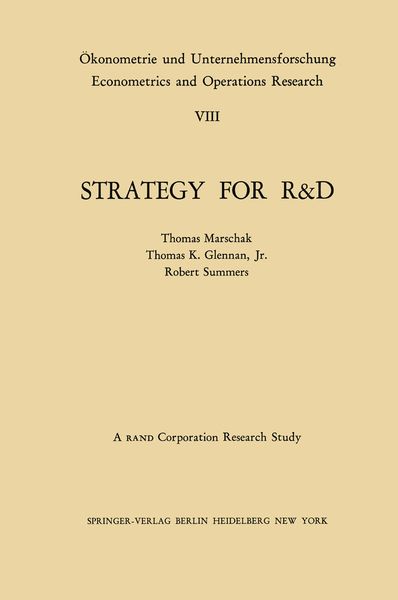
  • Produktbild: Strategy for R&D: Studies in the Microeconomics of Development
  • Produktbild: Strategy for R&D: Studies in the Microeconomics of Development
Band 8

Strategy for R&D: Studies in the Microeconomics of Development

51,99 €

inkl. gesetzl. MwSt., Versandkostenfrei


Beschreibung

Produktdetails

Einband

Taschenbuch

Erscheinungsdatum

29.02.2012

Verlag

Springer Berlin

Seitenzahl

330

Maße (L/B/H)

22,9/15,2/1,9 cm

Gewicht

505 g

Auflage

Softcover reprint of the original 1st ed. 1967

Sprache

Englisch

ISBN

978-3-642-46097-5

Beschreibung

Produktdetails

Einband

Taschenbuch

Erscheinungsdatum

29.02.2012

Verlag

Springer Berlin

Seitenzahl

330

Maße (L/B/H)

22,9/15,2/1,9 cm

Gewicht

505 g

Auflage

Softcover reprint of the original 1st ed. 1967

Sprache

Englisch

ISBN

978-3-642-46097-5

Herstelleradresse

Springer-Verlag KG
Sachsenplatz 4-6
1201 Wien
AT

Email: GPSR Kontakt

Noch keine Bewertungen vorhanden

Verfassen Sie die erste Bewertung zu diesem Artikel

Helfen Sie anderen Kundinnen und Kunden durch Ihre Meinung.

Kundinnen und Kunden meinen

Bewertungen (0)

  • Produktbild: Strategy for R&D: Studies in the Microeconomics of Development
  • Produktbild: Strategy for R&D: Studies in the Microeconomics of Development
  • 1. The Microeconomic Study of Development.- The Nature of the Studies.- The Microeconomic Study of Development and its Relation to Broader Economic Issues.- The Management of Government-financed R&D.- The Market Allocation of Resources to R&D.- R&D, Technical Change, and Economic Growth.- 2. Issues in the Choice of Development Policies.- A. What Is Development?.- B. The Structure of a Development: Uncertainty Reducing and Routine Tasks.- C. The Nature of Internal Uncertainties in Development.- D. The Resolution of Uncertainty.- E. The Elements of Development Policy.- F. The Component State of the Art Advance.- G. Component Interrelatedness.- H. The Use of Parallel Developments.- I. Distribution of Effort Among Uncertainty Reducing Tasks.- J. The Impact of Available Time and Resources upon Development Strategies.- K. External Uncertainties.- L. The Relation of Development Strategies to External Uncertainties.- M. Conclusion.- 3. The Role of Project Histories in the Study of R&D.- A. Introduction.- B. Airborne Radars.- “Side-looking” Radar.- World War II Radars.- Some Postwar Radars.- Interpretation.- C. Aircraft Engines.- The Nature of Engine Development: An Illustrative Model.- Issues to Be Examined in the Engine Histories.- The J-79.- The J-57 and J-75.- The J-40.- Some Shorter Histories: J-46, J-33, J-35, T-35.- Tabular Summaries of Uncertainties in the Engine Projects Studied.- Summary.- D. Fighter Aircraft.- The F-100.- The F-102.- The F-104.- E. Two Postwar Strategic Jet Bomber Programs.- The B-52.- The B-47.- F. The Sidewinder Missile.- Development History.- G. Conclusions.- 4. Cost Estimates as Predictors of Actual Costs: A Statistical Study of Military Developments.- A. Introduction and Summary.- Aims and Scope of the Study.- Outline of Methods and Results.- B. An Analysis of Cost-estimate Chronologies.- Errors in Nonmilitary Cost Estimating.- Model of the Development Process (I).- Preliminary Description of the Data.- Raw Measure of Accuracy of Estimates: Raw F.- Adjusted Measure of Accuracy of Estimates: F.- Model of the Development Process (II); First Variable: Timing Within the Development Program.- Second Variable: Technological Advance.- Bivariate Analysis of t and A.- Third Variable: Length of Development Period.- Fourth Variable: Calendar Date.- Regression Results: Algebraic.- Hypothesis Testing.- Regression Results: Graphic.- Fifth Variable: Missiles Versus Aircraft; Sixth Variable: Quantity Adjustment.- Seventh Variable: Estimator and/or Contractor.- Eighth Variable: Benchmark Time.- Data Problem: Errors in Measurement.- Data Problem: Randomness.- Estimation of Independent Variables; Weighting Observations.- Cost Changes of Major Article Components.- The “Changing-configuration” Hypothesis.- Conscious Underbidding of Contractors?.- C. The Consequences of Cost-estimate Inaccuracies.- Cost Inaccuracies Versus Other Uncertainties.- System Choice and Inaccurate Cost Estimates: Bias.- System Choice and Inaccurate Cost Estimates: Variance.- Implications for Cost-effectiveness Studies.- Implications for Force-structure Projections.- 5. Toward a Normative Theory of Development.- A. Introduction.- B. Normative Problems in Development Strategy.- 1. The Framework.- 2. The Developer’s Task Under Certainty.- 3. The Developer’s Task Under Uncertainty.- 4. The Pure Parallel Approach Problem with One or More Review Points.- 5. The Parallel Approach Problem with Sequential Selection of Approaches at Each Review Point.- 6, The Pursuit of Approaches with Different Intensities.- 7. Multi-component Problems.- 8. Further Refinements for the Case of Two Valued Preferences.- 9. Many Valued Preferences.- 10. Changes in the World Outside the Developer’s Control.- 11. Project Selection Problems.- 12. Previously Explored Sequential Decision Problems Related to the Parallel Approach Problem.- 13. Limitations of Problems Based on the Approach Concept.- C. Normative Problems in Development Organization.- 1. General Normative Models of Organizations.- 2. Normative Models of the Development Project.- Appendix: Proof of Theorem 4 of Chapter 5.