
Gutscheinbedingungen

**Gültig von 22.06.2026 ab 19 Uhr bis 23.06.2026 24 Uhr auf Spielzeug, Schreibwaren, Filme, Geschenke & Trends, Musik, tolino eReader & Zubehör, Hörbücher und Hörbuch-Downloads (außer Abo), nicht preisgebundene Bücher und Kalender online auf thalia.at und in der Thalia App. Einzelne Artikel können ausgeschlossen sein. Aufgrund der Buchpreisbindung sind deutschsprachige Bücher und eBooks ausgenommen. Zusätzlich ausgenommen sind preisgebundene Artikel, Abos & Flatrates, eBooks, Games, Geschenkkarten/-boxen, Shelfies, Software, Zeitschriften sowie einzelne Artikel von tonies®. Pro Einkauf einmal einlösbar. Click & Collect nur bei Onlinevorabzahlung möglich. Keine Barauszahlung. Nicht kombinierbar mit anderen Aktionen und Gutscheinen. Gutschein wird auf max. 500€ Bestellwert angerechnet. Nicht gültig für Versandkosten und Services.

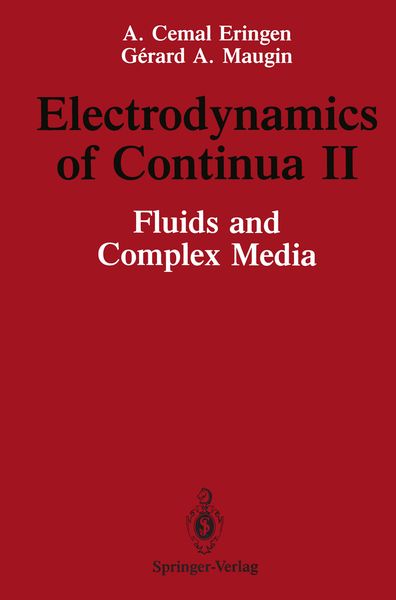
  • Produktbild: Electrodynamics of Continua II
  • Produktbild: Electrodynamics of Continua II
  • Produktbild: Electrodynamics of Continua II
- 12%

Electrodynamics of Continua II Fluids and Complex Media

12% sparen

95,99 € UVP 109,99 €

inkl. gesetzl. MwSt., Versandkostenfrei


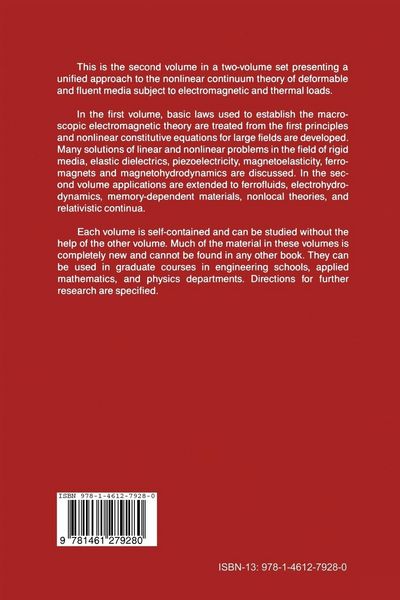
Beschreibung

Produktdetails

Einband

Taschenbuch

Erscheinungsdatum

17.09.2011

Verlag

Springer Us

Seitenzahl

363

Maße (L/B/H)

23,5/15,5/2,1 cm

Gewicht

575 g

Auflage

Softcover reprint of the original 1st ed. 1990

Sprache

Englisch

ISBN

978-1-4612-7928-0

Beschreibung

Produktdetails

Einband

Taschenbuch

Erscheinungsdatum

17.09.2011

Verlag

Springer Us

Seitenzahl

363

Maße (L/B/H)

23,5/15,5/2,1 cm

Gewicht

575 g

Auflage

Softcover reprint of the original 1st ed. 1990

Sprache

Englisch

ISBN

978-1-4612-7928-0

Herstelleradresse

Springer-Verlag KG
Sachsenplatz 4-6
1201 Wien
AT

Email: ProductSafety@springernature.com

Kundinnen und Kunden meinen

0 Bewertungen

Informationen zu Bewertungen

Zur Abgabe einer Bewertung ist eine Anmeldung im Konto notwendig. Die Authentizität der Bewertungen wird von uns nicht überprüft. Wir behalten uns vor, Bewertungstexte, die unseren Richtlinien widersprechen, entsprechend zu kürzen oder zu löschen.

Die Bewertungen sind nach Format, Anzahl Sterne und Datum sortiert.

Verfassen Sie die erste Bewertung zu diesem Artikel

Helfen Sie anderen Kund*innen durch Ihre Meinung

Kundinnen und Kunden meinen

0 Bewertungen filtern

  • Produktbild: Electrodynamics of Continua II
  • Produktbild: Electrodynamics of Continua II
  • Produktbild: Electrodynamics of Continua II
  • (Volume II).- 9 Elastic Ferromagnets.- 9.0. An Overview of Basic Equations.- 9.1. Scope of the Chapter.- 9.2. Model of Interactions.- A. Gyroscopic Nature of the Spin Density.- B. Spin-Lattice Model of Interactions.- 9.3. Balance Equations.- A. Global Balance Equations.- B. Local Balance Equations.- C. The Clausius-Duhem (C-D) Inequality.- D. Boundary Conditions.- 9.4. Constitutive Theory.- A. Saturated Ferromagnetic Elastic Insulators.- B. Free Energy.- C. Correspondence Between the Microscopic Model and the Continuous Representation.- D. Infinitesimal Strains.- E. Centrosymmetric Cubic Crystals.- F. Uniaxial Crystals.- G. Elementary Dissipative Processes.- H. Small Fields Superposed on a Constant Bias Magnetic Field.- 9.5. Résumé of Basic Equations.- 9.6. Coupled Magnetoelastic Waves in Ferromagnets.- A. Preliminary Remarks.- B. Plane Harmonic Waves.- C. Damping of Magnetoelastic Waves.- D. Magnetoelastic Faraday Effect.- 9.7. Applications of the Magnon-Phonon Coupling.- A. Pumping and Temporal Magnon-Phonon Conversion.- B. Drift-Type Amplification of Magnetoelastic Waves.- 9.8. Other Works.- A. Continuum Descriptions of Ferromagnetic Deformable Bodies.- B. Wave Propagation.- C. Ferrimagnetic Deformable Bodies.- Problems.- 10 Magnetohydrodynamics.- 10.1. Scope of the Chapter.- 10.2. Basic Equations of Electromagnetic Fluids.- 10.3. Magnetohydrodynamic Approximation.- 10.4. Perfect Magnetohydrodynamics.- A. Field Equations.- B. “Frozen-In” Fields.- C. Bernoulli’s Equation in Magnetohydrodynamics.- D. Kelvin’s Circulation Theorem in Magnetohydrodynamics.- E. Alfvén Waves.- F. Generalized Hugoniot Condition.- 10.5. Incompressible Viscous Magnetohydrodynamic Flow.- A. Magnetohydrodynamic Poiseuille Flow.- B. Magnetohydrodynamic Couette Flow.- 10.6. One-Dimensional Compressible Flow.- 10.7. Shock Waves in Magnetohydrodynamics.- A. Classification of Magnetohydrodynamic Shock Waves.- B. Shock Structure.- 10.8. Magnetohydrodynamic Equilibria.- 10.9. Equilibrium of Magnetic Stars.- 10.10. Magnetohydrodynamic Stability.- A. The Energy Method.- B. Equilibrium States and Perturbations.- C. Quantities Conserved in the Perturbation.- D. Elementary Perturbations.- E. Change in the Energy Integrals.- F. Application to the Linear Pinch.- Problems.- 11 Eleetrohydrodynamics.- 11.1. Scope of the Chapter.- 11.2. Field Equations.- 11.3. Charge Relaxation.- 11.4. Stability Condition.- 11.5. Helmholtz and Bernoulli Equations.- A. Generalization of the Helmholtz Equation.- B. Vorticity Generation in a Space-Charge-Loaded Electric Field.- C. Generalization of Bernoulli’s Equations.- 11.6. Equilibrium of a Free Interface.- 11.7. Effect of Free Charges at an Interface.- 11.8. Electrohydrodynamic Stability.- 11.9. Electrohydrodynamic Flow in a Circular Cylindrical Conduit.- 11.10. Electrogasdynamic Energy Converter.- Problems.- 12 Ferrofluids.- 12.1. Scope of the Chapter.- 12.2. Constitutive Equations of Ferromagnetic Fluids.- 12.3. Theory of Ferrofluids.- A. Equilibrium Constitutive Equations.- B. Nonequilibrium Constitutive Equations.- C. Balance Laws.- 12.4. Existence and Stability of a Constant Magnetization in a Moving Ferrofluid.- 12.5. Ferrohydrodynamic Approximation.- 12.6. Some General Theorems in Ferrohydrodynamics.- A. Generalization of the Helmholtz Equation.- B. Generalization of the Bernoulli Equation.- 12.7. Ferrohydrostatics.- A. Equilibrium of a Free Surface.- B. Energy Conversion.- 12.8. Ferrohydrodynamic Flow of Nonviscous Fluids.- A. Preliminary Remarks.- B. Steady Two-Dimensional Source Flow.- 12.9. Simple Shear of a Viscous Ferrofluid.- 12.10. Stagnation-Point Flow of a Viscous Ferrofluid.- 12.11. Interfacial Stability of Ferrofluids.- 12.12. Other Problems in Ferrofluids.- Problems.- 13 Memory-Dependent Electromagnetic Continua.- 13.1. Scope of the Chapter.- 13.2. Constitutive Equations.- 13.3. Thermodynamics of Materials with Continuous Memory.- 13.4. Quasi-Linear and Linear Theories.- A. Quadratic Memory Dependence.- B. Finite-Linear Theory.- C. Linear Theory.- D. Linear Isotropic Materials.- E. General Polynomial Constitutive Equations.- 13.5. Rigid Bodies.- A. Continuous Memory.- B. Polynomial Constitutive Equations.- 13.6. Dispersion and Absorption.- 13.7. A Simple Atomic Model.- 13.8. Free Motion of an Electron Under Magnetic Field.- 13.9. Electromagnetic Waves in Memory-Dependent Solids.- 13.10. Electromagnetic Waves in Isotropic Viscoelastic Materials.- 13.11. Nonlinear Atomic Models for Polarization.- 13.12. Constitutive Equations of Birefringent Viscoelastic Materials.- A. Rate-Dependent Materials.- B. Linear, Continuous Memory of Strains.- 13.13. Propagation of Waves in Birefringent Viscoelastic Materials.- 13.14. Photoviscoelasticity.- Problems.- 14 Nonlocal Electrodynamics of Elastic Solids.- 14.1. Scope of the Chapter.- 14.2. Constitutive Equations.- 14.3. Thermodynamics.- 14.4. Linear Theory.- 14.5. Material Symmetry.- 14.6. Nature of Nonlocal Moduli.- 14.7. Nonlocal Rigid Solids.- 14.8. Electromagnetic Waves.- 14.9. Point Charge.- 14.10. Rigid Magnetic Solids.- 14.11. Superconductivity.- 14.12. Piezoelectric Waves.- 14.13. Infrared Dispersion and Lattice Vibrations.- 14.14. Memory-Dependent Nonlocal Electromagnetic Elastic Continua.- 14.15. Linear Nonlocal Theory for Electromagnetic Elastic Solids.- 14.16. Natural Optical Activity.- 14.17. Anomalous Skin Effects.- Problems.- 15 Relativistic Electrodynamics of Continua.- 15.1. Scope of the Chapter.- 15.2. Space-Time, Notation.- A. Space-Time.- B. Special Relativity.- C. General Relativity.- D. Inertial Frames and Rest Frame.- E. Proper Time, Timelikeness.- F. Space and Time Decomposition.- G. Antisymmetric Tensors and Axial Four-Vectors.- 15.3. Relativistic Kinematics of Continua.- A. Motion, Strain Tensors.- B. Relativistic Rate of Strain.- C. Contravariant Convective Time Derivative.- 15.4. Covariant Formulation of Maxwell’s Equations in Matter.- A. Electromagnetic Fields.- B. Integral Formulation of Maxwell’s Equations.- C. Four-Vector Formulation of Maxwell’s Equations.- 15.5. Relativistically Invariant Balance Laws.- 15.6. Electromagnetic Interactions with Matter.- 15.7. Thermoelastic Electromagnetic Insulators.- 15.8. Electromagnetic Fluids.- A. General Nondissipative Case.- B. Linear Electromagnetic Constitutive Equations.- C. Elementary Dissipative Processes.- D. Relativistic Perfect Magnetohydrodynamics.- 15.9. Further Problems in the Relativistic Electrodynamics of Continua.- Problems.- References.