Gutscheinbedingungen

**Gültig bis 28.07.2026 auf Spielzeug, Schreibwaren, Filme, Geschenke & Trends, Musik, tolino eReader & Zubehör, Hörbücher und Hörbuch-Downloads (außer Abo), nicht preisgebundene Bücher und Kalender in der Thalia App. Einzelne Artikel können ausgeschlossen sein. Aufgrund der Buchpreisbindung sind deutschsprachige Bücher und eBooks ausgenommen. Zusätzlich ausgenommen sind preisgebundene Artikel, Abos & Flatrates, eBooks, Games, Geschenkkarten/-boxen, Shelfies, Software, Zeitschriften sowie einzelne Artikel von tonies®. Pro Einkauf einmal einlösbar. Click & Collect nur bei Onlinevorabzahlung möglich. Keine Barauszahlung. Nicht kombinierbar mit anderen Aktionen und Gutscheinen. Gutschein wird auf max. 500€ Bestellwert angerechnet. Nicht gültig für Versandkosten und Services.

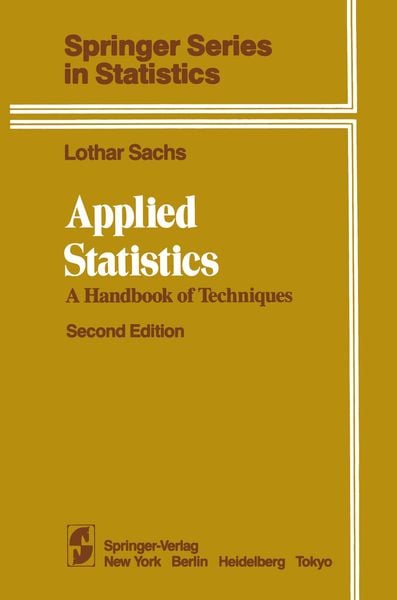
  • Produktbild: Applied Statistics
  • Produktbild: Applied Statistics

Applied Statistics A Handbook of Techniques

51,99 €

inkl. gesetzl. MwSt., Versandkostenfrei


Beschreibung

Produktdetails

Einband

Taschenbuch

Erscheinungsdatum

11.11.2011

Abbildungen

XXVIII, 707 p.

Verlag

Springer Us

Seitenzahl

707

Maße (L/B/H)

23,5/15,5/4 cm

Gewicht

1101 g

Auflage

Second Edition 1984

Übersetzt von

Zenon Reynarowych

Sprache

Englisch

ISBN

978-1-4612-9755-0

Beschreibung

Produktdetails

Einband

Taschenbuch

Erscheinungsdatum

11.11.2011

Abbildungen

XXVIII, 707 p.

Verlag

Springer Us

Seitenzahl

707

Maße (L/B/H)

23,5/15,5/4 cm

Gewicht

1101 g

Auflage

Second Edition 1984

Übersetzt von

Zenon Reynarowych

Sprache

Englisch

ISBN

978-1-4612-9755-0

Herstelleradresse

Libri GmbH
Europaallee 1
36244 Bad Hersfeld
DE

Email: GPSR Kontakt

Noch keine Bewertungen vorhanden

Verfassen Sie die erste Bewertung zu diesem Artikel

Helfen Sie anderen Kundinnen und Kunden durch Ihre Meinung.

Kundinnen und Kunden meinen

Bewertungen (0)

  • Produktbild: Applied Statistics
  • Produktbild: Applied Statistics
  • to Statistics.- 0 Preliminaries.- 0.1 Mathematical Abbreviations.- 0.2 Arithmetical Operations.- 0.3 Computational Aids.- 0.4 Rounding Off.- 0.5 Computations with Inaccurate Numbers.- 1 Statistical Decision Techniques.- 1.1 What Is Statistics? Statistics and the Scientific Method.- 1.2 Elements of Computational Probability.- 1.3 The Path to the Normal Distribution.- 1.4 The Road to the Statistical Test.- 1.5 Three Important Families of Test Distributions.- 2 Statistical Methods in Medicine and Technology.- 2.1 Medical Statistics.- 2.2 Sequential Test Plans.- 2.3 Evaluation of Biologically Active Substances Based on Dosage-Dichotomous Effect Curves.- 2.4 Statistics in Engineering.- 2.5 Operations Research.- 3 The Comparison of Independent Data Samples.- 3.1 The Confidence Interval of the Mean and of the Median.- ?3.2 Comparison of an Empirical Mean with the Mean of a Normally Distributed Population.- ?3.3 Comparison of an Empirical Variance with Its Parameter.- 3.4 Confidence Interval for the Variance and for the Coefficient of Variation.- 3.5 Comparison of Two Empirically Determined Variances of Normally Distributed Populations.- ?3.6 Comparison of Two Empirical Means of Normally Distributed Populations.- 3.7 Quick Tests Which Assume Nearly Normally Distributed Data.- 3.8 The Problem of Outliers and Some Tables Useful in Setting Tolerance Limits.- 3.9 Distribution-Free Procedures for the Comparison of Independent Samples.- 4 Further Test Procedures.- 4.1 Reduction of Sampling Errors by Pairing Observations: Paired Samples.- 4.2 Observations Arranged in Pairs.- 4.3 The ?2 Goodness of Fit Test.- 4.4 The Kolmogoroff-Smirnoff Goodness of Fit Test.- 4.5 The Frequency of Events.- 4.6 The Evaluation of Fourfold Tables.- 4.7 Testing the Randomness of a Sequence ofDichotomous Data or of Measured Data.- 4.8 The S3 Sign Test of Cox and Stuart for Detection of a Monotone Trend.- 5 Measures of Association: Correlation and Regression.- 5.1 Preliminary Remarks and Survey.- 5.2 Hypotheses on Causation Must Come from Outside, Not from Statistics.- 5.3 Distribution-Free Measures of Association.- 5.4 Estimation Procedures.- 5.5 Test Procedures.- 5.6 Nonlinear Regression.- 5.7 Some Linearizing Transformations.- ?5.8 Partial and Multiple Correlations and Regressions.- 6 The Analysis of k x 2 and Other Two Way Tables.- 6.1 Comparison of Several Samples of Dichotomous Data and the Analysis of a k x 2 Two Way Table.- 6.2 The Analysis of r x c Contingency and Homogeneity Tables.- 7 Analysis of Variance Techniques.- ?7.1 Preliminary Discussion and Survey.- 7.2 Testing the Equality of Several Variances.- 7.3 One Way Analysis of Variance.- 7.4 Two Way and Three Way Analysis of Variance.- 7.5 Rapid Tests of Analysis of Variance.- 7.6 Rank Analysis of Variance for Several Correlated Samples.- ?7.7 Principles of Experimental Design.- Bibliography and General References.- Exercises.- Solutions to the Exercises.- Few Names and Some Page Numbers.