
Gutscheinbedingungen

**Gültig nur für Bestellungen an die Wunsch-Poststation bis 10.06.2026 auf Spielzeug, Schreibwaren, Filme, Geschenke & Trends, Musik, tolino eReader & Zubehör, Hörbücher und Hörbuch-Downloads (außer Abo), nicht preisgebundene Bücher und Kalender online auf thalia.at und in der Thalia App. Einzelne Artikel können ausgeschlossen sein. Aufgrund der Buchpreisbindung sind deutschsprachige Bücher und eBooks ausgenommen. Zusätzlich ausgenommen sind preisgebundene Artikel, Abos & Flatrates, eBooks, Games, Geschenkkarten/-boxen, Shelfies, Software, Zeitschriften sowie einzelne Artikel von tonies®. Pro Einkauf einmal einlösbar. Kein Click & Collect möglich. Keine Barauszahlung. Nicht kombinierbar mit anderen Aktionen und Gutscheinen. Gutschein wird auf max. 500€ Bestellwert angerechnet. Nicht gültig für Versandkosten und Services.

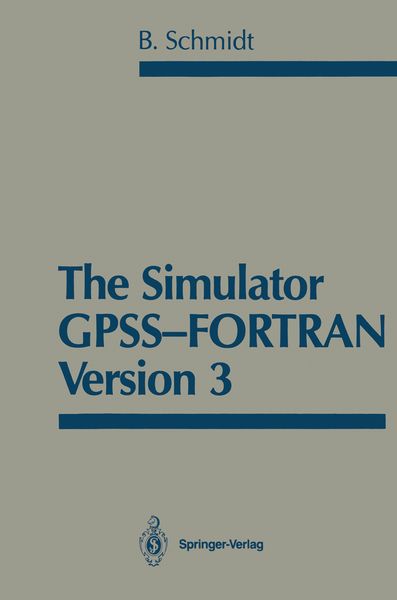
  • Produktbild: The Simulator GPSS-FORTRAN Version 3
  • Produktbild: The Simulator GPSS-FORTRAN Version 3

The Simulator GPSS-FORTRAN Version 3

99,99 €

inkl. gesetzl. MwSt., Versandkostenfrei


Beschreibung

Produktdetails

Einband

Taschenbuch

Erscheinungsdatum

12.10.2011

Verlag

Springer Us

Seitenzahl

336

Maße (L/B/H)

23,5/15,5/2 cm

Gewicht

534 g

Auflage

Softcover reprint of the original 1st ed. 1987

Sprache

Englisch

ISBN

978-1-4612-9141-1

Beschreibung

Produktdetails

Einband

Taschenbuch

Erscheinungsdatum

12.10.2011

Verlag

Springer Us

Seitenzahl

336

Maße (L/B/H)

23,5/15,5/2 cm

Gewicht

534 g

Auflage

Softcover reprint of the original 1st ed. 1987

Sprache

Englisch

ISBN

978-1-4612-9141-1

Herstelleradresse

Springer-Verlag GmbH
Tiergartenstr. 17
69121 Heidelberg
DE

Email: ProductSafety@springernature.com

Kundinnen und Kunden meinen

0 Bewertungen

Informationen zu Bewertungen

Zur Abgabe einer Bewertung ist eine Anmeldung im Konto notwendig. Die Authentizität der Bewertungen wird von uns nicht überprüft. Wir behalten uns vor, Bewertungstexte, die unseren Richtlinien widersprechen, entsprechend zu kürzen oder zu löschen.

Die Bewertungen sind nach Format, Anzahl Sterne und Datum sortiert.

Verfassen Sie die erste Bewertung zu diesem Artikel

Helfen Sie anderen Kund*innen durch Ihre Meinung

Kundinnen und Kunden meinen

0 Bewertungen filtern

  • Produktbild: The Simulator GPSS-FORTRAN Version 3
  • Produktbild: The Simulator GPSS-FORTRAN Version 3
  • 0. Introduction.- 0.1 The Structure of the Simulator GPSS-FORTRAN Version 3.- 0.1.1 The Program Package.- 0.1.2 Modular Structure and Structured Programming.- 0.2 Modelling.- 0.2.1 Queuing Models.- 0.2.2 Event Oriented Simulation.- 0.2.3 Simulation of Continuous Systems.- 0.2.4 Combined Models.- 0.3 Ease of Use.- 0.3.1 The Documentation.- 0.3.2 Model Construction.- 0.3.3 The Input and Output.- 0.3.4 The Operational Modes.- 0.3.5 The Size of the Simulator.- 0.3.6 Possible Environments of the Simulator GPSS-FORTRAN Version 3.- 0.3.7 How to Learn the Use of GPSS-FORTRAN Version 3.- 0.4 Acknowledgements.- 1. The Flow Control.- 1.1 Model Classification.- 1.2 State Transitions.- 1.2.1 Scheduled State Transitions.- 1.2.2 Conditional State Transitions.- 1.3 The Subroutine FLOWC.- 1.3.1 The Schedules of the State Transitions.- 1.3.2 The Subroutines for the State Transitions.- 1.3.3 The Flow Chart of the Subroutine FLOWC.- 1.3.4 The Structure of the Simulator.- 1.4 Simultaneous Activities.- 1.4.1 The Processing Sequence for Simultaneous Activities.- 1.4.2 The Discriminator EPS.- 2. The Simulation of Continuous Systems.- 2.1 Differential Equations in GPSS-FORTRAN Version 3.- 2.1.1 The Formulation of the Differential Equations.- 2.1.2 Sets.- 2.1.3 Numerical Integration.- 2.2 Scheduled State Transitions.- 2.2.1 The Data Areas and the Calling Sequence.- 2.2.2 Treatment of Time.- 2.2.3 The Initial State and Scheduled Events.- 2.2.4 The Monitor.- 2.2.5 An Example of a Model.- 2.2.6 Delays.- 2.3 Conditional State Transitions.- 2.3.1 Crossings and the Flag Variables IFLAG and JFLAG.- 2.3.2 Crossings and Sets.- 2.3.3 The Conditions and Their Checking.- 2.4 The Subroutine EQUAT.- 2.4.1 Performance of an Integration Step.- 2.4.2 Localising the Crossing.- 2.4.3 The Remaining Operations of EQUAT.- 2.4.4 Discontinuity of Delayed Variables.- 2.5 Adding to or Removing from a Chain Using TCHAIN andNCHAIN.- 2.6 Integration Methods.- 2.6.1 The Subroutine INTEG.- 2.6.2 Subroutines Containing the Integration Methods.- 3. Queued Models.- 3.1 Transactions.- 3.1.1 Data Areas for Transactions.- 3.1.2 Transaction States.- 3.1.3 Stations.- 3.1.4 Transaction Control.- 3.1.5 The Subroutines DBLOCK and RBLOCK.- 3.1.6 Queue Management and Policy.- 3.2 Subroutines for Processing Transactions.- 3.2.1 Subroutines for Generating and Eliminating Transactions.- 3.2.2 Deactivation of Transactions for Known Length of Time.- 3.2.3 Subroutines for Gates.- 3.2.4 Transfer of Transactions.- 3.2.5 Combined Models.- 3.3 An Example of a Model.- 3.3.1 Description of Model.- 3.3.2 The Sequence of Activities.- 3.3.3 The Blocked Transactions.- 4. Stations and Queued Models.- 4.1 Facilities.- 4.1.1 SEIZE.- 4.1.2 WORK.- 4.1.3 CLEAR.- 4.1.4 PREEMP.- 4.1.5 Setting Up and Closing Down Times at Preemption.- 4.1.6 Occupation of a Facility in Parallel Processing Paths.- 4.1.7 The Blocking Indicator.- 4.2 Multifacilities.- 4.2.1 The Structure of the Multifacilities.- 4.2.2 Occupation, Processing, and Freeing.- 4.2.3 Preemption in Multifacilities.- 4.2.4 The Plan for Freeing and Occupying Individual Elements.- 4.3 Pools and Storages.- 4.3.1 Pools.- 4.3.2 Structure of the Storages.- 4.3.3 The Occupying and Freeing of Storages.- 4.3.4 Strategies.- 4.4 Coordination in Processing Paths.- 4.4.1 Coordination in a Processing Path.- 4.4.2 Coordination of Parallel Processing Paths.- 4.5 Families.- 4.5.1 The Grouping Together of Transactions.- 4.5.2 Generation and Elimination of Members of a Family.- 4.5.3 The Coordination of Family Members in a Single Path.- 4.5.4 The Coordination of Family Members in Parallel Paths.- 4.6 Match Stations.- 5. Evaluation and Representation of the Results.- 5.1 The Behaviour of the Queues.- 5.1.1 Bins.- 5.1.2 Characteristic Quantities of a Bin.- 5.1.3 Calculation of the Mean Values.- 5.1.4 Mean Values for Intervals.- 5.1.5 The Subprogram ENDBIN.- 5.1.6 The Computation of the Confidence Interval and the End of the Settling Phase.- 5.2 The Computation of Frequency Tables.- 5.3 Output of the State of the Model.- 5.3.1 The Report Subroutines.- 5.3.2 The Trace Indicators IPRINT and JPRINT.- 5.4 Auxiliary Aids.- 5.4.1 Initialisation of the Data Areas.- 5.4.2 Saving and Reinputting the State of the System.- 5.4.3 Ending the Simulation Run.- 5.4.4 The Subroutine FUNCT.- 6. The Generation of Random Numbers.- 6.1 Generators of Random Numbers.- 6.2 Generation of Uniformly Distributed Random Numbers.- 6.3 Generation of Random Numbers with an Arbitrary Distribution.- 6.3.1 Generation of Random Numbers Using Inverse Functions.- 6.3.2 The Erlang Distribution.- 6.3.3 The Gaussian Distribution.- 6.3.4 The Logarithmic Gaussian Distribution.- 6.3.5 Approximation of Empirically Determined Distribution.- 6.3.6 The Truncation of the Frequency Function.- 6.4 Random Numbers in GPSS-FORTRAN Version 3.- 6.4.1 The Function RN.- 6.4.2 UNIFRM.- 6.4.3 ERLANG.- 6.4.4 GAUSS.- 6.4.5 LOGNOR.- 6.4.6 BOXEXP.- 6.4.7 Notes.- 7. Input and Output.- 7.1 Free Format Input.- 7.1.1 The Input Data Records.- 7.1.2 The Subroutine INPUT.- 7.1.3 The Input of Variables using a VARI Data Record.- 7.2 Output of Plots.- 7.2.1 The Recording of the Plot Data.- 7.2.2 The Plot Arrays.- 7.2.3 The Subroutine PLOT.- 7.3 Output of Bar Charts Using GRAPH.- 7.4 Operational Modes.- 7.4.1 Real Time Operation.- 7.4.2 Interactive Mode.- 7.4.3 Interactive Commands.- 7.5 Graphic Representation.- 7.5.1 Commands in Interactive Mode with Graphics.- 7.5.2 Menu for the Z Command.- 7.5.3 The Second Level of the Menu Hierarchy.- 7.5.4 The Third Level of the Menu Hierarchy.- References.