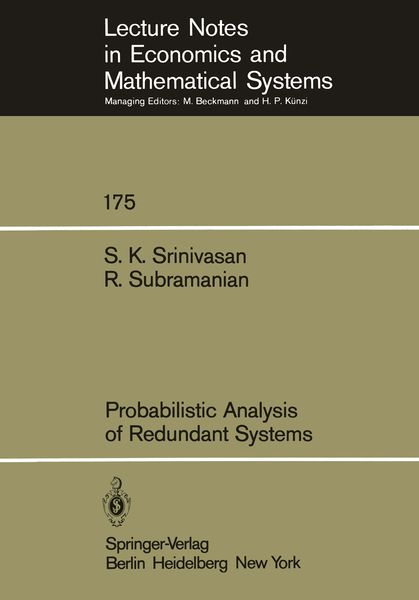

• Produktbild: Probabilistic Analysis of Redundant Systems
  • Produktbild: Probabilistic Analysis of Redundant Systems
Band 175 - 12%

Probabilistic Analysis of Redundant Systems

12% sparen

95,99 € UVP 109,99 €

inkl. gesetzl. MwSt., Versandkostenfrei


Beschreibung

Produktdetails

Einband

Taschenbuch

Erscheinungsdatum

01.01.1980

Verlag

Springer Berlin

Seitenzahl

360

Maße (L/B/H)

24,4/17/2,1 cm

Gewicht

640 g

Auflage

1. Auflage

Sprache

Englisch

ISBN

978-3-540-09736-5

Beschreibung

Produktdetails

Einband

Taschenbuch

Erscheinungsdatum

01.01.1980

Verlag

Springer Berlin

Seitenzahl

360

Maße (L/B/H)

24,4/17/2,1 cm

Gewicht

640 g

Auflage

1. Auflage

Sprache

Englisch

ISBN

978-3-540-09736-5

Herstelleradresse

Springer-Verlag GmbH
Heidelberger Platz 3
14197 Berlin
Deutschland
Email: sdc-bookservice@springer.com
Url: www.springer.com
Telephone: +49 30 827870
Fax: +49 30 8214091

Noch keine Bewertungen vorhanden

Verfassen Sie die erste Bewertung zu diesem Artikel

Helfen Sie anderen Kundinnen und Kunden durch Ihre Meinung.

Kundinnen und Kunden meinen

Bewertungen (0)

  • Produktbild: Probabilistic Analysis of Redundant Systems
  • Produktbild: Probabilistic Analysis of Redundant Systems
  • 1 Redundant Systems.- 1.1 Introduction.- 1.2 Repairable Systems.- 1.3 2-Unit Standby Redundant Systems.- 1.4 Parallel Redundant System.- 1.5 Multiple Unit Systems.- 1.6 Gnedenko Systems.- 1.7 Systems with Imperfect Switchover.- 1.8 Priority Redundant Systems.- 1.9 Intermittently Used Systems.- 1.10 Optimization Problems in Reliability.- 1.11 Scope of the Present Work.- 2 Renewal Theory and Point Processes.- 2.1 Introduction.- 2.2 Renewal Process.- 2.3 Stationary Point Processes.- 2.4 Special Point Processes.- 2.4a Stationary Renewal Processes.- 2.4b Alternating Renewal Processes.- 2.4c Markov Renewal Processes.- 2.5 Regenerative Processes.- 2.6 Multivariate Point Processes.- 3 Cold Standby Systems.- 3.1 Introduction.- 3.2 Reliability Analysis.- 3.3 Availability Analysis.- 3.4 Multivariate Point Process of the Events Ei.- 3.5 Steady State Characteristics.- 3.6 Visits to Different States and Sojourn times.- 3.7 Special Cases.- 3.7a Lifetime Exponentially Distributed.- 3.7b Repair Time Exponentially Distributed.- 3.8 Cold Standby System of Dissimilar Units.- 4 Warm Standby System.- 4.1 Introduction.- 4.2 Reliability and Availability Analysis.- 4.3 Characterization of events.- 4.4 Steady State Characteristics.- 4.5 Dissimilar Units 92.- 4.6 Special Cases.- 4.7 Numerical Results.- 5 Warm Standby Systems with an Imperfect Switchover.- 5.1 Introduction.- 5.2 Problem Description and Notation.- 5.3 Reliability Analysis.- 5.4 Availability Analysis.- 5.5 A System of Dissimilar Units.- 5.5a Reliability Analysis.- 5.5b Availability Analysis.- 5.6 System with Identical Units.- 5.6a Reliability Analysis.- 5.6b Availability Analysis.- 5.7 Numerical Results.- 6 Warm Standby Systems with an Imperfect Switchover and a Single Repair Ficitity.- 6.1 Introduction.- 6.2 General Analysis.- 6.3 Reliability Analysis.- 6.4 Availability Analysis.- 6.5 The Effect of Preemptive Priorities in Service on Reliability Measures.- 6.6 System with Dissimilar Units.- 6.7 Numerical Results.- 7 Intermittently Used Cold Standby Systems.- 7.1 Introduction.- 7.2 Formulation of the Problem.- 7.3 One Unit System with a Repair Facility.- 7.4 Two Unit System with Single Repair Facility.- 7.5 Numerical Results 201.- 7.5a One Unit System.- 7.5b Two Unit System.- 8 Intermittently Used Two Unit Systems: Warm Standby Redundancy.- 8.1 Introduction.- 8.2 Formulation of the Problem.- 8.2a P.d.f. of the Time to the First D-event.- 8.2b Mean Number of D-events.- 8.2c Mean Square Number of D-events.- 8.2d Duration of Disappointment.- 8.3 A System of Dissimilar Units: Standby under Perpetual Vigil.- 8.3a P.d.f. of the Time to the First D-event.- 8.3b Mean Number of D-events.- 8.3c Mean Square Number of D-events.- 8.3d Expected Duration of Disappointments.- 8.3e Special Cases.- 8.4 Warm Standby Redundancy in which Failures are Detected only During Need Periods.- 8.4a Behaviour of the Sub-system in Standby.- 8.4b Stochastic Process of a-events.- 8.4c Stochastic Process of D-events.- 8.4d Duration of Disappointment.- 8.4e Special Cases.- 9 Priority Standby Redundant Systems.- 9.1 Priority Systems.- 9.2 The Model.- 9.3 Analysis of the Model.- 9.4 Preemptive Repair.- 9.4a Reliability Analysis.- 9.4b Availability Analysis.- 9.5 Nonpreemptive Repair.- 9.5a Reliability Analysis.- 9.5b Availability Analysis.- 9.6 Cold Standby System.- 9.6a Preemptive Repair.- 9.6b Nonpreemptive Repair.- 9.7 Optimization Model.- 9.8 Numerical Results.- 10 Multicomponent Systems.- 10.1 Introduction.- 10.2 Model 1: Single Repair Facility.- 10.2a System Description 290.- 10.2b The Birth and Death Process Associated with the Spares.- 10.2c Time to System Failure (TSF).- 10.2d Availability Analysis.- 10.3 Model 2: r-repair Facilities.- 10.3a System Description 297.- 10.3b The Birth and Death Process Associated with the Spares.- 10.3c Time to System Failure.- 10.3d Availability Analysis.- 10.4 Explicit Solution for the case m=2 and r=l.- 10.5 Explicit Solution for the Case m=5 and r=3.- 10.6 Numerical Results.- 10.7 Optimization Problems.- 10.8 n-unit System with Arbitrary Repair Rate.- 10.8a Reliability Analysis.- 10.8b Availability Analysis.- 10.8c The 3-unit System.- 10.9 Grnedenko Systems.- 10.9a Reliability Analysis.- 10.9b Availability Analysis.- 10.9c A More General Model.- References.- Author Index.