Gutscheinbedingungen

**Gültig bis 15.06.2026 auf Spiele & Spielzeug online auf thalia.at, in der Thalia App ab einem Mindestbestellwert von 30€ und in allen Thalia Buchhandlungen in Österreich. In den Buchhandlungen nur gültig auf lagernde Ware. Einzelne Artikel können ausgeschlossen sein. Ausgenommen sind preisgebundene Artikel sowie online auf thalia.at und in der Thalia App einzelne Artikel von tonies®. Pro Einkauf einmal einlösbar. Nur gültig gegen Vorlage oder im Onlineshop hinterlegter Bonuscard. Infos zur Einlösung in der Buchhandlung sind auf der Bonuscard-Vorteilspreisseite zu finden. Click & Collect nur bei Onlinevorabzahlung möglich. Keine Einlösung bei Scan & Go-Bezahlung. Keine Barauszahlung. Nicht kombinierbar mit anderen Aktionen und Gutscheinen. Gutschein wird auf max. 500€ Bestellwert angerechnet. Nicht gültig für Geschenkkarten, Versandkosten und Services.

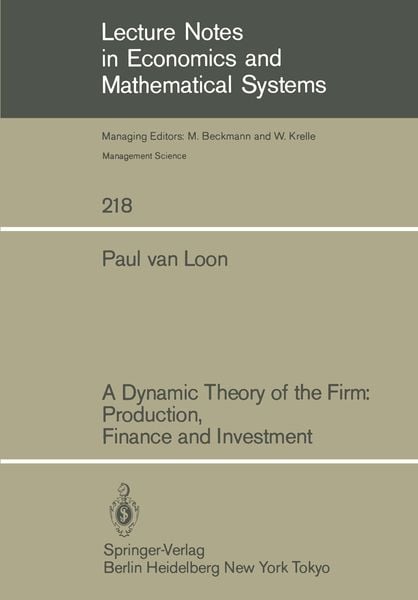
  • Produktbild: A Dynamic Theory of the Firm: Production, Finance and Investment
  • Produktbild: A Dynamic Theory of the Firm: Production, Finance and Investment
Band 218

A Dynamic Theory of the Firm: Production, Finance and Investment

51,99 €

inkl. gesetzl. MwSt., Versandkostenfrei


Beschreibung

Produktdetails

Einband

Taschenbuch

Erscheinungsdatum

01.08.1983

Verlag

Springer Berlin

Seitenzahl

194

Maße (L/B/H)

24,4/17/1,2 cm

Gewicht

362 g

Auflage

Softcover reprint of the original 1st ed. 1983

Sprache

Englisch

ISBN

978-3-540-12678-2

Beschreibung

Produktdetails

Einband

Taschenbuch

Erscheinungsdatum

01.08.1983

Verlag

Springer Berlin

Seitenzahl

194

Maße (L/B/H)

24,4/17/1,2 cm

Gewicht

362 g

Auflage

Softcover reprint of the original 1st ed. 1983

Sprache

Englisch

ISBN

978-3-540-12678-2

Herstelleradresse

Springer-Verlag KG
Sachsenplatz 4-6
1201 Wien
AT

Email: ProductSafety@springernature.com

Kundinnen und Kunden meinen

0 Bewertungen

Informationen zu Bewertungen

Zur Abgabe einer Bewertung ist eine Anmeldung im Konto notwendig. Die Authentizität der Bewertungen wird von uns nicht überprüft. Wir behalten uns vor, Bewertungstexte, die unseren Richtlinien widersprechen, entsprechend zu kürzen oder zu löschen.

Die Bewertungen sind nach Format, Anzahl Sterne und Datum sortiert.

Verfassen Sie die erste Bewertung zu diesem Artikel

Helfen Sie anderen Kund*innen durch Ihre Meinung

Kundinnen und Kunden meinen

0 Bewertungen filtern

  • Produktbild: A Dynamic Theory of the Firm: Production, Finance and Investment
  • Produktbild: A Dynamic Theory of the Firm: Production, Finance and Investment
  • 1. Introduction.- 1. Scope of the book.- 2. Outline of the book.- 3. Relevance of dynamic theories of the firm.- 4. Origins of dynamic theories of the firm.- 5. Nature of the theory of the firm and of this book.- 6. Summary.- 2. A Survey of Dynamic Theories of the Firm.- 1. Introduction.- 2. Shareholders.- 3. Management.- 4. Employees.- 5. Labour Market.- 6. Output Market.- 7. Competitors.- 8. Lenders of debt money.- 9. Suppliers of assets.- 10. Government.- 11. Macro economic data.- 12. Summary.- 3. Some Predecessors.- 1. Introduction.- 2. Investments and depreciation (Jorgenson).- 3. Production and finance I (Leland).- 4. Finance and the value of the firm (Ludwig).- 5. Production and finance II (Lesourne & Leban).- 6. Summary.- 4. A Dynamic Model of the Firm.- 1. Introduction.- 2. Production.- 3. Sales and operating income.- 4. Financing and government.- 5. Policy of the firm.- 6. The model.- 7. Further assumptions.- 8. Optimal solution.- 9. Summary.- 5. Optimal Trajectories of the Firm.- 1. Introduction.- 2. Basic trajectory.- 3. Depth investments.- 4. Consolidation.- 5. Depth investments and consolidation.- 6. Summary.- 6. A Further Analysis.- 1. Introduction.- 2. Optimal decision rules.- 2.1 Production.- 2.2 Financial structure.- 2.3 Investment and dividend.- 3. Environmental influence on the trajectory of the firm.- 3.1 Reallocation.- 3.2 Final output.- 3.3 Consolidation.- 3.4 Expansion.- 3.5 Substitution.- 3.6 Financial substitution.- 4. Influence of (sets of) environmental parameters.- 4.1 Corporation profit tax rate.- 4.2 Investment grant rate.- 4.3 Abolishing investment grants.- 4.4 Financial parameters.- 4.5 Wage rate.- 5. Summary.- 7. Conclusions.- Appendix 1. An Interpretation of the Maximum Principle.- 1. Introduction.- 2. Technical terms.- 3. The Maximum Principle of Pontryagin.- 4. Mixed control constraints.- 5. State constraints.- 6. Summary.- Appendix 2. Solutions of the Models of Chapter 3.- 1. Introduction.- 2. A general solution procedure.- 3. The model of Jorgenson.- 4. The model of Ludwig.- 5. The model of Lesourne & Leban.- 6. Summary.- Appendix 3. Solution of the Model of Chapter 4.- 1. A reduced form of the model.- 2. Optimality conditions.- 3. A reduced form of the optimality conditions.- 4. Infeasible paths.- 5. Feasible paths.- 6. Final paths.- 7. Coupling conditions.- 8. Coupling procedure.- 9. Summary.- List of Symbols.- References.- Author Index.