KI-Beratung Beta

Gutscheinbedingungen

**Gültig am 20.11.2026 ab einem Mindestbestellwert von 30€ auf Spielzeug, Schreibwaren, Filme, Geschenke & Trends, Musik, tolino eReader & Zubehör, Hörbücher und Hörbuch-Downloads, nicht preisgebundene Bücher und Kalender online auf thalia.at und in der Thalia App. Einzelne Artikel können ausgeschlossen sein. Aufgrund der Buchpreisbindung sind deutschsprachige Bücher und eBooks ausgenommen. Zusätzlich ausgenommen sind Abos & Flatrates, Games, Geschenkkarten/-boxen, Shelfies, Software, Zeitschriften sowie einzelne Artikel von tonies®. Pro Einkauf einmal einlösbar. Click & Collect nur bei Onlinevorabzahlung möglich. Keine Barauszahlung. Nicht kombinierbar mit anderen Aktionen und Gutscheinen. Gutschein wird auf max. 500€ Bestellwert angerechnet. Nicht gültig für Versandkosten und Services. Preisgebundene Artikel sind vom Mindestbestellwert ausgeschlossen.

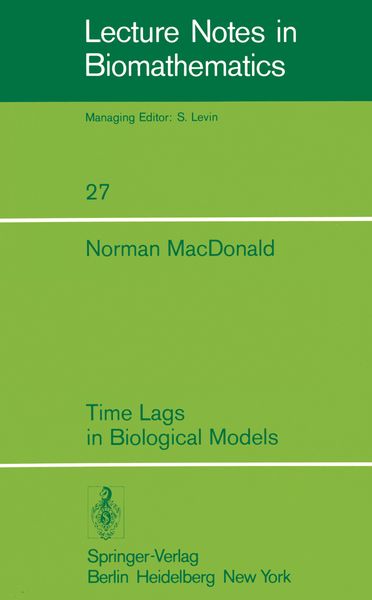
  • Produktbild: Time Lags in Biological Models
  • Produktbild: Time Lags in Biological Models
Band 27

Time Lags in Biological Models

51,99 €

inkl. gesetzl. MwSt., Versandkostenfrei


Beschreibung

In many biological models it is necessary to allow the rates of change of the variables to depend on the past history, rather than only the current values, of the variables. The models may require discrete lags, with the use of delay-differential equations, or distributed lags, with the use of integro-differential...

Beschreibung

In many biological models it is necessary to allow the rates of change of the variables to depend on the past history, rather than only the current values, of the variables. The models may require discrete lags, with the use of delay-differential equations, or distributed lags, with the use of integro-differential equations. In these lecture notes I discuss the reasons for including lags, especially distributed lags, in biological models. These reasons may be inherent in the system studied, or may be the result of simplifying assumptions made in the model used. I examine some of the techniques available for studying the solution of the equations. A large proportion of the material presented relates to a special method that can be applied to a particular class of distributed lags. This method uses an extended set of ordinary differential equations. I examine the local stability of equilibrium points, and the existence and frequency of periodic solutions. I discuss the qualitative effects of lags, and how these differ according to the choice of discrete or distributed lag. The models studied are drawn from the population dynamiCS of single species (logistic growth, the chemostat) and of interacting pairs of species (predation, mutualism), from cell population dynamiCS (haemopoiesis) and from biochemical kinetics (the Goodwin oscillator). The last chapter is devoted to a population model employing difference equations. All these models include non-linear terms.

Produktdetails

Einband

Taschenbuch

Erscheinungsdatum

05.11.1978

Abbildungen

VIII, 114 p.

Verlag Springer Berlin

Produktdetails

Einband

Taschenbuch

Erscheinungsdatum

05.11.1978

Abbildungen

VIII, 114 p.

Verlag Springer Berlin
Seitenzahl

114

Maße (L/B/H)

24,4/17/0,8 cm

Gewicht

236 g

Sprache

Englisch

ISBN

978-3-540-09092-2

Herstelleradresse

Springer-Verlag KG
Sachsenplatz 4-6
1201 Wien
AT

Email: ProductSafety@springernature.com

Noch keine Bewertungen vorhanden

Verfassen Sie die erste Bewertung zu diesem Artikel

Helfen Sie anderen Kundinnen und Kunden durch Ihre Meinung.

Kundinnen und Kunden meinen

Bewertungen (0)

  • Produktbild: Time Lags in Biological Models
  • Produktbild: Time Lags in Biological Models
  • 1. Introduction.- a. Discrete and Distributed Lag.- b. Origin of Lags in Biological Models.- c. Lag as an Alternative to Age Structure.- d. Lag as an Alternative to Spatial Structure.- e. The Effects of Lag.- f. Lags and Stochastic Models.- 2. Stability Analysis.- a. The Linear Chain Trick.- b. Instantaneous Models.- c. Models with a Single Discrete Lag.- d. Models with a Single Distributed Lag.- e. An Inequality for Distributed Lag.- f. The Monod Chemostat Model.- g. May’s Model of Obligate Mutualism.- 3. Periodic Solutions.- a. Periodic Solutions of the Linear Chain Equations.- b. The Method of Hastings, Tyson and Webster.- c. Hopf Bifurcation.- d. Numerical Integration.- 4. Logistic Growth of a Single Species.- a. Discrete Lag.- b. Distributed Lag in a Model of a Self-poisoning Population.- c. Linear Chain Calculations.- d. Hopf and H.T.W. Methods.- e. Constant Harvesting of a Population in the Presence of Lag.- f. Poincaré-Lindstedt Method for Discrete Lag.- g. An Epidemic Model Related to the Logistic Equation.- 5. Biochemical Oscillator Model.- a. The Goodwin Model.- b. Necessary Condition for Instability.- c. Expanding the Set of Equations.- d. A Single Goodwin Equation with Lag.- e. Discrete Lag in the Goodwin Equation.- 6. Models of Haemopoiesis.- a. Wheldon’s Model of Chronic Granulocytic Leukemia.- b. Two-lag Models of Cyclical Neutropenia.- c. Time Lag with Attrition; a Model of Cyclical Pancytopenia.- 7. Predation Models of the Volterra Type.- 8. Difference Equation Models.- a. Stability Analysis.- b. Conditions under which Spreading the Lag does not affect Local Stability.- c. Chaos in Discrete Dynamical Systems.- d. Extended Diapause in a Single Species Population Model.- e. Analogous Treatment of a Functional Differential Equation.- SupplementaryBibliography.- References.