Gutscheinbedingungen

**Gültig von 22.06.2026 ab 19 Uhr bis 23.06.2026 24 Uhr auf Spielzeug, Schreibwaren, Filme, Geschenke & Trends, Musik, tolino eReader & Zubehör, Hörbücher und Hörbuch-Downloads (außer Abo), nicht preisgebundene Bücher und Kalender online auf thalia.at und in der Thalia App. Einzelne Artikel können ausgeschlossen sein. Aufgrund der Buchpreisbindung sind deutschsprachige Bücher und eBooks ausgenommen. Zusätzlich ausgenommen sind preisgebundene Artikel, Abos & Flatrates, eBooks, Games, Geschenkkarten/-boxen, Shelfies, Software, Zeitschriften sowie einzelne Artikel von tonies®. Pro Einkauf einmal einlösbar. Click & Collect nur bei Onlinevorabzahlung möglich. Keine Barauszahlung. Nicht kombinierbar mit anderen Aktionen und Gutscheinen. Gutschein wird auf max. 500€ Bestellwert angerechnet. Nicht gültig für Versandkosten und Services.

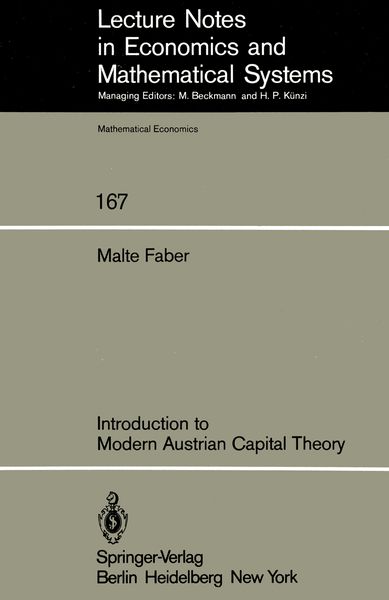
Produktbild: Introduction to Modern Austrian Capital Theory
Band 167

Introduction to Modern Austrian Capital Theory

51,99 €

inkl. gesetzl. MwSt., Versandkostenfrei


Beschreibung

Produktdetails

Einband

Taschenbuch

Erscheinungsdatum

05.03.1979

Verlag

Springer Berlin

Seitenzahl

201

Maße (L/B/H)

24,4/17/1,2 cm

Gewicht

375 g

Auflage

Softcover reprint of the original 1st ed. 1979

Sprache

Englisch

ISBN

978-3-540-09121-9

Beschreibung

Produktdetails

Einband

Taschenbuch

Erscheinungsdatum

05.03.1979

Verlag

Springer Berlin

Seitenzahl

201

Maße (L/B/H)

24,4/17/1,2 cm

Gewicht

375 g

Auflage

Softcover reprint of the original 1st ed. 1979

Sprache

Englisch

ISBN

978-3-540-09121-9

Herstelleradresse

Springer-Verlag KG
Sachsenplatz 4-6
1201 Wien
AT

Email: ProductSafety@springernature.com

Kundinnen und Kunden meinen

0 Bewertungen

Informationen zu Bewertungen

Zur Abgabe einer Bewertung ist eine Anmeldung im Konto notwendig. Die Authentizität der Bewertungen wird von uns nicht überprüft. Wir behalten uns vor, Bewertungstexte, die unseren Richtlinien widersprechen, entsprechend zu kürzen oder zu löschen.

Die Bewertungen sind nach Format, Anzahl Sterne und Datum sortiert.

Verfassen Sie die erste Bewertung zu diesem Artikel

Helfen Sie anderen Kund*innen durch Ihre Meinung

Kundinnen und Kunden meinen

0 Bewertungen filtern

  • Produktbild: Introduction to Modern Austrian Capital Theory
  • I: Austrian Capital Theory and the von Neumann-Model.- 1. Introduction.- 1.1 Problems.- 2. The Austrian Theory of Interest.- 2.1 von Böhm-Bawerk.- 2.2 von Stackelberg.- 2.3 An Assessment of Austrian Interest Theory.- 2.4 Problems.- 3. The von Neumann-Model and its Relations to Austrian Capital and Interest Theory.- 3.1 Introduction.- 3.2 The Meaning, Import and Historical Point of Departure of the Ideas of the von Neumann-Model.- 3.3 The von Neumann-Model.- 3.4 Criticism and Generalization of the von Neumann-Model.- 3.5 Solutions to Problems of Austrian Capital Theory.- 3.6 The Interest Rate in the Stationary State.- 3.7 Problems.- II: Modern Austrian Capital Theory.- 4. A Two-Period Two-Sector Neo-Austrian Model.- 4.1 Outline of the Procedure.- 4.2 The Technology.- 4.3 The Transformation Curve.- 4.4 Condition for Roundaboutness.- 4.5 Condition for Superiority.- 4.6 Prices in a Planned Economy.- 4.7 The Rate of Interest in a Planned Economy.- 4.8 Decentralizing the Decisions.- 4.9 Problems.- 5. A Multiperiod Two-Sector Model.- 5.1 Extension of the Model.- 5.2 A Model with n-Period Horizon.- 5.3 A Model with Two Techniques Using a Capital Good.- 5.3.1 The Model.- 5.3.2 The Sign of the Rate of Interest.- 5.4 Problems.- 6. A Multisector Model.- 6.1 The Problem and the Main Results.- 6.2 The Model.- 6.3 Superiority, Roundaboutness and Positive Rate of Interest.- 6.4 A Finite Economic Horizon with More than two Periods.- 6.5 Problems.- 7. The Schumpeter-von Böhm-Bawerk Controversy on the Rate of Interest in the Stationary State.- 7.1 Introduction.- 7.2 The Origins of the Controversy.- 7.3 The Rate of Interest in a Stationary State.- 7.4 Schumpeter’s Dynamic Theory of Interest.- 7.5 Problems.- III: Relationship to other Approaches to Capital Theory.- 8. A Comparison with Results of Neoclassical Capital and Growth Theory.- 8.1 Introduction.- 8.2 A Simple Growth Model.- 8.3 A Neoclassical Version for Steady States.- 8.3.1 Factor-Price Frontier for T*3 and T*4.- 8.3.2 Factor-Price Frontier for T1 and T2.- 8.3.3 Consumption-Growth Frontier.- 8.3.4 The Relationship between the Interest Rate and the Growth Rate.- 8.4 Charcteristics of Optimal Steady State Programs.- 8.5 Problems.- 9. Hicks’ Neo-Austrian Theory of Capital.- 9.1 Introduction.- 9.2 Hicks’ Model.- 9.3 The Index of Improvement in Efficiency.- 9.4 Hicks’ New Classification of Technological Change.- 9.5 Superiority and the Index of Efficiency.- 9.6 Concluding Remarks.- 9.7 Problems.- References.- Author Index.