
• Produktbild: Hearing Mechanisms and Speech
  • Produktbild: Hearing Mechanisms and Speech
Band 2

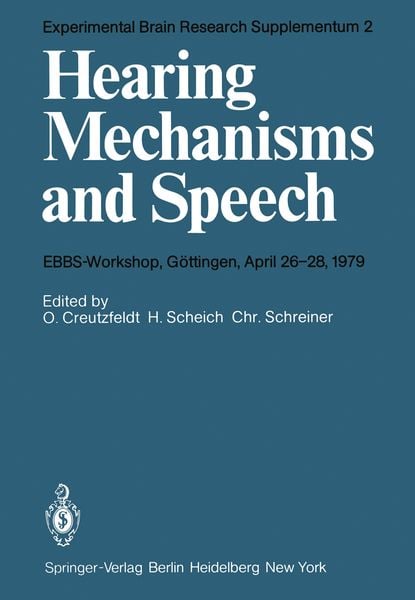
Hearing Mechanisms and Speech EBBS-Workshop, Göttingen, April 26–28, 1979

99,99 €

inkl. gesetzl. MwSt., Versandkostenfrei


Beschreibung

Produktdetails

Einband

Taschenbuch

Erscheinungsdatum

01.10.1979

Herausgeber

O. Creutzfeldt + weitere

Verlag

Springer Berlin

Seitenzahl

414

Maße (L/B/H)

24,4/17/2,4 cm

Gewicht

753 g

Auflage

Softcover reprint of the original 1st ed. 1979

Sprache

Englisch

ISBN

978-3-540-09655-9

Beschreibung

Produktdetails

Einband

Taschenbuch

Erscheinungsdatum

01.10.1979

Herausgeber

Verlag

Springer Berlin

Seitenzahl

414

Maße (L/B/H)

24,4/17/2,4 cm

Gewicht

753 g

Auflage

Softcover reprint of the original 1st ed. 1979

Sprache

Englisch

ISBN

978-3-540-09655-9

Herstelleradresse

Springer-Verlag GmbH
Tiergartenstr. 17
69121 Heidelberg
DE

Email: ProductSafety@springernature.com

Kundinnen und Kunden meinen

0 Bewertungen

Informationen zu Bewertungen

Zur Abgabe einer Bewertung ist eine Anmeldung im Konto notwendig. Die Authentizität der Bewertungen wird von uns nicht überprüft. Wir behalten uns vor, Bewertungstexte, die unseren Richtlinien widersprechen, entsprechend zu kürzen oder zu löschen.

Die Bewertungen sind nach Format, Anzahl Sterne und Datum sortiert.

Verfassen Sie die erste Bewertung zu diesem Artikel

Helfen Sie anderen Kund*innen durch Ihre Meinung

Kundinnen und Kunden meinen

0 Bewertungen filtern

  • Produktbild: Hearing Mechanisms and Speech
  • Produktbild: Hearing Mechanisms and Speech
  • I) Functional and structural conditions for transmission of auditory signals in the nervous system..- Basic mechanisms of auditory processing in the cochlea.- On the peripheral coding of the level of individual frequency components of complex sounds at high sound levels.- Universal mechanical response curves for the cochlea.- The human cochlea nuclei.- Coding of complex sounds in the auditory nervous system.- Embryological evolution and typology of cells of the inferior colliculus.- Functional and topographic organization of the auditory cortex.- II) The representation of complex natural sounds in the auditory system..- Neural image of sound in the grassfrog.- Spectro-temporal analysis of auditory neurons in the grassfrog.- Tonotopy and analysis of wide-band calls in field L of the guinea fowl.- Selective responses of neurons to vowel sounds in the auditory neostriatum of the mynah bird.- The increase of response selectivity within the avian auditory pathway.- Encoding of complex sounds by thalamic and cortical neurons.- Time segmentation in central analysis of complex signals.- Temporal suppression and speech processing.- Feature detection by single units in squirrel monkey auditory cortex.- Processing of self-produced vocalizations by single neurons in the auditory cortex of the squirrel monkey (Saimiri Sciureus).- Encoding processes of speech sounds in the auditory system.- Verb and noun meaning of homophone word activate different cortical generators: a topographical study of evoked potential fields.- III) Brain mechanisms of speech perception and production..- Anatomical and functional cerebral organization of phonation in animals.- Basal ganglia participation in aphasia.- Participation of mesial cortex in speech: evidence from cerebral potentials preceding speech production in man.- Electrical stimulation mapping of language cortex.- Human language cortex: identification of common sites for sequencing motor activity and speech discrimination.- Studies on language comprehension in hemispherectomy, split brain and asphasic patients. A possible contribution to the knowledge of the physiological mechanisms of speech comprehension.- Timing in speech production: aspects of (German) hesitation vowels.- Inborn vocalizations of the human baby and communicative value for the mother.- IV) Psychoacoustic elements in language..- What acoustic stimulation can teach us about physiological mechanisms underlying speech perception.- An outline of pitch analysis in speech: a hearing theory approach.- Pitch determination of speech signals — a survey.- Virtual pitch and our own voice.- On the perception of spectral information in speech.- Perceptual difference limens in pair-comparison of complex (speech-related) signals.- V) Linguistic elements in speech perception..- Aspects of categorical processing of speech sounds in man: on the determinants of phonetic category boundaries.- Selective adaptation of acoustic and phonetic feature sensitive detectors.- Speech sounds in realtion to speech processing.- Perceptual grouping of speech components.- Aspects of the temporal relationship between speech- and word-recognition processes.- The acquisiton of grammar.- VI) Receptive defects of linguistic elements in aphasia..- Auditory agnosia after lesions of the superior temporal gyrus in monkey and man.- Selective impairment of perception of articulatory place in a case of cortical auditory disorder.- Phonemic auditory discrimination and articulatory defects in aphasia.- Comprehension of natural sounds in aphasia.- Lexical and syntactic factors in language comprehension of aphasic patients.- Interaural integration in the perception of complete and truncated words by brain damaged and control subjects.- Auditory analogue of deep dyslexia.- The influence of prosodic features in language comprehension in aphasic patients.