• Produktbild: Data Analysis and Information Systems
  • Produktbild: Data Analysis and Information Systems

Data Analysis and Information Systems Statistical and Conceptual Approaches Proceedings of the 19th Annual Conference of the Gesellschaft für Klassifikation e.V. University of Basel, March 8–10, 1995

99,99 €

inkl. gesetzl. MwSt., Versandkostenfrei


Beschreibung

Produktdetails

Einband

Taschenbuch

Erscheinungsdatum

18.03.1996

Herausgeber

Hans-Hermann Bock + weitere

Verlag

Springer Berlin

Seitenzahl

548

Maße (L/B/H)

24,2/17/3,1 cm

Gewicht

952 g

Auflage

Softcover reprint of the original 1st ed. 1996

Sprache

Englisch

ISBN

978-3-540-60774-8

Beschreibung

Produktdetails

Einband

Taschenbuch

Erscheinungsdatum

18.03.1996

Herausgeber

Verlag

Springer Berlin

Seitenzahl

548

Maße (L/B/H)

24,2/17/3,1 cm

Gewicht

952 g

Auflage

Softcover reprint of the original 1st ed. 1996

Sprache

Englisch

ISBN

978-3-540-60774-8

Herstelleradresse

Springer-Verlag KG
Sachsenplatz 4-6
1201 Wien
AT

Email: ProductSafety@springernature.com

Kundinnen und Kunden meinen

0 Bewertungen

Informationen zu Bewertungen

Zur Abgabe einer Bewertung ist eine Anmeldung im Konto notwendig. Die Authentizität der Bewertungen wird von uns nicht überprüft. Wir behalten uns vor, Bewertungstexte, die unseren Richtlinien widersprechen, entsprechend zu kürzen oder zu löschen.

Die Bewertungen sind nach Format, Anzahl Sterne und Datum sortiert.

Verfassen Sie die erste Bewertung zu diesem Artikel

Helfen Sie anderen Kund*innen durch Ihre Meinung

Kundinnen und Kunden meinen

0 Bewertungen filtern

  • Produktbild: Data Analysis and Information Systems
  • Produktbild: Data Analysis and Information Systems
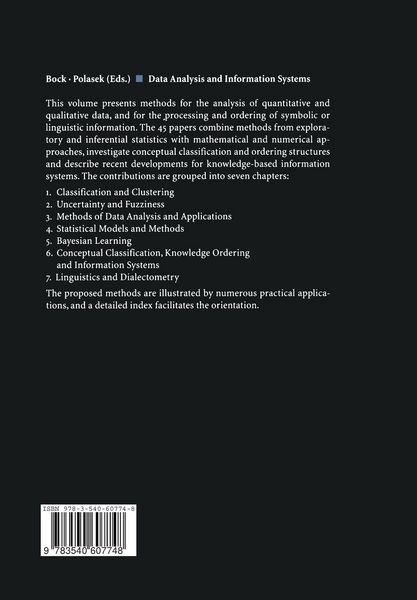
  • Section 1: Classification and Clustering.- MDL for Mixtures of Normal Distributions.- A New Algorithm for Two-Mode Clustering.- Computational Methods in Clustering from a Mathematical Programming Viewpoint.- Classification of Time Series with Optimized Time-Frequency Representations.- Cluster Analysis Using Spatial Autocorrelation.- Bounds for p-values of Combinatorial Tests for Clustering in Epidemiology.- Probability Distributions on Indexed Dendrograms and Related Problems of Classifiability.- On the Validation of Classification Trees.- Section 2: Uncertainty and Fuzziness.- Modeling Weak Information with Generalized Basic Probability Assignments.- Validity Measures for Fuzzy Partitions.- Uncertainty and Actor-Oriented Information Retrieval in µ-AKCESS. An Approach Based on Fuzzy Set Theory.- The “Combination Problem” for Probability Intervals: Necessary Assumptions.- A Classification System for Uncertainty Theories: How to Select an Appropriate Formalism?.- Section 3: Methods of Data Analysis and Applications.- Analyzing Paired Comparisons Data Using Probabilistic Ideal Point Models and Probabilistic Vector Models.- Consensus Rules for Molecular Sequences: Open Problems.- Latent Dimensions of Managers’ Risk Perception: An Application of Correspondence Analysis.- Analysis of the Behaviour of New Car Buyers.- Statistical Analysis of Spatial Data in Geographic Information Systems.- Analysis of Spatio-Temporal Data Using Interactive Statistical Graphics.- Representation of Finite Ordinal Data in Real Vector Spaces.- Section 4: Statistical Models and Methods.- Statistical Models and Artificial Neural Networks.- Smoothing for Categorical Data: Discrete Kernel Regression and Local Likelihood Approaches.- Computer-based Design of Experiments in Industry.- Testing Simple Hypotheses.- Section 5: Bayesian Learning.- Bayesian Hierarchical Models for Random Routes in Finite Populations.- Metropolis Sampling in Bilinear Time Series Models.- Exact Likelihood Function Forms for an ARFIMA Process.- Learning about Degradation Models and Prognostic Factors.- Bayesian Classification Using Predictive Diagnostic Measures.- Section 6: Conceptual Classification, Knowledge Ordering and Information Systems.- On the Relationship between Description Logics and Conceptual Graphs with some References to the Medical Domain.- The Design of an Interpreter for Dialog-Controlled Rule Systems.- Conceptual Classifications and Nomenclatures in Medicine.- A Method for the Detection of Sources in the Logic Information System LIS.- Two Conceptual Approaches to Acquire Human Expert Knowledge in a Complex Real World Domain.- Terminology and Knowledge Representation in Complex Domains.- Knowledge Spaces and Formal Concept Analysis.- A Deductive Approach for Knowledge Base Refinement in Expert Systems and its Application to Credit Analysis.- Knowledge Representation of Pathological States.- Attribute Exploration with Background Implications and Exceptions.- Integrating an OR Model Base into a Knowledge-Based System for Marketing Data Analysis.- LIS/THESAURUS: A Model for Structuring and Representing Concepts of Mathematical Logic.- Section 7: Linguistics and Dialectometry.- Gender Classification of German Nouns: Symbolic and Sub-Symbolic Approaches.- Automatic Inference of DATR Theories.- Probability Distributions of Polysemantic Expressions.- German Dialectometry.- Subject Index (including List of Authors).