KI-Beratung Beta

Gutscheinbedingungen

**Gültig bis 30.11.2026 auf Spielzeug, Schreibwaren, Filme, Geschenke & Trends, Musik, tolino eReader & Zubehör, Hörbücher und Hörbuch-Downloads, nicht preisgebundene Bücher und Kalender online auf thalia.at und in der Thalia App. Einzelne Artikel können ausgeschlossen sein. Aufgrund der Buchpreisbindung sind deutschsprachige Bücher und eBooks ausgenommen. Zusätzlich ausgenommen sind Abos & Flatrates, Games, Geschenkkarten/-boxen, Shelfies, Software, Zeitschriften sowie einzelne Artikel von tonies®. Pro Einkauf einmal einlösbar. Nur gültig mit im Onlineshop hinterlegter Bonuscard. Click & Collect nur bei Onlinevorabzahlung möglich. Keine Barauszahlung. Nicht kombinierbar mit anderen Aktionen und Gutscheinen. Gutschein wird auf max. 500€ Bestellwert angerechnet. Nicht gültig für Versandkosten und Services.

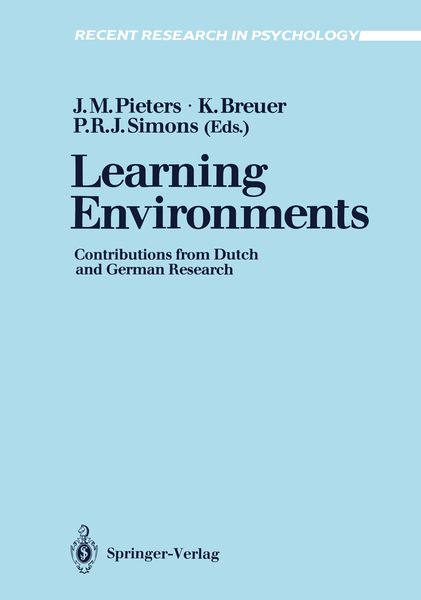
  • Produktbild: Learning Environments
  • Produktbild: Learning Environments

Learning Environments Contributions from Dutch and German Research

99,99 €

inkl. gesetzl. MwSt., Versandkostenfrei


Beschreibung

In view of the present attempts to broaden the scope of educational research as far as learning is concerned, there has been increased interest in the functional environment of the learner. Since this environment includes psychological, pedagogical, sociological and even cultural-anthropological variables,...

Beschreibung

In view of the present attempts to broaden the scope of educational research as far as learning is concerned, there has been increased interest in the functional environment of the learner. Since this environment includes psychological, pedagogical, sociological and even cultural-anthropological variables, the term learning environment is more often used. Traditionally this environment has consisted of the teacher and students in a situation similar to the real context, for instance in an apprenticeship. Although the apprenticeship form of learning has almost disappeared in Western educational systems, its characteristics can now be designed within intelligent learning environments that have the computation and storage capacity of modern technological innovations. The different perspectives regarding learning environments have been bundled into this book in an overview of Dutch and German research. These perspectives pertain to various system levels (learning activities, class- room and school) and to various disciplinary views (pedagogical, psychological, sociological).

Produktdetails

Einband

Taschenbuch

Erscheinungsdatum

05.09.1990

Abbildungen

IX, 364 p.

Herausgeber Jules M. Pieters + weitere

Produktdetails

Einband

Taschenbuch

Erscheinungsdatum

05.09.1990

Abbildungen

IX, 364 p.

Herausgeber
Verlag Springer Berlin
Seitenzahl

364

Maße (L/B/H)

24,2/17/2,1 cm

Gewicht

643 g

Sprache

Englisch

ISBN

978-3-540-52903-3

Herstelleradresse

Springer-Verlag GmbH
Tiergartenstr. 17
69121 Heidelberg
DE

Email: ProductSafety@springernature.com

Noch keine Bewertungen vorhanden

Verfassen Sie die erste Bewertung zu diesem Artikel

Helfen Sie anderen Kundinnen und Kunden durch Ihre Meinung.

Kundinnen und Kunden meinen

Bewertungen (0)

  • Produktbild: Learning Environments
  • Produktbild: Learning Environments
  • General Introduction.- Learning environments: An introduction.- I: Classroom Environments.- Facilitating adults’ learning by coaching: Development and evaluation of an andragogical model of continuing vocational education within industrial companies.- Concepts of schooling and the learning environment: A relationship tested in law faculties.- Work simulation: A natural environment for learning job skills and job attitudes.- Teacher enthusiasm: Congruence between ratings and behaviour.- Teacher praise and classroom climate: Another paradoxical relation.- II: Evaluation of Learning Environments.- Assessing the quality of kindergarten environments with the Early Childhood Environment Rating Scale.- School-provided measures against truancy and drop-out.- Some school effectiveness indicators and their relation to school characteristics.- III: Computer-Based Environments.- The use of a computer microworld as a learning environment to develop conceptual change in the field of mechanics.- Intelligent tutoring system for learning English.- A genetic model for tutoring addition and subtraction skills in an adaptive computer program.- A production system explaining errors in long division of learning disabled students in junior vocational education.- A computer simulation of the acquisition of a computational skill in a discovery-oriented microworld.- A systematic problem approach in business administration: A methodology to make knowledge explicit for Computer-Assisted Instruction.- On the surplus of computerized traffic education.- IV: Environments for Meta-Learning.- Metacognition: Learning to learn and learning to think.- General and differential effectiveness of learning-to-learn programs.- Teaching problem solving in higher education: From field regulation toself-regulation.- Executive control, self-regulation trained in mathematics.- Children’s reflection on text-coherence during reading.- The Leittext method: Learning to learn in commerce and industry.- Training self-regulation in several educational fields.- V: Theoretical Issues of Learning Environments.- Measuring individual differences in cognitive processes: How a speed-accuracy methodology can improve the results.- The influence of topic interest, prior knowledge and cognitive capabilities on text comprehension.- Instructional implications of recent research and empirically-based theories on the effect of prior knowledge on learning.- Contributors’ addresses.