KI-Beratung Beta

Gutscheinbedingungen

**Gültig am 20.11.2026 ab einem Mindestbestellwert von 30€ auf Spielzeug, Schreibwaren, Filme, Geschenke & Trends, Musik, tolino eReader & Zubehör, Hörbücher und Hörbuch-Downloads, nicht preisgebundene Bücher und Kalender online auf thalia.at und in der Thalia App. Einzelne Artikel können ausgeschlossen sein. Aufgrund der Buchpreisbindung sind deutschsprachige Bücher und eBooks ausgenommen. Zusätzlich ausgenommen sind Abos & Flatrates, Games, Geschenkkarten/-boxen, Shelfies, Software, Zeitschriften sowie einzelne Artikel von tonies®. Pro Einkauf einmal einlösbar. Click & Collect nur bei Onlinevorabzahlung möglich. Keine Barauszahlung. Nicht kombinierbar mit anderen Aktionen und Gutscheinen. Gutschein wird auf max. 500€ Bestellwert angerechnet. Nicht gültig für Versandkosten und Services. Preisgebundene Artikel sind vom Mindestbestellwert ausgeschlossen.

  • Produktbild: Arteriovenous Hemofiltration
  • Produktbild: Arteriovenous Hemofiltration

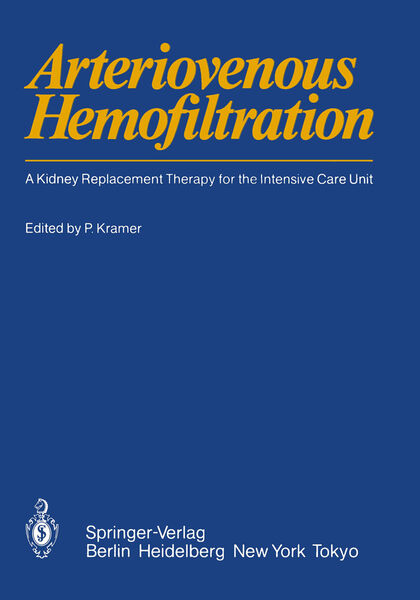
Arteriovenous Hemofiltration A Kidney Replacement Therapy for the Intensive Care Unit

99,99 €

inkl. gesetzl. MwSt., Versandkostenfrei


Beschreibung

Discovery and Relative Importance of Continuous Arteriovenous HemofIltration Lee W. Henderson Continuous arteriovenous hemofiltration (CAVH) has seen a brisk upswing in popularity in Europe since its introduction by Dr. Kramer and colleagues from Gottingen, West Germany in 1977 [1]. In the United States,...

Beschreibung

Discovery and Relative Importance of Continuous Arteriovenous HemofIltration Lee W. Henderson Continuous arteriovenous hemofiltration (CAVH) has seen a brisk upswing in popularity in Europe since its introduction by Dr. Kramer and colleagues from Gottingen, West Germany in 1977 [1]. In the United States, the technique re ceived approval as a clinical tool from the Food and Drug Administration in April 1982. This approval flowed, in no small measure, from the extensive expe rience reported from Europe and in particular West Germany [e. g. , 2, 3]. Reports of its clinical utility now have begun to appear in the United States [4]. Removal of excess total body water using synthetic membranes in an extracor poreal circuit dates back to the work of Alwall and the artificial kidney that he designed which permitted utilization of a hydrostatic pressure gradient to moti vate water flow across the membrane [5]. Kolffs original rotating drum with its unencased membrane required an osmotic driving force [6]. Hemofiltration, the use of the filtration process to remove uremic solutes with the artificial kidney, in analogy with the glomerulus, was reported in 1967 [7]. This was made possible by the availability of synthetic membranes with far higher hydraulic permeability (approximately 10 times higher) than conventionally used cellulosic hemodialysis membrane. Specific applications of these "high flux" membranes to the removal primarily of excess total body water followed shortly thereafter [8].

Produktdetails

Einband

Taschenbuch

Erscheinungsdatum

01.12.1985

Abbildungen

XI, 244 p. 40 illus.

Herausgeber Peter Kramer

Produktdetails

Einband

Taschenbuch

Erscheinungsdatum

01.12.1985

Abbildungen

XI, 244 p. 40 illus.

Herausgeber Peter Kramer
Verlag Springer Berlin
Seitenzahl

244

Maße (L/B/H)

24,4/17/1,5 cm

Gewicht

455 g

Auflage

1985

Sprache

Englisch

ISBN

978-3-540-15317-7

Herstelleradresse

Springer-Verlag KG
Sachsenplatz 4-6
1201 Wien
AT

Email: ProductSafety@springernature.com

Noch keine Bewertungen vorhanden

Verfassen Sie die erste Bewertung zu diesem Artikel

Helfen Sie anderen Kundinnen und Kunden durch Ihre Meinung.

Kundinnen und Kunden meinen

Bewertungen (0)

  • Produktbild: Arteriovenous Hemofiltration
  • Produktbild: Arteriovenous Hemofiltration
  • Discovery and Relative Importance of Continuous Arteriovenous Hemofiltration.- Physical Determinants of Continuous Arteriovenous Hemofiltration.- Mass Transfer in Arteriovenous Hemofiltration.- Effect of Hydrostatic Pressure and Hematocrit on Blood Flow and Filtration Rate.- Influence of Colloid-Osmotic Pressure on the Filtration Rate During Continuous Arteriovenous Hemofiltration.- Biocompatibility.- Leukocyte Counts and Complement Activation Düring Arteriovenous and Pump-Driven Hemofiltration.- Vascular Accesses.- Puncture and Long-Term Cannulation of the Femoral Artery and Vein in Adults.- Venovenous Ultrafiltration and Hemofiltration Via the Internal Jugular Vein Using a Double-Head Pump. A Simple Emergency Procedure.- Comparison Between Scribner Shunt and Femoral Catheters as Vascular Access for Continuous Arteriovenous Hemofiltration.- Coagulation — Anticoagulation — Heparin Dosage.- Alterations of Blood Coagulation in Patients with Acute Renal Failure.- Anticoagulation in Continuous Arteriovenous Hemofiltration.- Activated Clotting Time for Heparin in Dosage Monitoring in Continuous Arteriovenous Hemofiltration.- Setup and Fluid-Balancing Equipment.- Preparation of the Setup for Performing Arteriovenous Hemofiltration.- Simple Techniques for Accurate Fluid Balancing During Continuous Arteriovenous Hemofiltration.- A New Mechanical Device for Automatic Fluid Balancing in Continuous Arteriovenous Hemofiltration.- A Computer Monitor to Simplify the Management of Fluid Balance During Continuous Arteriovenous Hemofiltration.- Blood Volume and Blood Flow.- Continuous Noninvasive Monitoring of Blood Volume During Arteriovenous Hemofiltration.- Doppler Sonographie Measurement of the Blood-Flow Rate in the Extracorporeal Tubing System Düring ArteriovenousHemofiltration.- Bedside Estimation of Blood-Flow Rate.- Fluid and Electrolyte Substitution.- Management of Electrolyte and Acid-Base Metabolism with Continuous Arteriovenous Hemofiltration.- Potential Risks of Large-Volume Intravenous Fluid Therapy by Bacteria, Endotoxins, Trace Elements, and Particulate Matter.- Parenteral Nutrition.- Parenteral Nutrition in Patients with Acute Renal Failure Treated by Continuous Arteriovenous Hemofiltration.- Energy Balance and Survival in Patients with Acute Renal Failure.- Drug Dosage.- Drug Dosage in Patients on Continuous Arteriovenous Hemofiltration.- Cardiopulmonary Failure and Bypass.- Importance of Continuous and Slow Fluid Withdrawal in Patients with Impending Cardiogenic Shock.- Pulmonary Interstitial Edema: An Indication for Continuous Arteriovenous Hemofiltration?.- Ultrafiltration Düring Cardiopulmonary Bypass.- General Surgery.- Experience with Continuous Arteriovenous Hemofiltration in Surgical Intensive Care Patients.- Potentials and Pitfalls of Continuous Arteriovenous Hemofiltration.- Intensive Care Potentials of Continuous Arteriovenous Hemofiltration.- Differential Indications for the Use of Continuous Arteriovenous Hemofiltration.- Limitations and Pitfalls of Continuous Arteriovenous Hemofiltration.- Chronic Renal Failure.- Slow Continuous Ultrafiltration. Supplemental Therapy to Intermittent Hemodialysis.- Miscellaneous.- Continuous Pump-Driven Hemofiltration in Renal Failure.- Diagnostic Hemoperfusion Düring Continuous Arteriovenous Hemofiltration in Patients with Septicemic Acute Renal Failure.- Intestinal Substitution in Arteriovenous Hemofiltration. An Experimental Study on Inexpensive Long-Term Application of Continuous Arteriovenous Hemofiltration.- Cerebral Edema: Treatment by Continuous ArteriovenousHemofiltration. A Case Report.