KI-Beratung Beta

Gutscheinbedingungen

**Gültig bis 30.11.2026 auf Spielzeug, Schreibwaren, Filme, Geschenke & Trends, Musik, tolino eReader & Zubehör, Hörbücher und Hörbuch-Downloads, nicht preisgebundene Bücher und Kalender online auf thalia.at und in der Thalia App. Einzelne Artikel können ausgeschlossen sein. Aufgrund der Buchpreisbindung sind deutschsprachige Bücher und eBooks ausgenommen. Zusätzlich ausgenommen sind Abos & Flatrates, Games, Geschenkkarten/-boxen, Shelfies, Software, Zeitschriften sowie einzelne Artikel von tonies®. Pro Einkauf einmal einlösbar. Nur gültig mit im Onlineshop hinterlegter Bonuscard. Click & Collect nur bei Onlinevorabzahlung möglich. Keine Barauszahlung. Nicht kombinierbar mit anderen Aktionen und Gutscheinen. Gutschein wird auf max. 500€ Bestellwert angerechnet. Nicht gültig für Versandkosten und Services.

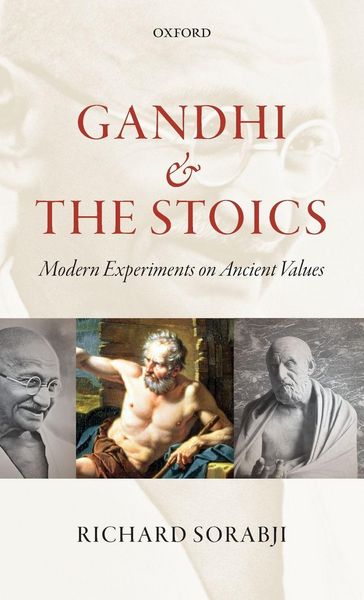
Produktbild: Gandhi and the Stoics

Gandhi and the Stoics Modern Experiments on Ancient Values. by Richard Sorabji

69,99 €

inkl. gesetzl. MwSt., Versandkostenfrei


Beschreibung

"Was Gandhi a philosopher? Yes." So begins this remarkable investigation of the guiding principles that motivated the transformative public acts of one of the top historical figures of the twentieth century. Richard Sorabji, continuing his exploration of the many connections between South Asian thought...

Beschreibung

"Was Gandhi a philosopher? Yes." So begins this remarkable investigation of the guiding principles that motivated the transformative public acts of one of the top historical figures of the twentieth century. Richard Sorabji, continuing his exploration of the many connections between South Asian thought and ancient Greek and Roman philosophy, brings together in this volume the unlikely pairing of Mahatma Gandhi and the Stoics, uncovering a host of parallels that suggests a deep affinity spanning the two millennia between them. While scholars have long known Gandhi's direct Western influences to be Platonic and Christian, Sorabji shows how a look at Gandhi's convergence with the Stoics works mutually, throwing light on both of them. Both emphasized emotional detachment, which provided a necessary freedom, a suspicion of universal rules of conduct that led to a focus not on human rights but human duties--the personally determined paths each individual must make for his or her self. By being "indifferent," paradoxically, both the Stoics and Gandhi could "love" manifoldly. In drawing these links to the fore, Sorabji demonstrates the comparative consistency of Gandhi's philosophical ideas, isolating the specific ideological strengths that were required to support some of the most consequential political acts and experiments in how to live.

Produktdetails

Einband

Gebundene Ausgabe

Erscheinungsdatum

27.09.2012

Abbildungen

3 illustrations

Verlag Oxford University Press

Produktdetails

Einband

Gebundene Ausgabe

Erscheinungsdatum

27.09.2012

Abbildungen

3 illustrations

Verlag Oxford University Press
Seitenzahl

240

Maße (L/B/H)

22,2/14,5/1,8 cm

Gewicht

475 g

Sprache

Englisch

ISBN

978-0-19-964433-9

Herstelleradresse

Libri GmbH
Europaallee 1
36244 Bad Hersfeld
DE

Email: gpsr@libri.de

Noch keine Bewertungen vorhanden

Verfassen Sie die erste Bewertung zu diesem Artikel

Helfen Sie anderen Kundinnen und Kunden durch Ihre Meinung.

Kundinnen und Kunden meinen

Bewertungen (0)

  • Produktbild: Gandhi and the Stoics

    • Introduction: Gandhi's use of Platonic, Christian, and Stoic values: reinterpretation, experimentation, and mere convergence


    • 1: Emotional detachment: how to square it with love of family and all humans in the Stoics and Gandhi


    • 2: Emotional detachment: how to square with politics in the Stoics and Gandhi


    • 3: Individual freedom: Gandhi's and Isaiah Berlin on Zeno's--sour grapes?


    • 4: Non-violence as universal love: origins and Gandhi's supplements to Tolstoy--dilemmas, successes, and failures


    • 5: From universal love to human rights?


    • 6: Individual duty: persona, svadharma


    • 7: General rules in morality


    • 8: Moral conscience


    • 9: Restrictions on private property in Gandhi, Christianity, Plato, and the Stoics


    • 10: Isaiah Berlin's Stoic revolution: depoliticisation


    • Select Bibliography


    • Index