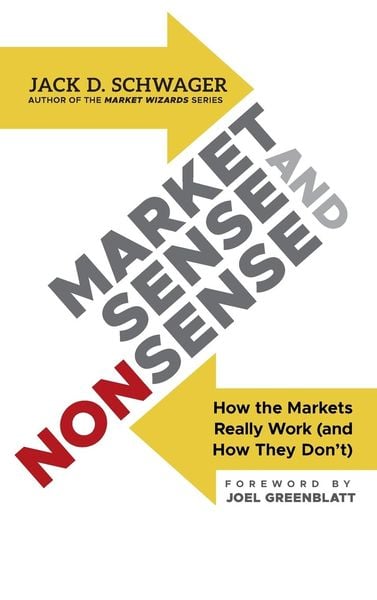
Produktbild: Market Sense and Nonsense

Market Sense and Nonsense How the Markets Really Work (and How They Don't)

39,99 €

inkl. gesetzl. MwSt., Versandkostenfrei


Beschreibung

Produktdetails

Einband

Gebundene Ausgabe

Erscheinungsdatum

07.12.2012

Verlag

John Wiley & Sons Inc

Seitenzahl

368

Maße (L/B/H)

23,5/15,7/2,4 cm

Gewicht

680 g

Auflage

1. Auflage

Sprache

Englisch

ISBN

978-1-118-49456-1

Beschreibung

Rezension

'Everybody, and I mean everybody who has an investment portfolio will profit from reading this book...kudos to the author for offering the investing world an uncommonly worthwhile book.' (forexpros.com, 12th Novemebr 2012)
 
'...Mr Schwager's book starts off with plenty of sound, basic advice... before expertly demonstrating that a leveraged exchange traded fund is a dreadful investment because of its structure, being almost bound to disappoint' (The Economist, January 2013)
 
'Full of common sense' (Pensions World, February 2013)

Produktdetails

Einband

Gebundene Ausgabe

Erscheinungsdatum

07.12.2012

Verlag

John Wiley & Sons Inc

Seitenzahl

368

Maße (L/B/H)

23,5/15,7/2,4 cm

Gewicht

680 g

Auflage

1. Auflage

Sprache

Englisch

ISBN

978-1-118-49456-1

Herstelleradresse

Libri GmbH
Europaallee 1
36244 Bad Hersfeld
DE

Email: gpsr@libri.de

Kundinnen und Kunden meinen

0 Bewertungen

Informationen zu Bewertungen

Zur Abgabe einer Bewertung ist eine Anmeldung im Konto notwendig. Die Authentizität der Bewertungen wird von uns nicht überprüft. Wir behalten uns vor, Bewertungstexte, die unseren Richtlinien widersprechen, entsprechend zu kürzen oder zu löschen.

Die Bewertungen sind nach Format, Anzahl Sterne und Datum sortiert.

Verfassen Sie die erste Bewertung zu diesem Artikel

Helfen Sie anderen Kund*innen durch Ihre Meinung

Kundinnen und Kunden meinen

0 Bewertungen filtern

Die Leseprobe wird geladen.
  • Produktbild: Market Sense and Nonsense
  • Foreword xv

    Prologue xvii

    Part One Markets, Return, and Risk

    Chapter 1 Expert Advice 3

    Comedy Central versus CNBC 3

    The Elves Index 6

    Paid Advice 8

    Investment Insights 11

    Chapter 2 The Deficient Market Hypothesis 13

    The Efficient Market Hypothesis and Empirical Evidence 14

    The Price is Not Always Right 15

    The Market is Collapsing; Where is the News? 24

    The Disconnect between Fundamental Developments and Price Moves 27

    Price Moves Determine Financial News 37

    Is It Luck or Skill? Exhibit A: The Renaissance Medallion Track Record 39

    The Flawed Premise of the Efficient Market Hypothesis: A Chess Analogy 40

    Some Players are Not Even Trying to Win 42

    The Missing Ingredient 44

    Right for the Wrong Reason: Why Markets are Difficult to Beat 47

    Diagnosing the Flaws of the Efficient Market Hypothesis 49

    Why the Efficient Market Hypothesis is Destined for the Dustbin of Economic Theory 50

    Investment Insights 52

    Chapter 3 The Tyranny of Past Returns 55

    S&P Performance in Years Following High- and Low-Return Periods 57

    Implications of High- and Low-Return Periods on Longer-Term Investment Horizons 59

    Is There a Benefit in Selecting the Best Sector? 63

    Hedge Funds: Relative Performance of the Past Highest-Return Strategy 70

    Why Do Past High-Return Sectors and Strategy Styles Perform So Poorly? 77

    Wait a Minute. Do We Mean to Imply . . . ? 78

    Investment Insights 85

    Chapter 4 The Mismeasurement of Risk 87

    Worse Than Nothing 87

    Volatility as a Risk Measure 88

    The Source of the Problem 92

    Hidden Risk 95

    Evaluating Hidden Risk 100

    The Confusion between Volatility and Risk 103

    The Problem with Value at Risk (VaR) 105

    Asset Risk: Why Appearances May Be Deceiving, or Price Matters 107

    Investment Insights 109

    Chapter 5 Why Volatility is Not Just about Risk, and the Case of Leveraged ETFs 111

    Leveraged ETFs: What You Get May Not Be What You Expect 112

    Investment Insights 121

    Chapter 6 Track Record Pitfalls 123

    Hidden Risk 123

    The Data Relevance Pitfall 124

    When Good Past Performance is Bad 126

    The Apples-and-Oranges Pitfall 128

    Longer Track Records Could Be Less Relevant 129

    Investment Insights 132

    Chapter 7 Sense and Nonsense about Pro Forma Statistics 133

    Investment Insights 136

    Chapter 8 How to Evaluate Past Performance 137

    Why Return Alone is Meaningless 137

    Risk-Adjusted Return Measures 142

    Visual Performance Evaluation 156

    Investment Insights 166

    Chapter 9 Correlation: Facts and Fallacies 169

    Correlation Defined 169

    Correlation Shows Linear Relationships 170

    The Coefficient of Determination (r2) 171

    Spurious (Nonsense) Correlations 171

    Misconceptions about Correlation 173

    Focusing on the Down Months 176

    Correlation versus Beta 179

    Investment Insights 182

    Part Two Hedge Funds as an Investment

    Chapter 10 The Origin of Hedge Funds 185

    Chapter 11 Hedge Funds 101 195

    Differences between Hedge Funds and Mutual Funds 196

    Types of Hedge Funds 200

    Correlation with Equities 210

    Chapter 12 Hedge Fund Investing: Perception and Reality 211

    The Rationale for Hedge Fund Investment 213

    Advantages of Incorporating Hedge Funds in a Portfolio 214

    The Special Case of Managed Futures 215

    Single-Fund Risk 217

    Investment Insights 220

    Chapter 13 Fear of Hedge Funds: It's Only Human 223

    A Parable 223

    Fear of Hedge Funds 225

    Chapter 14 The Paradox of Hedge Fund of Funds Underperformance 231

    Investment Insights 236

    Chapter 15 The Leverage Fallacy 239

    The Folly of Arbitrary Investment Rules 241

    Leverage and Investor Preference 242

    When Leverage is Dangerous 243

    Investment Insights 245

    Chapter 16 Managed Accounts: An Investor-Friendly Alternative to Funds 247

    The Essential Difference between Managed Accounts and Funds 248

    The Major Advantages of a Managed Account 249

    Individual Managed Accounts versus Indirect Managed Account Investment 250

    Why Would Managers Agree to Managed Accounts? 251

    Are There Strategies That are Not Amenable to Managed Accounts? 253

    Evaluating Four Common Objections to Managed Accounts 253

    Investment Insights 259

    Postscript to Part Two: Are Hedge Fund Returns a Mirage? 261

    Part Three Portfolio Matters

    Chapter 17 Diversification: Why 10 is Not Enough 267

    The Benefits of Diversification 267

    Diversification: How Much is Enough? 268

    Randomness Risk 269

    Idiosyncratic Risk 272

    A Qualification 273

    Investment Insights 274

    Chapter 18 Diversification: When More is Less 277

    Investment Insights 281

    Chapter 19 Robin Hood Investing 283

    A New Test 286

    Why Rebalancing Works 290

    A Clarification 291

    Investment Insights 292

    Chapter 20 Is High Volatility Always Bad? 295

    Investment Insights 299

    Chapter 21 Portfolio Construction Principles 301

    The Problem with Portfolio Optimization 301

    Eight Principles of Portfolio Construction 305

    Correlation Matrix 309

    Going Beyond Correlation 310

    Investment Insights 314

    Epilogue 32 Investment Observations 315

    Appendix A Options-Understanding the Basics 319

    Appendix B Formulas for Risk-Adjusted Return Measures 323

    Sharpe Ratio 323

    Sortino Ratio 324

    Symmetric Downside-Risk Sharpe Ratio 325

    Gain-to-Pain Ratio (GPR) 326

    Tail Ratio 326

    MAR and Calmar Ratios 326

    Return Retracement Ratio 327

    Acknowledgments 329

    About the Author 331

    Index 333