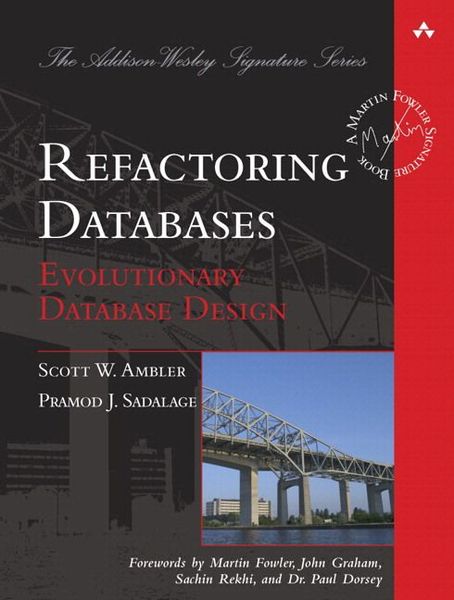
Refactoring Databases: Evolutionary Database Design Evolutionary Database Design
-
- Taschenbuch ausgewählt
- eBook
-
Sprache:Englisch
49,99 €
inkl. gesetzl. MwSt.,
Beschreibung
Produktdetails
Einband
Taschenbuch
Erscheinungsdatum
03.03.2006
Verlag
Pearson Education LimitedSeitenzahl
384
Maße (L/B/H)
23,5/17,8/2,1 cm
Gewicht
594 g
Auflage
1
Sprache
Englisch
ISBN
978-0-321-77451-4
Refactoring has proven its value in a wide range of development projects–helping software professionals improve system designs, maintainability, extensibility, and performance. Now, for the first time, leading agile methodologist Scott Ambler and renowned consultant Pramodkumar Sadalage introduce powerful refactoring techniques specifically designed for database systems.
Ambler and Sadalage demonstrate how small changes to table structures, data, stored procedures, and triggers can significantly enhance virtually any database design–without changing semantics. You’ll learn how to evolve database schemas in step with source code–and become far more effective in projects relying on iterative, agile methodologies.
This comprehensive guide and reference helps you overcome the practical obstacles to refactoring real-world databases by covering every fundamental concept underlying database refactoring. Using start-to-finish examples, the authors walk you through refactoring simple standalone database applications as well as sophisticated multi-application scenarios. You’ll master every task involved in refactoring database schemas, and discover best practices for deploying refactorings in even the most complex production environments.
The second half of this book systematically covers five major categories of database refactorings. You’ll learn how to use refactoring to enhance database structure, data quality, and referential integrity; and how to refactor both architectures and methods. This book provides an extensive set of examples built with Oracle and Java and easily adaptable for other languages, such as C#, C++, or VB.NET, and other databases, such as DB2, SQL Server, MySQL, and Sybase.
Using this book’s techniques and examples, you can reduce waste, rework, risk, and cost–and build database systems capable of evolving smoothly, far into the future.
Noch keine Bewertungen vorhanden
Verfassen Sie die erste Bewertung zu diesem Artikel
Helfen Sie anderen Kundinnen und Kunden durch Ihre Meinung.
Kurze Frage zu unserer Seite
Vielen Dank für Ihr Feedback
Wir nutzen Ihr Feedback, um unsere Produktseiten zu verbessern. Bitte haben Sie Verständnis, dass wir Ihnen keine Rückmeldung geben können. Falls Sie Kontakt mit uns aufnehmen möchten, können Sie sich aber gerne an unseren Kund*innenservice wenden.
zum Kundenservice