Beschreibung
Produktdetails
Einband
Gebundene Ausgabe
Erscheinungsdatum
15.07.2013
Verlag
John Wiley & Sons IncSeitenzahl
472
Maße (L/B/H)
26,6/17,2/0,2 cm
Gewicht
874 g
Auflage
1. Auflage
Sprache
Englisch
ISBN
978-0-470-68613-3
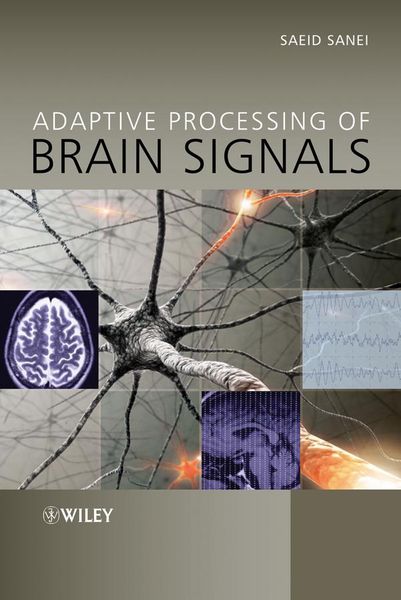
In this book, the field of adaptive learning and processing is extended to arguably one of its most important contexts which is the understanding and analysis of brain signals. No attempt is made to comment on physiological aspects of brain activity; instead, signal processing methods are developed and used to assist clinical findings. Recent developments in detection, estimation and separation of diagnostic cues from different modality neuroimaging systems are discussed.
These include constrained nonlinear signal processing techniques which incorporate sparsity, nonstationarity, multimodal data, and multiway techniques.
Key features:
* Covers advanced and adaptive signal processing techniques for the processing of electroencephalography (EEG) and magneto-encephalography (MEG) signals, and their correlation to the corresponding functional magnetic resonance imaging (fMRI)
* Provides advanced tools for the detection, monitoring, separation, localising and understanding of functional, anatomical, and physiological abnormalities of the brain
* Puts a major emphasis on brain dynamics and how this can be evaluated for the assessment of brain activity in various states such as for brain-computer interfacing emotions and mental fatigue analysis
* Focuses on multimodal and multiway adaptive processing of brain signals, the new direction of brain signal research
These include constrained nonlinear signal processing techniques which incorporate sparsity, nonstationarity, multimodal data, and multiway techniques.
Key features:
* Covers advanced and adaptive signal processing techniques for the processing of electroencephalography (EEG) and magneto-encephalography (MEG) signals, and their correlation to the corresponding functional magnetic resonance imaging (fMRI)
* Provides advanced tools for the detection, monitoring, separation, localising and understanding of functional, anatomical, and physiological abnormalities of the brain
* Puts a major emphasis on brain dynamics and how this can be evaluated for the assessment of brain activity in various states such as for brain-computer interfacing emotions and mental fatigue analysis
* Focuses on multimodal and multiway adaptive processing of brain signals, the new direction of brain signal research
Noch keine Bewertungen vorhanden
Verfassen Sie die erste Bewertung zu diesem Artikel
Helfen Sie anderen Kundinnen und Kunden durch Ihre Meinung.
Kurze Frage zu unserer Seite
Vielen Dank für Ihr Feedback
Wir nutzen Ihr Feedback, um unsere Produktseiten zu verbessern. Bitte haben Sie Verständnis, dass wir Ihnen keine Rückmeldung geben können. Falls Sie Kontakt mit uns aufnehmen möchten, können Sie sich aber gerne an unseren Kund*innenservice wenden.
zum Kundenservice