KI-Beratung Beta

Gutscheinbedingungen

**Gültig bis 18.11.2026 auf englischsprachige Klassiker (klassiker-32728) online auf thalia.at und in der Thalia App. Einzelne Artikel können ausgeschlossen sein. Ausgenommen sind preisgebundene Artikel & eBooks. Pro Einkauf einmal einlösbar. Click & Collect nur bei Onlinevorabzahlung möglich. Keine Barauszahlung. Nicht kombinierbar mit anderen Aktionen und Gutscheinen. Gutschein wird auf max. 500€ Bestellwert angerechnet. Nicht gültig für Geschenkkarten, Versandkosten und Services.

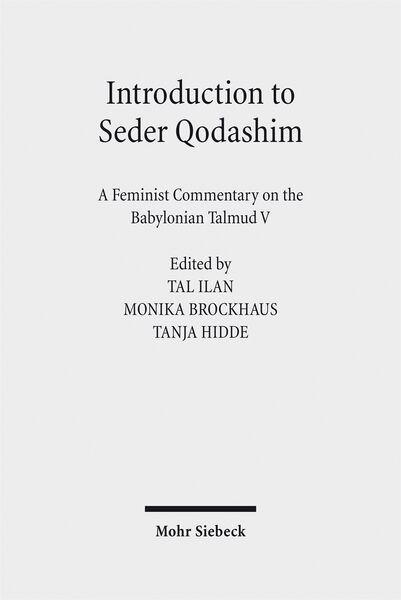
Produktbild: Introduction to Seder Qodashim

Introduction to Seder Qodashim A Feminist Commentary on the Babylonian Talmud V

127,99 €

inkl. gesetzl. MwSt., Versandkostenfrei


Beschreibung

The Order of Qodashim in the Mishnah and the Babylonian Talmud discusses the Temple and its rituals, especially the sacrifices. It is well known that the Jewish Temple in Jerusalem, while it stood, was almost exclusively a male institution. The purpose of the feminist commentary on Seder Qodashim is...

Beschreibung

The Order of Qodashim in the Mishnah and the Babylonian Talmud discusses the Temple and its rituals, especially the sacrifices. It is well known that the Jewish Temple in Jerusalem, while it stood, was almost exclusively a male institution. The purpose of the feminist commentary on Seder Qodashim is to discover niches in this elaborate system where women were present and active. Differences between male and female participation in the Temple cult - as they are presented in the mishnaic and talmudic texts - are the topic of the essays in this volume. The contributions by highly esteemed scholars of rabbinic literature represent a surprising selection of topics that touch on Temple and gender. This volume sums up two conferences, held in Berlin and Jerusalem, devoted to the Order of Qodashim, initiating the Feminist Commentary Series on this Order. Contributors: Moshe Benovitz, Monika Brockhaus, Aryeh Cohen, Federico Dal Bo, Klaus Herrmann, Tal Ilan, Jane Kanarek, Reuven Kiperwasser, Gail Labovitz, Moshe Lavee, Marjorie Lehman, Andreas Lehnardt, Sarra Lev, David Levine, Dalia Marx, Tirzah Meacham, Ishay Rosen-Zvi, Ze’ev Safrai, Günter Stemberger, Christiane Tzuberi, Dvora Weisberg

Portrait

is academic assistant in the Feminist Commentary on the Babylonian Talmud Project. Worked for the Feminist Commentary on the Babylonian Talmud Project. Born 1956; professor emerita of Jewish studies at the Freie Universität Berlin.

Produktdetails

Einband

Gebundene Ausgabe

Erscheinungsdatum

Mai 2012

Herausgeber Tal Ilan + weitere
Verlag Mohr Siebeck

Produktdetails

Einband

Gebundene Ausgabe

Erscheinungsdatum

Mai 2012

Herausgeber
Verlag Mohr Siebeck
Seitenzahl

396

Maße (L/B/H)

24,4/16,2/2,8 cm

Gewicht

741 g

Auflage

1. Auflage

Sprache

Englisch

ISBN

978-3-16-151930-7

Herstelleradresse

Mohr Siebeck GmbH & Co. KG
Wilhelmstr. 18
72074 Tübingen
Deutschland
Email: sales@mohrsiebeck.com
Url: www.mohrsiebeck.com
Telephone: +49 7071 92317
Fax: +49 7071 51104

Noch keine Bewertungen vorhanden

Verfassen Sie die erste Bewertung zu diesem Artikel

Helfen Sie anderen Kundinnen und Kunden durch Ihre Meinung.

Kundinnen und Kunden meinen

Bewertungen (0)

  • Produktbild: Introduction to Seder Qodashim
  • Tal Ilan: Introduction

    1. Women in the Temple
    Günter Stemberger: Did Women Actively Participate in the Sacrificial Cult of the Temple of Jerusalem? Some Preliminary Observations - Andreas Lehnardt: "The Scent of Women." Incense and Perfume in ySheq 5:2 ( Sheqalim) - Marjorie Lehman: Reading the Gendered Rhetoric of Yom Kippur ( Yoma) - Moshe Benovitz: Miriam bat Bilgah in the Temple: Self, Symbol, Substitute or Stereotype? ( Sukkah) - Ishay Rosen-Zvi: The Sotah in the Temple: A Well-Ordered Choreography ( Sotah) - Tirzah Meacham: How Pragmatism Trumps Dogmatism: Marginalization and the Masses in the Case of Coming to the Temple ( Niddah)

    2. Women after the Destruction of the Temple
    Aryeh Cohen: The Gender of Shabbat ( Shabbat) - Gail Labovitz: The Omitted Adornment: Women and Men Mourning the Destruction ( Mo'ed Qatan) - Klaus Herrmann: Do Women have Access to the Divine Realm? Temple Ideology in Judaism ( Hagigah) - Christiane Tzuberi: "And the Woman is a High-Priest": From the Temple to the Kitchen, From the Laws of Ritual Im/Purity to the Laws of Kashrut ( Toharot) - David Levine: Why No Women in the Beit Midrash?

    3. Women in the Temple and in Seder Qodashim
    Dvora Weisberg: Clothes (un)Make the Man: bMenahot 109b ( Menahot) - Jane Kanarek: All are Obligated: Sacrifice, Sight and Study ( Arakhin) - Monika Brockhaus: : How do the "Harlot" and the "Dog" Affect the Sacrifice ( Temurah) - Federico Dal Bo: "Women to Think with:" Sexual Transgressions as Heuristics in bKeritot 17a-20a ( Keritot) - Dalia Marx: Tractate Qinnim: Marginality or Horizons ( Qinnim)

    4. Women in Seder Qodashim
    Tal Ilan: Males are for God, Females are for Us: Sacred and Kosher Slaughter Rhetorics in Seder Qodashim and Tractate Hullin ( Hullin) - Moshe Lavee: Birth, Seminal Emission and Conversion: Gender, Self-Control and Identity in bBekhorot ( Bekhorot) - Reuven Kiperwasser: Body of the Whore, Body of the Story and Metaphor of the Body ( Bekhorot) - Sarra Lev: "Metaphors of Me'ilah: 'Metaphoric' Use of the Word in Tanakh and in Rabbinic Sources" ( Me'ila)
    Appendix
    Ze'ev Safrai: The Place of Women in Non-Establishment Religion During the Period of the Second Temple, the Mishnah and the Talmud