Beschreibung
Produktdetails
Einband
Gebundene Ausgabe
Erscheinungsdatum
30.06.2014
Verlag
John Wiley & SonsSeitenzahl
512
Maße (L/B/H)
24/16,1/3,2 cm
Gewicht
933 g
Auflage
2nd Revised edition
Sprache
Englisch
ISBN
978-1-118-30608-6
Praise for the First Edition
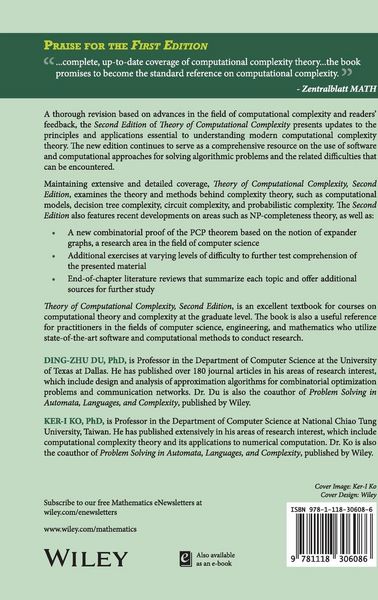
"...complete, up-to-date coverage of computational complexity theory...the book promises to become the standard reference on computational complexity." -Zentralblatt MATH
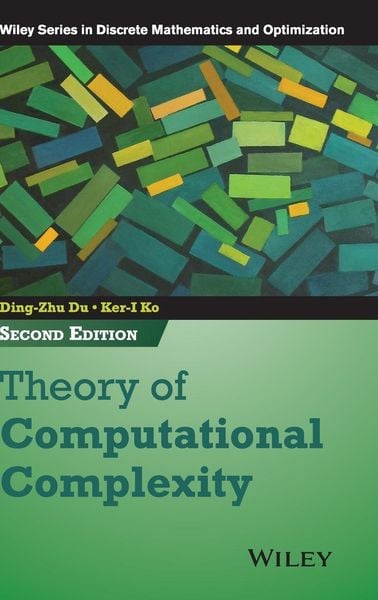
A thorough revision based on advances in the field of computational complexity and readers' feedback, the Second Edition of Theory of Computational Complexity presents updates to the principles and applications essential to understanding modern computational complexity theory. The new edition continues to serve as a comprehensive resource on the use of software and computational approaches for solving algorithmic problems and the related difficulties that can be encountered.
Maintaining extensive and detailed coverage, Theory of Computational Complexity, Second Edition, examines the theory and methods behind complexity theory, such as computational models, decision tree complexity, circuit complexity, and probabilistic complexity. The Second Edition also features recent developments on areas such as NP-completeness theory, as well as:
* A new combinatorial proof of the PCP theorem based on the notion of expander graphs, a research area in the field of computer science
* Additional exercises at varying levels of difficulty to further test comprehension of the presented material
* End-of-chapter literature reviews that summarize each topic and offer additional sources for further study
Theory of Computational Complexity, Second Edition, is an excellent textbook for courses on computational theory and complexity at the graduate level. The book is also a useful reference for practitioners in the fields of computer science, engineering, and mathematics who utilize state-of-the-art software and computational methods to conduct research. A thorough revision based on advances in the field of computational complexity and readers' feedback, the Second Edition of Theory of Computational Complexity presents updates to the principles and applications essential to understanding modern computational complexity theory. The new edition continues to serve as a comprehensive resource on the use of software and computational approaches for solving algorithmic problems and the related difficulties that can be encountered. Maintaining extensive and detailed coverage, Theory of Computational Complexity, Second Edition, examines the theory and methods behind complexity theory, such as computational models, decision tree complexity, circuit complexity, and probabilistic complexity. The Second Edition also features recent developments on areas such as NP-completeness theory, as well as: * A new combinatorial proof of the PCP theorem based on the notion of expander graphs, a research area in the field of computer science * Additional exercises at varying levels of difficulty to further test comprehension of the presented material * End-of-chapter literature reviews that summarize each topic and offer additional sources for further study Theory of Computational Complexity, Second Edition, is an excellent textbook for courses on computational theory and complexity at the graduate level. The book is also a useful reference for practitioners in the fields of computer science, engineering, and mathematics who utilize state-of-the-art software and computational methods to conduct research.
"...complete, up-to-date coverage of computational complexity theory...the book promises to become the standard reference on computational complexity." -Zentralblatt MATH
A thorough revision based on advances in the field of computational complexity and readers' feedback, the Second Edition of Theory of Computational Complexity presents updates to the principles and applications essential to understanding modern computational complexity theory. The new edition continues to serve as a comprehensive resource on the use of software and computational approaches for solving algorithmic problems and the related difficulties that can be encountered.
Maintaining extensive and detailed coverage, Theory of Computational Complexity, Second Edition, examines the theory and methods behind complexity theory, such as computational models, decision tree complexity, circuit complexity, and probabilistic complexity. The Second Edition also features recent developments on areas such as NP-completeness theory, as well as:
* A new combinatorial proof of the PCP theorem based on the notion of expander graphs, a research area in the field of computer science
* Additional exercises at varying levels of difficulty to further test comprehension of the presented material
* End-of-chapter literature reviews that summarize each topic and offer additional sources for further study
Theory of Computational Complexity, Second Edition, is an excellent textbook for courses on computational theory and complexity at the graduate level. The book is also a useful reference for practitioners in the fields of computer science, engineering, and mathematics who utilize state-of-the-art software and computational methods to conduct research. A thorough revision based on advances in the field of computational complexity and readers' feedback, the Second Edition of Theory of Computational Complexity presents updates to the principles and applications essential to understanding modern computational complexity theory. The new edition continues to serve as a comprehensive resource on the use of software and computational approaches for solving algorithmic problems and the related difficulties that can be encountered. Maintaining extensive and detailed coverage, Theory of Computational Complexity, Second Edition, examines the theory and methods behind complexity theory, such as computational models, decision tree complexity, circuit complexity, and probabilistic complexity. The Second Edition also features recent developments on areas such as NP-completeness theory, as well as: * A new combinatorial proof of the PCP theorem based on the notion of expander graphs, a research area in the field of computer science * Additional exercises at varying levels of difficulty to further test comprehension of the presented material * End-of-chapter literature reviews that summarize each topic and offer additional sources for further study Theory of Computational Complexity, Second Edition, is an excellent textbook for courses on computational theory and complexity at the graduate level. The book is also a useful reference for practitioners in the fields of computer science, engineering, and mathematics who utilize state-of-the-art software and computational methods to conduct research.
Kundinnen und Kunden meinen
Verfassen Sie die erste Bewertung zu diesem Artikel
Helfen Sie anderen Kund*innen durch Ihre Meinung
Kurze Frage zu unserer Seite
Vielen Dank für Ihr Feedback
Wir nutzen Ihr Feedback, um unsere Produktseiten zu verbessern. Bitte haben Sie Verständnis, dass wir Ihnen keine Rückmeldung geben können. Falls Sie Kontakt mit uns aufnehmen möchten, können Sie sich aber gerne an unseren Kund*innenservice wenden.
zum Kundenservice