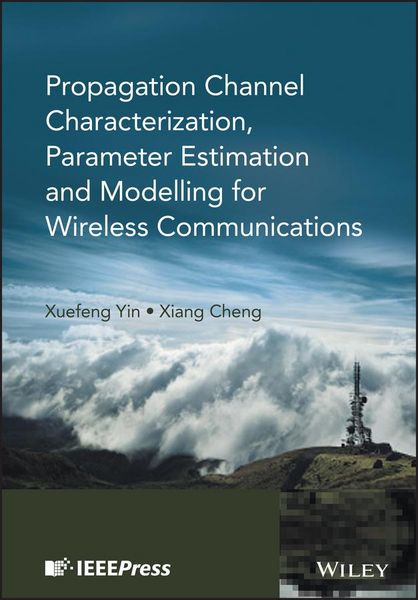
Propagation Channel Characterization, Parameter Estimation, and Modeling for Wireless Communications
-
- Englisch ausgewählt
177,99 €
inkl. gesetzl. MwSt.,
Beschreibung
Produktdetails
Einband
Gebundene Ausgabe
Erscheinungsdatum
21.12.2015
Verlag
John Wiley & SonsSeitenzahl
350
Maße (L/B/H)
24,4/17,3/2,3 cm
Gewicht
748 g
Auflage
1. Auflage
Sprache
Englisch
ISBN
978-1-118-18823-1
Thoroughly covering channel characteristics and parameters, this book provides the knowledge needed to design various wireless systems, such as cellular communication systems, RFID and ad hoc wireless communication systems. It gives a detailed introduction to aspects of channels before presenting the novel estimation and modelling techniques which can be used to achieve accurate models.
To systematically guide readers through the topic, the book is organised in three distinct parts. The first part covers the fundamentals of the characterization of propagation channels, including the conventional single-input single-output (SISO) propagation channel characterization as well as its extension to multiple-input multiple-output (MIMO) cases. Part two focuses on channel measurements and channel data post-processing. Wideband channel measurements are introduced, including the equipment, technology and advantages and disadvantages of different data acquisition schemes. The channel parameter estimation methods are then presented, which include conventional spectral-based estimation, the specular-path-model based high-resolution method, and the newly derived power spectrum estimation methods. Measurement results are used to compare the performance of the different estimation methods. The third part gives a complete introduction to different modelling approaches. Among them, both scattering theoretical channel modelling and measurement-based channel modelling approaches are detailed. This part also approaches how to utilize these two modelling approaches to investigate wireless channels for conventional cellular systems and some new emerging communication systems. This three-part approach means the book caters for the requirements of the audiences at different levels, including readers needing introductory knowledge, engineers who are looking for more advanced understanding, and expert researchers in wireless system design as a reference.
* Presents technical explanations, illustrated with examples of the theory in practice
* Discusses results applied to 4G communication systems and other emerging communication systems, such as relay, CoMP, and vehicle-to-vehicle rapid time-variant channels
* Can be used as comprehensive tutorial for students or a complete reference for engineers in industry
* Includes selected illustrations in color
* Program downloads available for readers
* Companion website with program downloads for readers and presentation slides and solution manual for instructors
Essential reading for Graduate students and researchers interested in the characteristics of propagation channel, or who work in areas related to physical layer architectures, air interfaces, navigation, and wireless sensing
Noch keine Bewertungen vorhanden
Verfassen Sie die erste Bewertung zu diesem Artikel
Helfen Sie anderen Kundinnen und Kunden durch Ihre Meinung.
Kurze Frage zu unserer Seite
Vielen Dank für Ihr Feedback
Wir nutzen Ihr Feedback, um unsere Produktseiten zu verbessern. Bitte haben Sie Verständnis, dass wir Ihnen keine Rückmeldung geben können. Falls Sie Kontakt mit uns aufnehmen möchten, können Sie sich aber gerne an unseren Kund*innenservice wenden.
zum Kundenservice