KI-Beratung Beta

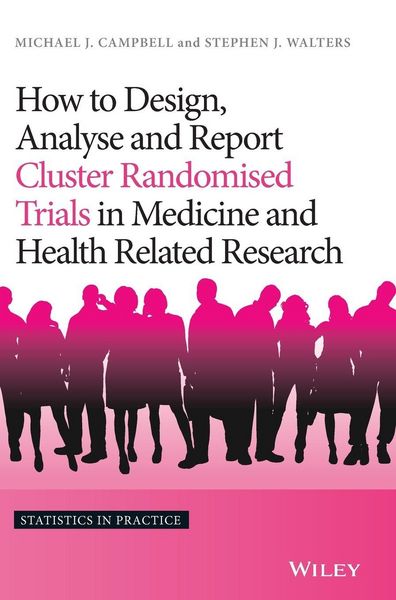
Produktbild: How to Design, Analyse and Report Cluster Randomised Trials in Medicine and Health Related Research

How to Design, Analyse and Report Cluster Randomised Trials in Medicine and Health Related Research

Aus der Reihe Statistics in Practice

119,99 €

inkl. gesetzl. MwSt., Versandkostenfrei


Beschreibung

A complete guide to understanding cluster randomised trials   Written by two researchers with extensive experience in the field, this book presents a complete guide to the design, analysis and reporting of cluster randomised trials. It spans a wide range of applications: trials in developing countries,...

Beschreibung

A complete guide to understanding cluster randomised trials
 
Written by two researchers with extensive experience in the field, this book presents a complete guide to the design, analysis and reporting of cluster randomised trials. It spans a wide range of applications: trials in developing countries, trials in primary care, trials in the health services. A key feature is the use of R code and code from other popular packages to plan and analyse cluster trials, using data from actual trials. The book contains clear technical descriptions of the models used, and considers in detail the ethics involved in such trials and the problems in planning them. For readers and students who do not intend to run a trial but wish to be a critical reader of the literature, there are sections on the CONSORT statement, and exercises in reading published trials.
* Written in a clear, accessible style
* Features real examples taken from the authors' extensive practitioner experience of designing and analysing clinical trials
* Demonstrates the use of R, Stata and SPSS for statistical analysis
* Includes computer code so the reader can replicate all the analyses
* Discusses neglected areas such as ethics and practical issues in running cluster randomised trials
 
How to Design, Analyse and Report Cluster Randomised Trials in Medicine and Health Related Research provides an excellent reference tool and can be read with profit by statisticians, health services researchers, systematic reviewers and critical readers of cluster randomised trials.

Produktdetails

Einband

Gebundene Ausgabe

Erscheinungsdatum

03.06.2014

Verlag John Wiley & Sons
Seitenzahl

272

Produktdetails

Einband

Gebundene Ausgabe

Erscheinungsdatum

03.06.2014

Verlag John Wiley & Sons
Seitenzahl

272

Maße (L/B/H)

25,1/17,2/2,2 cm

Gewicht

571 g

Auflage

1. Auflage

Sprache

Englisch

ISBN

978-1-119-99202-8

Herstelleradresse

Libri GmbH
Europaallee 1
36244 Bad Hersfeld
DE

Email: gpsr@libri.de

Noch keine Bewertungen vorhanden

Verfassen Sie die erste Bewertung zu diesem Artikel

Helfen Sie anderen Kundinnen und Kunden durch Ihre Meinung.

Kundinnen und Kunden meinen

Bewertungen (0)

Die Leseprobe wird geladen.
  • Produktbild: How to Design, Analyse and Report Cluster Randomised Trials in Medicine and Health Related Research
  • Preface xiii
     
    Acronyms and abbreviations xv
     
    1 Introduction 1
     
    1.1 Randomised controlled trials 1
     
    1.1.1 A-Allocation at random 1
     
    1.1.2 B-Blindness 2
     
    1.1.3 C-Control 2
     
    1.2 Complex interventions 3
     
    1.3 History of cluster randomised trials 4

    1.4 Cohort and field trials 4
     
    1.5 The field/community trial 5
     
    1.5.1 The REACT trial 5
     
    1.5.2 The Informed Choice leaflets trial 6
     
    1.5.3 The Mwanza trial 7
     
    1.5.4 The paramedics practitioner trial 7
     
    1.6 The cohort trial 8
     
    1.6.1 The PoNDER trial 8
     
    1.6.2 The DESMOND trial 9
     
    1.6.3 The Diabetes Care from Diagnosis trial 10
     
    1.6.4 The REPOSE trial 11
     
    1.6.5 Other examples of cohort cluster trials 11
     
    1.7 Field versus cohort designs 11
     
    1.8 Reasons for cluster trials 12
     
    1.9 Between- and within-cluster variation 14
     
    1.10 Random-effects models for continuous outcomes 15
     
    1.10.1 The model 15
     
    1.10.2 The intracluster correlation coefficient 16
     
    1.10.3 Estimating the intracluster correlation (ICC) coefficient 16
     
    1.10.4 Link between the Pearson correlation coefficient and the intraclass correlation coefficient 17
     
    1.11 Random-effects models for binary outcomes 18
     
    1.11.1 The model 18
     
    1.11.2 The ICC for binary data 19
     
    1.11.3 The coefficient of variation 19
     
    1.11.4 Relationship between cvc and for binary data 20
     
    1.12 The design effect 20
     
    1.13 Commonly asked questions 21
     
    1.14 Websources 21
     
    Exercise 22
     
    Appendix 1.A 22
     
    2 Design issues 27
     
    2.1 Introduction 27
     
    2.2 Issues for a simple intervention 28
     
    2.2.1 Phases of a trial 28
     
    2.2.2 'Pragmatic' and 'explanatory' trials 29
     
    2.2.3 Intention-to-treat and per-protocol analyses 29
     
    2.2.4 Non-inferiority and equivalence trials 30
     
    2.3 Complex interventions 30
     
    2.3.1 Design of complex interventions 30
     
    2.3.2 Phase I modelling/qualitative designs 32
     
    2.3.3 Pilot or feasibility studies 33
     
    2.3.4 Example of pilot/feasibility studies in cluster trials 33
     
    2.4 Recruitment bias 34
     
    2.5 Matched-pair trials 34
     
    2.5.1 Design of matched-pair studies 34
     
    2.5.2 Limitations of matched-pairs designs 36
     
    2.5.3 Example of matched-pair design: The Family Heart Study 36
     
    2.6 Other types of designs 37
     
    2.6.1 Cluster factorial designs 37
     
    2.6.2 Example cluster factorial trial 38
     
    2.6.3 Cluster crossover trials 38
     
    2.6.4 Example of a cluster crossover trial 39
     
    2.6.5 Stepped wedge 39
     
    2.6.6 Pseudorandomised trials 40
     
    2.7 Other design issues 41
     
    2.8 Strategies for improving precision 41
     
    2.9 Randomisation 42
     
    2.9.1 Reasons for randomisation 42
     
    2.9.2 Simple randomisation 43
     
    2.9.3 Stratified randomisation 43
     
    2.9.4 Restricted randomisation 43
     
    2.9.5 Minimisation 44
     
    Exercise 45
     
    Appendix 2.A 48
     
    3 Sample size: How many subjects/clusters do I need for my cluster randomised controlled trial? 50
     
    3.1 Introduction 51
     
    3.1.1 Justification of the requirement for a sample size 51
     
    3.1.2 Significance tests, P-values and power 51
     
    3.1.3 Sample size and cluster trials 53
     
    3.2 Sample size for continuous data - comparing two means 53
     
    3.2.1 Basic formulae 53
     
    3.2.2 The design effect (DE) in cluster RCTs 54
     
    3.2.3 Exam