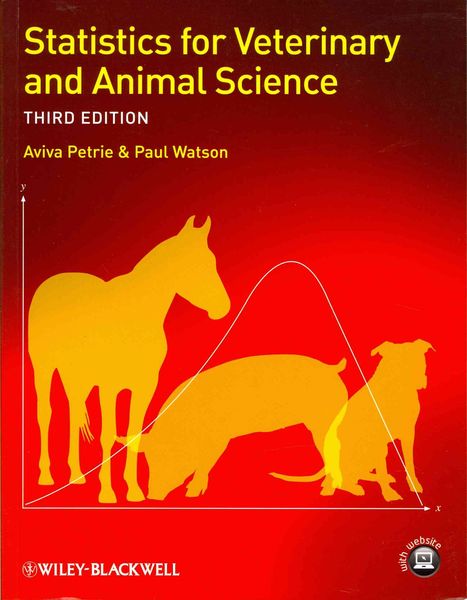
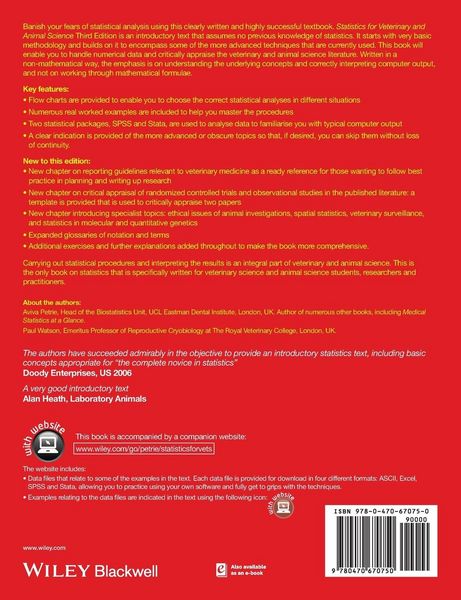
• Produktbild: Statistics for Veterinary and Animal Science
  • Produktbild: Statistics for Veterinary and Animal Science

Statistics for Veterinary and Animal Science

59,99 €

inkl. gesetzl. MwSt., Versandkostenfrei


Beschreibung

Produktdetails

Einband

Taschenbuch

Erscheinungsdatum

23.04.2013

Verlag

John Wiley & Sons

Seitenzahl

414

Maße (L/B/H)

24,6/18,9/2,2 cm

Gewicht

895 g

Auflage

3. Auflage

Sprache

Englisch

ISBN

978-0-470-67075-0

Beschreibung

Rezension

"This book succeeds in this and represents an appropriate text for anyone wishing to understand or produce veterinary and animal science research." (Veterinary Record, 14 December 2013)
 
"Any who carry out or interpret statistical results in a veterinary practice will find this a powerful read, packed with ideas presented in a non-mathematical method clear of jargon but pertinent to any daily practice." (Midwest Book Review, 1 September 2013)
 
"This book offers a good introduction to the most important tests used in veterinary statistics. It provides readers with relevant information on appropriate tests, computer programs, and use of the data. All the data is current and a website provides updated information." (Doody's, 6 September 2013)
 
"It also seems likely that the third edition of the book will be positively received and meet with approval from those looking for an introduction to statistics for students taking degree programs in veterinary medicine and animal sciences. Although written primarily with students and practitioners of veterinary medicine in mind, Statistics for Veterinary and Animal Science also has much to offer students and researchers within other branches of the biological sciences." (Aquaculture International, 22 July 2013)

Produktdetails

Einband

Taschenbuch

Erscheinungsdatum

23.04.2013

Verlag

John Wiley & Sons

Seitenzahl

414

Maße (L/B/H)

24,6/18,9/2,2 cm

Gewicht

895 g

Auflage

3. Auflage

Sprache

Englisch

ISBN

978-0-470-67075-0

Herstelleradresse

Libri GmbH
Europaallee 1
36244 Bad Hersfeld
DE

Email: gpsr@libri.de

Noch keine Bewertungen vorhanden

Verfassen Sie die erste Bewertung zu diesem Artikel

Helfen Sie anderen Kundinnen und Kunden durch Ihre Meinung.

Kundinnen und Kunden meinen

Bewertungen (0)

Die Leseprobe wird geladen.
  • Produktbild: Statistics for Veterinary and Animal Science
  • Produktbild: Statistics for Veterinary and Animal Science
  • Preface to third edition ix

    Preface to second edition xi

    Preface to first edition xiii

    About the companion website xv

    1 The whys and wherefores of statistics 1

    1.1 Learning objectives 1

    1.2 Aims of the book 1

    1.3 What is statistics? 2

    1.4 Statistics in veterinary and animal science 3

    1.5 Evidence-based veterinary medicine 4

    1.6 Types of variable 4

    1.7 Variations in measurements 5

    1.8 Terms relating to measurement quality 7

    1.9 Populations and samples 9

    1.10 Types of statistical procedures 10

    1.11 Conclusion 10

    Exercises 10

    2 Descriptive statistics 12

    2.1 Learning objectives 12

    2.2 Summarizing data 12

    2.3 Empirical frequency distributions 12

    2.4 Tables 14

    2.5 Diagrams 15

    2.6 Numerical measures 19

    2.7 Reference interval 24

    Exercises 25

    3 Probability and probability distributions 28

    3.1 Learning objectives 28

    3.2 Probability 28

    3.3 Probability distributions 30

    3.4 Discrete probability distributions 31

    3.5 Continuous probability distributions 33

    3.6 Relationships between distributions 42

    Exercises 43

    4 Sampling and sampling distributions 46

    4.1 Learning objectives 46

    4.2 Distinction between the sample and the population 46

    4.3 Statistical inference 46

    4.4 Sampling distribution of the mean 48

    4.5 Confidence interval for a mean 50

    4.6 Sampling distribution of the proportion 52

    4.7 Confidence interval for a proportion 53

    4.8 Bootstrapping and jackknifing 53

    Exercises 54

    5 Experimental design and clinical trials 55

    5.1 Learning objectives 55

    5.2 Types of study 55

    5.3 Introducing clinical trials 59

    5.4 Importance of design in the clinical trial 60

    5.5 Control group 61

    5.6 Assignment of animals to the treatment groups 62

    5.7 Avoidance of bias in the assessment procedure 65

    5.8 Increasing the precision of the estimates 66

    5.9 Further considerations 68

    Exercises 73

    6 An introduction to hypothesis testing 75

    6.1 Learning objectives 75

    6.2 Introduction 75

    6.3 Basic concepts of hypothesis testing 75

    6.4 Type I and Type II errors 79

    6.5 Distinction between statistical and biological significance 80

    6.6 Confidence interval approach to hypothesis testing 81

    6.7 Collecting our thoughts on confidence intervals 82

    6.8 Equivalence and non-inferiority studies 82

    Exercises 83

    7 Hypothesis tests 1 - the t-test: comparing one or two means 85

    7.1 Learning objectives 85

    7.2 Requirements for hypothesis tests for comparing means 85

    7.3 One-sample t-test 87

    7.4 Two-sample t-test 89

    7.5 Paired t-test 92

    Exercises 96

    8 Hypothesis tests 2 - the F-test: comparing two variances or more than two means 100

    8.1 Learning objectives 100

    8.2 Introduction 100

    8.3 The F-test for the equality of two variances 100

    8.4 Levene's test for the equality of two or more variances 102

    8.5 Analysis of variance (ANOVA) for the equality of means 102

    8.6 One-way analysis of variance 105

    Exercises 109

    9 Hypothesis tests 3 - the Chi-squared test: comparing proportions 112

    9.1 Learning objectives 112

    9.2 Introduction 112

    9.3 Testing a hypothesis about a single proportion 112

    9.4 Comparing two proportions: independent groups 113

    9.5 Testing associations in an r × c contingency table 117

    9.6 Comparing two proportions: paired observations 120

    9.7 Chi-squared goodness-of-fit test 122

    Exercises 123

    10 Linear correlation and regression 126

    10.1 Learning objectives 126

    10.2 Introducing linear correlation and regression 126

    10.3 Linear correlation 127

    10.4 Simple (univariable) linear regression 132

    10.5 Regression to the mean 142

    Exercises 142

    11 Further regression analyses 146

    11.1 Learning objectives 146

    11.2 Introduction 146

    11.3 Multiple (multivariable) linear regression 147

    11.4 Multiple logistic regression: a binary response variable 154

    11.5 Poisson regression 159

    11.6 Regression methods for clustered data 161

    Exercises 163

    12 Non-parametric statistical methods 165

    12.1 Learning objectives 165

    12.2 Parametric and non-parametric tests 165

    12.3 Sign test 167

    12.4 Wilcoxon signed rank test 169

    12.5 Wilcoxon rank sum test 171

    12.6 Non-parametric analyses of variance 173

    12.7 Spearman's rank correlation coefficient 175

    Exercises 178

    13 Further aspects of design and analysis 181

    13.1 Learning objectives 181

    13.2 Transformations 181

    13.3 Sample size 184

    13.4 Sequential and interim analysis 189

    13.5 Meta-analysis 190

    13.6 Methods of sampling 194

    Exercises 198

    14 Additional techniques 200

    14.1 Learning objectives 200

    14.2 Diagnostic tests 200

    14.3 Bayesian analysis 208

    14.4 Measuring agreement 211

    14.5 Measurements at successive points in time 218

    14.6 Survival analysis 221

    14.7 Multivariate analysis 226

    Exercises 227

    15 Some specialized issues and procedures 230

    15.1 Learning objectives 230

    15.2 Introduction 230

    15.3 Ethical and legal issues 230

    15.4 Spatial statistics and geospatial information systems 233

    15.5 Veterinary surveillance 237

    15.6 Molecular and quantitative genetics 240

    Exercises 242

    16 Evidence-based veterinary medicine 243

    16.1 Learning objectives 243

    16.2 Introduction 243

    16.3 What is evidence-based veterinary medicine? 244

    16.4 Why has evidence-based veterinary medicine developed? 244

    16.5 What is involved in practising evidence-based veterinary medicine? 245

    16.6 Integrating evidence-based veterinary medicine into clinical practice 249

    16.7 Example 249

    Exercises 250

    17 Reporting guidelines 252

    17.1 Learning objectives 252

    17.2 Introduction to reporting guidelines (EQUATOR network) 252

    17.3 REFLECT statement (livestock and food safety RCTs) 254

    17.4 ARRIVE guidelines (research using laboratory animals) 255

    17.5 STROBE statement (observational studies) 255

    17.6 STARD statement (diagnostic accuracy) 256

    17.7 PRISMA statement (systematic reviews and meta-analysis) 256

    18 Critical appraisal of reported studies 269

    18.1 Learning objectives 269

    18.2 Introduction 269

    18.3 A template for critical appraisal of published research involving animals 270

    18.4 Paper 1 273

    18.5 Critical appraisal of paper 1 284

    18.6 Paper 2 288

    18.7 Critical appraisal of paper 2 297

    18.8 General conclusion 302

    Solutions to exercises 303

    Appendices 323

    A Statistical tables 323

    B Tables of confidence intervals 339

    C Glossary of notation 341

    D Glossary of terms 345

    E Flowcharts for selection of appropriate tests 368

    References 371

    Index 379

    Colour plate section can be found facing page 240