Beschreibung
Produktdetails
Einband
Taschenbuch
Erscheinungsdatum
04.01.2013
Verlag
John Wiley & Sons IncSeitenzahl
268
Maße (L/B/H)
24,4/16,7/1,5 cm
Gewicht
522 g
Auflage
1. Auflage
Sprache
Englisch
ISBN
978-0-470-97636-4
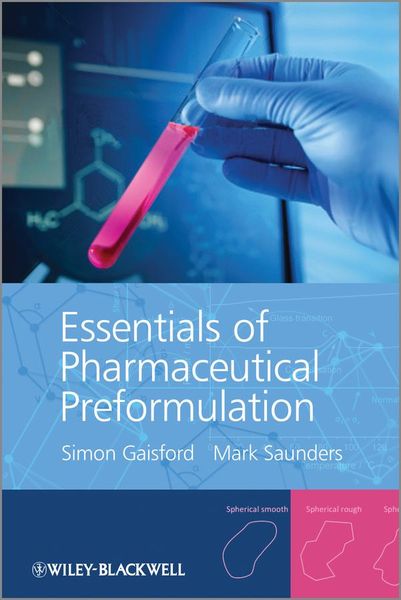
Essentials of Pharmaceutical Preformulation is a study guide which describes the basic principles of pharmaceutical physicochemical characterisation. Successful preformulation requires knowledge of fundamental molecular concepts (solubility, ionisation, partitioning, hygroscopicity and stability) and macroscopic properties (physical form, such as the crystalline and amorphous states, hydrates, solvates and co-crystals and powder properties), familiarity with the techniques used to measure them and appreciation of their effect on product performance, recognising that often there is a position of compromise to be reached between product stability and bioavailability.
This text introduces the basic concepts and discusses their wider implication for pharmaceutical development, with reference to many case examples of current drugs and drug products. Special attention is given to the principles and best-practice of the analytical techniques that underpin preformulation (UV spectrophotometry, TLC, DSC, XRPD and HPLC). The material is presented in the typical order that would be followed when developing a medicine and maps onto the indicative pharmacy syllabus of the Royal Pharmaceutical Society of Great Britain
Undergraduate-level pharmacy students and R&D / analytical scientists working in the pharmaceutical sector (with or without a pharmaceutical background) will find this text easy to follow with relevant pharmaceutical examples.
* Essential study guide for pharmacy and pharmaceutical science students
* Covers the pharmaceutical preformulation components of the Royal Pharmaceutical Society of Great Britain's indicative syllabus
* Easy to follow text highlighted with relevant pharmaceutical examples
* Self-assessment assignments in a variety of formats
* Written by authors with both academic and industrial experience
* Companion website with further information to maximise learning
This text introduces the basic concepts and discusses their wider implication for pharmaceutical development, with reference to many case examples of current drugs and drug products. Special attention is given to the principles and best-practice of the analytical techniques that underpin preformulation (UV spectrophotometry, TLC, DSC, XRPD and HPLC). The material is presented in the typical order that would be followed when developing a medicine and maps onto the indicative pharmacy syllabus of the Royal Pharmaceutical Society of Great Britain
Undergraduate-level pharmacy students and R&D / analytical scientists working in the pharmaceutical sector (with or without a pharmaceutical background) will find this text easy to follow with relevant pharmaceutical examples.
* Essential study guide for pharmacy and pharmaceutical science students
* Covers the pharmaceutical preformulation components of the Royal Pharmaceutical Society of Great Britain's indicative syllabus
* Easy to follow text highlighted with relevant pharmaceutical examples
* Self-assessment assignments in a variety of formats
* Written by authors with both academic and industrial experience
* Companion website with further information to maximise learning
Noch keine Bewertungen vorhanden
Verfassen Sie die erste Bewertung zu diesem Artikel
Helfen Sie anderen Kundinnen und Kunden durch Ihre Meinung.
Kurze Frage zu unserer Seite
Vielen Dank für Ihr Feedback
Wir nutzen Ihr Feedback, um unsere Produktseiten zu verbessern. Bitte haben Sie Verständnis, dass wir Ihnen keine Rückmeldung geben können. Falls Sie Kontakt mit uns aufnehmen möchten, können Sie sich aber gerne an unseren Kund*innenservice wenden.
zum Kundenservice