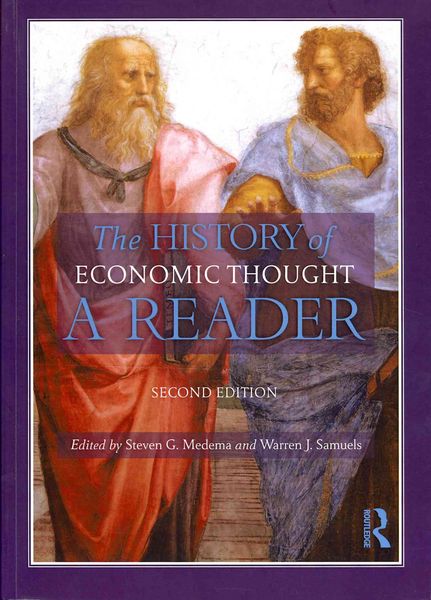
The History of Economic Thought A Reader; Second Edition
-
- Taschenbuch ausgewählt
- eBook
-
Sprache:Englisch
-
Verlag:Taylor & Francis
109,99 €
inkl. gesetzl. MwSt.,
Beschreibung
Produktdetails
Einband
Taschenbuch
Erscheinungsdatum
16.05.2013
Abbildungen
schwarz-weiss Illustrationen, Raster, schwarz-weiss, Zeichnungen, schwarz-weiss, Tabellen, schwarz-weiss
Herausgeber
Steven G. Medema + weitereVerlag
Taylor & FrancisSeitenzahl
784
Maße (L/B/H)
24,6/17,4/4,2 cm
Gewicht
1394 g
Auflage
2. Auflage
Sprache
Englisch
ISBN
978-0-415-56868-5
From the ancients to the moderns, questions of economic theory and policy have been an important part of intellectual and public debate, engaging the attention of some of history's greatest minds. This book brings together readings from more than two thousand years of writings on economic subjects. Through these selections, the reader can see first-hand how the great minds of past grappled with some of the central social and economic issues of their times and, in the process, enhanced our understanding of how economic systems function.
This collection of readings covers the major themes that have preoccupied economic thinkers throughout the ages, including price determination and the underpinnings of the market system, monetary theory and policy, international trade and finance, income distribution, and the appropriate role for government within the economic system. These ideas unfold, develop, and change course over time at the hands of scholars such as Aristotle, St. Thomas Aquinas, John Locke, François Quesnay, David Hume, Adam Smith, Thomas Robert Malthus, David Ricardo, John Stuart Mill, Karl Marx, William Stanley Jevons, Alfred Marshall, Irving Fisher, Thorstein Veblen, John Maynard Keynes, Milton Friedman, and Paul Samuelson. Each reading has been selected with a view to both enlightening the reader as to the major contributions of the author in question and to giving the reader a broad view of the development of economic thought and analysis over time.
This book will be useful for students, scholars, and lay people with an interest in the history of economic thought and the history of ideas generally.
Noch keine Bewertungen vorhanden
Verfassen Sie die erste Bewertung zu diesem Artikel
Helfen Sie anderen Kundinnen und Kunden durch Ihre Meinung.
Kurze Frage zu unserer Seite
Vielen Dank für Ihr Feedback
Wir nutzen Ihr Feedback, um unsere Produktseiten zu verbessern. Bitte haben Sie Verständnis, dass wir Ihnen keine Rückmeldung geben können. Falls Sie Kontakt mit uns aufnehmen möchten, können Sie sich aber gerne an unseren Kund*innenservice wenden.
zum Kundenservice