Gutscheinbedingungen

**Gültig bis 06.07.2026 auf fremdsprachige Bücher online auf thalia.at, in der Thalia App ab einem Mindestbestellwert von 30€ und in allen Thalia Buchhandlungen in Österreich. In den Buchhandlungen nur gültig auf lagernde Ware. Einzelne Artikel können ausgeschlossen sein. Ausgenommen sind preisgebundene Artikel & eBooks. Pro Einkauf einmal einlösbar. Nur gültig gegen Vorlage oder im Onlineshop hinterlegter Bonuscard. Infos zur Einlösung in der Buchhandlung sind auf der Bonuscard-Vorteilspreisseite zu finden. Click & Collect nur bei Onlinevorabzahlung möglich. Keine Einlösung bei Scan & Go-Bezahlung. Keine Barauszahlung. Nicht kombinierbar mit anderen Aktionen und Gutscheinen. Gutschein wird auf max. 500€ Bestellwert angerechnet. Nicht gültig für Versandkosten und Services.

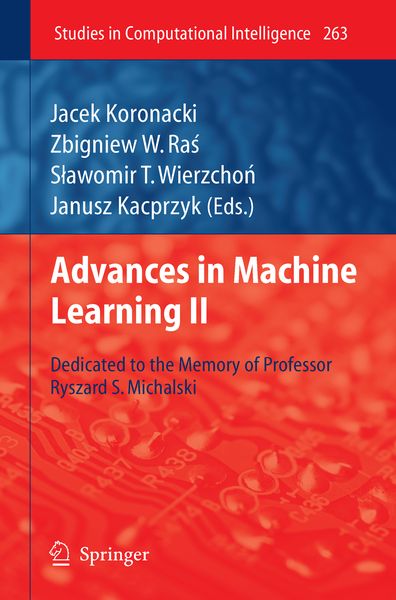
  • Produktbild: Advances in Machine Learning II
  • Produktbild: Advances in Machine Learning II
Band 263

Advances in Machine Learning II Dedicated to the memory of Professor Ryszard S. Michalski

201,99 €

inkl. gesetzl. MwSt., Versandkostenfrei


Beschreibung

Produktdetails

Einband

Taschenbuch

Erscheinungsdatum

04.05.2012

Herausgeber

Jacek Koronacki + weitere

Verlag

Springer Berlin

Seitenzahl

531

Maße (L/B/H)

23,5/15,5/3 cm

Gewicht

837 g

Auflage

2010

Sprache

Englisch

ISBN

978-3-642-26231-9

Beschreibung

Produktdetails

Einband

Taschenbuch

Erscheinungsdatum

04.05.2012

Herausgeber

Verlag

Springer Berlin

Seitenzahl

531

Maße (L/B/H)

23,5/15,5/3 cm

Gewicht

837 g

Auflage

2010

Sprache

Englisch

ISBN

978-3-642-26231-9

Herstelleradresse

Springer-Verlag KG
Sachsenplatz 4-6
1201 Wien
AT

Email: GPSR Kontakt

Noch keine Bewertungen vorhanden

Verfassen Sie die erste Bewertung zu diesem Artikel

Helfen Sie anderen Kundinnen und Kunden durch Ihre Meinung.

Kundinnen und Kunden meinen

Bewertungen (0)

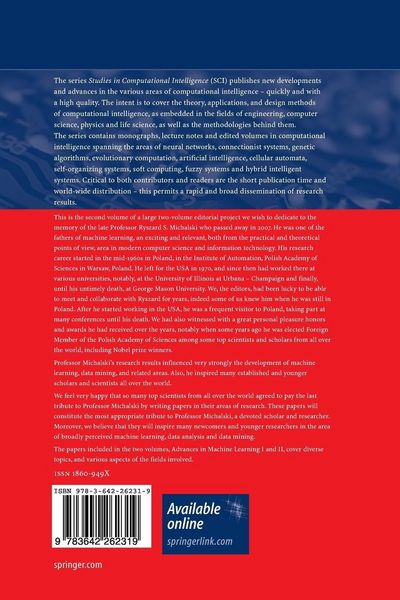
  • Produktbild: Advances in Machine Learning II
  • Produktbild: Advances in Machine Learning II
  • General Issues.- Knowledge-Oriented and Distributed Unsupervised Learning for Concept Elicitation.- Toward Interactive Computations: A Rough-Granular Approach.- Data Privacy: From Technology to Economics.- Adapting to Human Gamers Using Coevolution.- Wisdom of Crowds in the Prisoner’s Dilemma Context.- Logical and Relational Learning, and Beyond.- Towards Multistrategic Statistical Relational Learning.- About Knowledge and Inference in Logical and Relational Learning.- Two Examples of Computational Creativity: ILP Multiple Predicate Synthesis and the ‘Assets’ in Theorem Proving.- Logical Aspects of the Measures of Interestingness of Association Rules.- Text and Web Mining.- Clustering the Web 2.0.- Induction in Multi-Label Text Classification Domains.- Cluster-Lift Method for Mapping Research Activities over a Concept Tree.- On Concise Representations of Frequent Patterns Admitting Negation.- Classification and Beyond.- A System to Detect Inconsistencies between a Domain Expert’s Different Perspectives on (Classification) Tasks.- The Dynamics of Multiagent Q-Learning in Commodity Market Resource Allocation.- Simple Algorithms for Frequent Item Set Mining.- Monte Carlo Feature Selection and Interdependency Discovery in Supervised Classification.- Machine Learning Methods in Automatic Image Annotation.- Neural Networks and Other Nature Inspired Approaches.- Integrative Probabilistic Evolving Spiking Neural Networks Utilising Quantum Inspired Evolutionary Algorithm: A Computational Framework.- Machine Learning in Vector Models of Neural Networks.- Nature Inspired Multi-Swarm Heuristics for Multi-Knowledge Extraction.- Discovering Data Structures Using Meta-learning, Visualization and Constructive Neural Networks.- Neural Network and Artificial Immune Systems for Malware and Network Intrusion Detection.- Immunocomputing for Speaker Recognition.