KI-Beratung Beta

Gutscheinbedingungen

**Gültig bis 18.11.2026 auf englischsprachige Klassiker (klassiker-32728) online auf thalia.at und in der Thalia App. Einzelne Artikel können ausgeschlossen sein. Ausgenommen sind preisgebundene Artikel & eBooks. Pro Einkauf einmal einlösbar. Click & Collect nur bei Onlinevorabzahlung möglich. Keine Barauszahlung. Nicht kombinierbar mit anderen Aktionen und Gutscheinen. Gutschein wird auf max. 500€ Bestellwert angerechnet. Nicht gültig für Geschenkkarten, Versandkosten und Services.

Produktbild: Contemporary Curriculum Discourses
Band 70

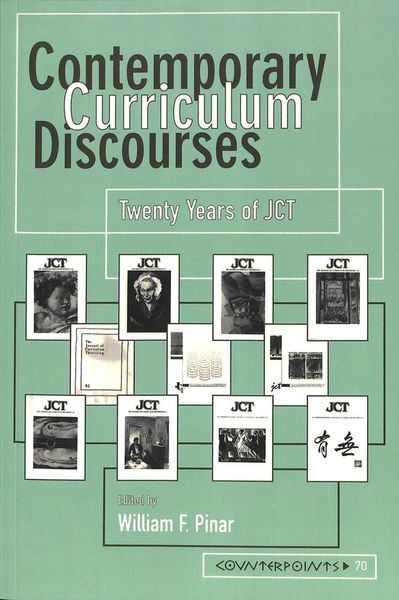
Contemporary Curriculum Discourses Twenty Years of JCT- Second Printing

Aus der Reihe Counterpoints

49,70 €

inkl. gesetzl. MwSt., Versandkostenfrei


Beschreibung

JCT was the most important journal of curriculum studies during the field’s «paradigm» shift in the 1970s. Its editors sponsored a yearly conference, which also supported the «intellectual breakthrough» that was the reconceptualization of American curriculum studies. This collection brings together «the...

Beschreibung

JCT was the most important journal of curriculum studies during the field’s «paradigm» shift in the 1970s. Its editors sponsored a yearly conference, which also supported the «intellectual breakthrough» that was the reconceptualization of American curriculum studies. This collection brings together «the best» of JCT articles, plus key documentary material of importance to scholars and students alike. Undergraduate and graduate students in curriculum, instruction, and foundations would find this book useful and insightful.

Rezension

«This is a celebration and a farewell. Twenty years have passed since ‘JCT’ and its conference appeared on the scene: twenty years of innovative and provocative articles, essays, several book-length pieces, and many remarkable conference presentations. I have used the term ‘reconceptualization’ to describe what occurred in the field during the 1970s, but the term is not dramatic enough to express the role that ‘JCT’ and the Bergamo Conference have played. Perhaps ‘intellectual breakthrough’ is more descriptive. You will, I think, agree with my choice of phrases once you’ve moved through this remarkable collection... Let us celebrate what is truly a collective achievement.» (From the introduction by William F. Pinar)

Portrait

The Editor: William F. Pinar teaches curriculum theory at Louisiana State University, where he serves as the St. Bernard Parish Alumni Endowed Professor. He is the author of Autobiography, Politics, and Sexuality (Lang, 1994), and senior author of Understanding Curriculum (Lang, 1995).

Produktdetails

Einband

Taschenbuch

Erscheinungsdatum

01.07.1999

Herausgeber William F. Pinar
Verlag Peter Lang Publishing Inc. New York

Produktdetails

Einband

Taschenbuch

Erscheinungsdatum

01.07.1999

Herausgeber William F. Pinar
Verlag Peter Lang Publishing Inc. New York
Seitenzahl

578

Maße (B/H)

14,8/21 cm

Gewicht

820 g

Auflage

2

Sprache

Englisch

ISBN

978-0-8204-3882-5

EU-Ansprechpartner

Kolibri 360 GmbH
Ettore-Bugatti-Straße 6-14
51149 Köln
DE
produktsicherheit@kolibri360.de

Herstelleradresse

Peter Lang
Avenue du Théâtre 7
1005 Lausanne
CH
orders@peterlang.com

Noch keine Bewertungen vorhanden

Verfassen Sie die erste Bewertung zu diesem Artikel

Helfen Sie anderen Kundinnen und Kunden durch Ihre Meinung.

Kundinnen und Kunden meinen

Bewertungen (0)

  • Produktbild: Contemporary Curriculum Discourses
  • Contents: William F. Pinar: Farewell and Celebrate – William F. Pinar: Editorial Statement – William F. Pinar: Notes on the Relationship Between a Field and Its Journals – Florence R. Krall: Living Metaphors. The Real Curriculum in Environmental Education – Henry A. Giroux: Dialectics and the Development of Curriculum Theory – Madeleine R. Grumet: Autobiography and Reconceptualization – Janet L. Miller: Women. The Evolving Educational Consciousness – Nel Noddings: Caring – William F. Pinar: Caring: Gender Considerations. A Response to Nel Noddings’ «Caring» – Mary Anne Raywid: Up From Agapé. Response to «Caring» by Nel Noddings – Herbert M. Kliebard: Dewey and the Herbartians: The Genesis of a Theory of Curriculum – Jo Anne Pagano: The Curriculum Field. Emergence of a Discipline – Mary Aswell Doll: Beyond the Window. Dreams and Learning – Michael S. Littleford: Curriculum Theorizing and the Possibilities and Conditions for Social Action. Toward Democratic Community and Education – Philip Wexler: Body and Soul. Sources of Social Change and Strategies of Education – Shigeru Asanuma: The Autobiographical Method in Japanese Education – Ted T. Aoki: Toward Understanding «Computer Application» – Alan A. Block: The Answer is Blowin’ in the Wind. A Deconstructive Reading of the School Text – Kathleen Casey: Teachers and Values. The Progressive Use of Religion in Education – Madeleine R. Grumet: Word Worlds. The Literary Reference for Curriculum Criticism – Patti Lather: Ideology and Methodological Attitude – David W. Jardine: A Bell Ringing in the Empty Sky – Patrick Slattery: Toward an Eschatological Curriculum Theory – Dennis Sumara: Of Seagulls and Glass Roses. Teachers’ Relationships with Literary Texts as Transformational Space – Michael W. Apple: Remembering Capital. On the Connections Between French Fries and Education – Brent Davis: Thinking Otherwise and Hearing Differently. Enactivism and School Mathematics – Joe L. Kincheloe: Schools Where Ronnie and Brandon Would Have Excelled. A Curriculum Theory of Academic and Vocational Integration – Cameron McCarthy: The Palace of the Peacock. Wilson Harris and the Curriculum in Troubled Times – Deborah P. Britzman: On Becoming a «Little Sex Researcher». Some Comments on a Polymorphously Perverse Curriculum – Suzanne de Castell: On Finding One’s Place in the Text. Literacy as a Technology of Self-Formation – Marla Morris: Toward a Ludic Pedagogy. An Uncertain Occasion – Petra Munro: Resisting «Resistance». Stories Women Teachers Tell – David Geoffrey Smith: Identity, Self, and Other in the Conduct of Pedagogical Action. An East/West Inquiry – Shirley R. Steinberg: Early Education as a Gendered Construction.