Gutscheinbedingungen

**Gültig bis 14.09.2026 auf Spielzeug, Schreibwaren, Filme, Geschenke & Trends, Musik, tolino eReader & Zubehör, Hörbücher, nicht preisgebundene Bücher und Kalender in der Thalia App. Einzelne Artikel können ausgeschlossen sein. Aufgrund der Buchpreisbindung sind deutschsprachige Bücher und eBooks ausgenommen. Zusätzlich ausgenommen sind Abos & Flatrates, Games, Geschenkkarten/-boxen, Shelfies, Software, Zeitschriften sowie einzelne Artikel von tonies®. Pro Einkauf einmal einlösbar. Nur gültig mit im Onlineshop hinterlegter Bonuscard. Click & Collect nur bei Onlinevorabzahlung möglich. Keine Barauszahlung. Nicht kombinierbar mit anderen Aktionen und Gutscheinen. Gutschein wird auf max. 500€ Bestellwert angerechnet. Nicht gültig für Versandkosten und Services.

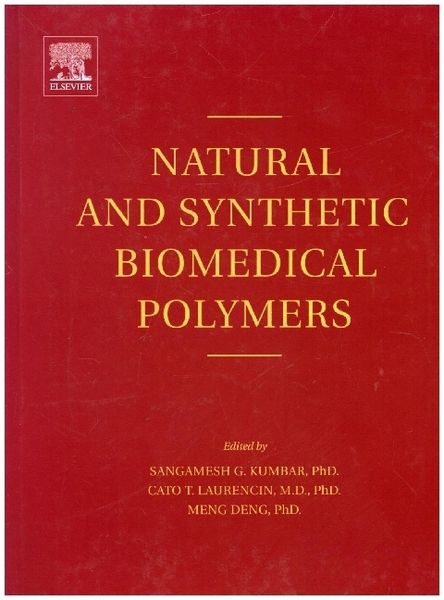
Produktbild: Natural and Synthetic Biomedical Polymers

Natural and Synthetic Biomedical Polymers

97,99 €

inkl. gesetzl. MwSt., Versandkostenfrei


Beschreibung

Produktdetails

Einband

Gebundene Ausgabe

Erscheinungsdatum

20.02.2014

Herausgeber

Sangamesh G. Kum bar + weitere

Verlag

Elsevier Science

Seitenzahl

420

Maße (L/B/H)

28,7/22,2/2,5 cm

Gewicht

1404 g

Sprache

Englisch

ISBN

978-0-12-396983-5

Beschreibung

Rezension

"Each chapter has a detailed table of contents. The text is generally well supported with figures and tables. Original literature is extensively cited. A useful index is provided. Overall, the book provides a concise introduction to biomedical polymers. It is hardbound and produced to a good quality."--Biotechnology Advances, 32, 2014

Portrait

Dr. Kumbar is an Assistant Professor in the Departments of Orthopaedic Surgery, Materials Science & Engineering and Biomedical Engineering at the University of Connecticut. His research is focused on synthesis and characterization of novel biomaterials for tissue engineering and drug delivery applications. These polymeric materials namely polysaccharides, polyphosphazenes, polyanhydrides, polyesters as well as blends of two or more of the polymeric materials and composites combining the polymeric materials with ceramics in the form of 3-dimentional porous structures will serve as scaffolds for variety of tissue engineering applications. Dr. Kumbar is an active member of Society for Biomaterials (SFB), Controlled Release Society (CRS), Materials Research Society (MRS) and Orthopaedic Research Society (ORS). Dr. Kumbar is serving as a reviewer for more than 25 journals in the field of biomaterials, drug delivery and tissue engineering. He has recently edited a book "Natural and Synthetic Biomedical Polymers” Elsevier Science & Technology, 2014- ISBN: 978-0-12-396983-5. He is also on the Editorial Board of more than 7 journals in the area of his expertise including Journal of Biomedical Materials Research-Part B, Journal of Applied Polymer Science, and Journal of Biomedical Nanotechnology.

Dr. Laurencin is the Van Dusen Distinguished Endowed Professor of Orthopaedic Surgery, and Professor of Chemical, Materials, and Biomedical Engineering at the University of Connecticut. In addition, Dr. Laurencin is a University Professor at the University of Connecticut (the 7th in the institution's history). He is the Director of both the Institute for Regenerative Engineering, and the Raymond and Beverly Sackler Center at the University of Connecticut Health Center. Dr. Laurencin serves as the Chief Executive Officer of the Connecticut Institute for Clinical and Translational Science at UCONN.

Dr. Laurencin earned his undergraduate degree in Chemical Engineering from Princeton, his medical degree, Magna Cum Laude, from Harvard Medical School, and his Ph.D. in Biochemical Engineering/Biotechnology from M.I.T.

A board certified orthopaedic surgeon and shoulder/ knee specialist, he won the Nicolas Andry Award from the Association of Bone and Joint Surgeons. His discoveries in research have been highlighted by Scientific American Magazine, and more recently by National Geographic Magazine in its "100 Scientific Discoveries that Changed the World” edition.

Dr. Laurencin is an outstanding mentor and he has received the Presidential Award for Excellence in Science, Mathematics and Engineering Mentoring in ceremonies at the White House. Dr. Laurencin has received the Elizabeth Hurlock Beckman Award for mentoring, and the American Association for the Advancement of Science's Mentor Award.

Dr. Laurencin previously served as the UConn Health Center's Vice President for Health Affairs and Dean of the School of Medicine. Prior to that, Dr. Laurencin was the Lillian T. Pratt Distinguished Professor and Chair of the Department of Orthopaedic Surgery at the University of Virginia, and Orthopaedic Surgeon-in-Chief for the University of Virginia Health System.

Dr. Laurencin is an elected member of the Institute of Medicine of the National Academy of Sciences, and an elected member of the National Academy of Engineering. He is also an elected member of the National Academy of Inventors.

Produktdetails

Einband

Gebundene Ausgabe

Erscheinungsdatum

20.02.2014

Herausgeber

Verlag

Elsevier Science

Seitenzahl

420

Maße (L/B/H)

28,7/22,2/2,5 cm

Gewicht

1404 g

Sprache

Englisch

ISBN

978-0-12-396983-5

Herstelleradresse

Libri GmbH
Europaallee 1
36244 Bad Hersfeld
DE

Email: gpsr@libri.de

Noch keine Bewertungen vorhanden

Verfassen Sie die erste Bewertung zu diesem Artikel

Helfen Sie anderen Kundinnen und Kunden durch Ihre Meinung.

Kundinnen und Kunden meinen

Bewertungen (0)

Die Leseprobe wird geladen.
  • Produktbild: Natural and Synthetic Biomedical Polymers
  • Section 1. Synthesis and Characterization
    1.1. Polymer Synthesis: the design and synthesis of important classes of polymeric biomaterials involving different monomers will be discussed.
    1.2. Characterization of Polymeric Biomaterials: in vitro and in vivo characterization of advanced biomaterials, (cell and tissue interactions with polymeric biomaterials with various physico-chemical, mechanical properties, surface and degradation properties
    Section 2. Currently Used Materials
    2.1. Proteins and poly(amino acids) including collagen, poly(amino acids), elastin and elastin-like polypeptides, albumin, and fibrin
    2.2. Polysaccharides including hyaluronic acid, chondroitin sulfate, chitin and chitosan, and alginic acid
    2.3. Poly(¿-ester)s including polylactides, polyglycolide, poly(lactide-co-glycolide), polycaprolactone, and bacterial polyesters
    2.4. Polyurethanes
    2.5. Poly(ester amide)
    2.6. Poly(ortho esters)
    2.7. Polyanhydrides
    2.8. Poly(propylene fumarate)
    2.9. Polyphosphazenes
    2.10. Pseudo poly(amino acid)s
    2.11. Polyphosphoester
    2.12. Polyacetals
    2.13. Poly(ethylene glycol)-based biomaterials
    2.14. Dendrimers
    2.15. Elastomers
    Section 3. Biomedical Applications of Polymeric Biomaterials
    3.1. Polymeric Biomaterials in Biomedical Implants
    3.2. Polymeric Biomaterials in Drug Delivery
    3.3. Polymeric Biomaterials in Tissue Engineering
    3.4. Polymeric Biomaterials in Medical Diagnostics