KI-Beratung Beta

Gutscheinbedingungen

**Gültig am 20.11.2026 ab einem Mindestbestellwert von 30€ auf Spielzeug, Schreibwaren, Filme, Geschenke & Trends, Musik, tolino eReader & Zubehör, Hörbücher und Hörbuch-Downloads, nicht preisgebundene Bücher und Kalender online auf thalia.at und in der Thalia App. Einzelne Artikel können ausgeschlossen sein. Aufgrund der Buchpreisbindung sind deutschsprachige Bücher und eBooks ausgenommen. Zusätzlich ausgenommen sind Abos & Flatrates, Games, Geschenkkarten/-boxen, Shelfies, Software, Zeitschriften sowie einzelne Artikel von tonies®. Pro Einkauf einmal einlösbar. Click & Collect nur bei Onlinevorabzahlung möglich. Keine Barauszahlung. Nicht kombinierbar mit anderen Aktionen und Gutscheinen. Gutschein wird auf max. 500€ Bestellwert angerechnet. Nicht gültig für Versandkosten und Services. Preisgebundene Artikel sind vom Mindestbestellwert ausgeschlossen.

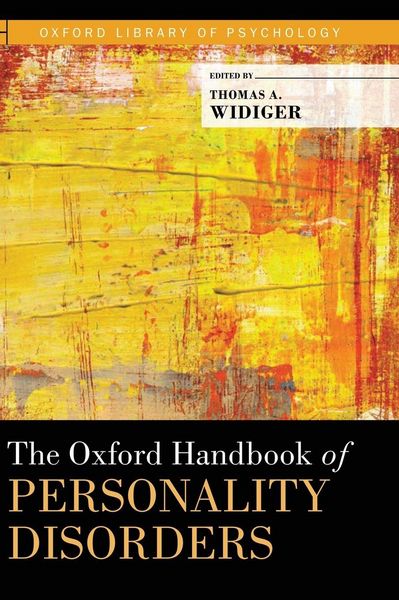
Produktbild: Oxford Handbook of Personality Disorders

Oxford Handbook of Personality Disorders

286,99 €

inkl. gesetzl. MwSt., Versandkostenfrei


Beschreibung

On the cusp of newest edition of the DSM, the field of personality disorders is thriving and productive. This is certainly a time of major transition for the classification, study, and treatment of personality disorders, as the personality disorders section of the DSM is undergoing major revision, leaving...

Beschreibung

On the cusp of newest edition of the DSM, the field of personality disorders is thriving and productive. This is certainly a time of major transition for the classification, study, and treatment of personality disorders, as the personality disorders section of the DSM is undergoing major revision, leaving researchers and clinicians to wonder whether their area of specialty in the field of personality disorders will be retained, deleted, or revised in DSM-5.
In advance of DSM-5, The Oxford Handbook of Personality Disorders provides a summary of the latest information concerning the diagnosis, assessment, construct validity, etiology, pathology, and treatment of personality disorders. Bringing together contributions from leading scholars, researchers, and clinicians from a wide variety of theoretical perspectives, this volume includes:
- Chapters devoted to personality disorders proposed for retention in DSM-5
- Chapters concerning personality disorders that are slated for deletion
- Chapters concerning three that have never obtained or had previously lost official recognition (i.e. passive-aggressive, depressive, and racist)
- Chapters authored by members of the DSM-5 Personality Disorders Work Group, which succinctly outline and explain the proposals, as well as chapters by authors who raise significant questions and concerns (often differing) about these proposals
- Special coverage of largely neglected areas of investigation (i.e. childhood antecedents of personality disorder, cross-cultural validity)
- Controversial areas for the DSM, such as schizotypal personality disorder, narcissism, depressive personality disorder, dependent personality disorder, and dimensional classification
In this time of transition, scholarship on personality disorders is proliferating, making this comprehensive, timely handbook the perfect resource for students, researchers, and clinical psychologists.

Rezension

The Oxford Handbook of Personality Disorders testifies to the fields vitality: It documents a rich and varied literature spanning basic biological mechanisms and cultural influences that will appeal to researchers and clinicians alike and indeed to anyone with an interest in mental health seeking an in-depth understanding of personality disorder. Anyone who has read the 38 chapters cannot but be impressed by the wealth of information that has accumulated in the 30-plus years since the third edition of the Diagnostic and Statistical Manual of Mental Disorders (DSMIII; American Psychiatric Association, 1980) was published... It provides a comprehensive overview so that anyone reading it will be well informed about the current state of personality disorder research and practice. I am not familiar with any other volume that is as comprehensive or as up to date. PsycCRITIQUES, August 2013

Produktdetails

Einband

Gebundene Ausgabe

Erscheinungsdatum

13.09.2012

Herausgeber Thomas A. Widiger + weitere
Verlag Oxford University Press

Produktdetails

Einband

Gebundene Ausgabe

Erscheinungsdatum

13.09.2012

Herausgeber
Verlag Oxford University Press
Seitenzahl

856

Maße (L/B/H)

26/18,3/5 cm

Gewicht

1773 g

Sprache

Englisch

ISBN

978-0-19-973501-3

Herstelleradresse

Libri GmbH
Europaallee 1
36244 Bad Hersfeld
DE

Email: gpsr@libri.de

Noch keine Bewertungen vorhanden

Verfassen Sie die erste Bewertung zu diesem Artikel

Helfen Sie anderen Kundinnen und Kunden durch Ihre Meinung.

Kundinnen und Kunden meinen

Bewertungen (0)

  • Produktbild: Oxford Handbook of Personality Disorders
    • 1. Preface

    • Thomas A. Widiger

    • Part One: Introduction and Clinical Description

    • 2. Historical Developments and Current Issues

    • Thomas A. Widiger

    • 3. Diagnosis and DSM-5: Work in Progress

    • Andrew Skodol

    • 4. The Schedule for Nonadaptive and Adaptive Personality: A Useful Tool for Diagnosis and Classification of Personality Disorder

    • Eunyoe Ro, Deborah Stringer, and Lee Anna Clark

    • 5. An Integration of Normal and Abnormal Personality: The Five-Factor Model

    • Thomas A. Widiger, Douglas B. Samuel, Stephanie Mullins-Sweatt, Whitney L. Gore, and Cristina Crego

    • 6. Assessment of Personality disorders and Related Traits: Bridging DSM-IV-TR and DSM-5

    • Joshua D. Miller, Lauren Few, and Thomas A. Widiger

    • Part Two: Construct Validity

    • 7. Behavior and Molecular Genetics of Personality Disorders

    • Susan C. South, Ted Reichborn-Kjennerud, Nicholas R. Eaton, and Robert F. Krueger

    • 8. Childhood Antecedents of Personality Disorders

    • Filip De Fruyt and Barbara De Clercq

    • 9. Epidemiology

    • Svenn Torgersen

    • 10. Gender and Personality Disorders

    • Thomas F. Oltmanns and Abigail D. Powers

    • 11. Axis II Comorbidity

    • Timothy J. Trull, Emily M. Scheiderer, and Rachel L. Tomko

    • 12. The Relationship of Personality Disorders and Axis I Clinical Disorders

    • Paul S. Links, Jamal Y Ansari, Fatima Fazalullash, and Ravi Shah

    • 13. Cultural Aspects of Personality Disorder

    • Roger T. Mulder

    • 14. Course of Personality Disorder

    • Leslie C. Morey and Justin K. Meyer

    • Part Three: Psychopathology

    • 15. Neurobiological Contributions

    • Panos Roussos and Larry J. Siever

    • 16. Cognitive Contributions to Personality Disorder

    • Jill Lobbestael and Arnoud Arntz

    • 17. Psychodynamic Models of Personality Disorders

    • Peter Fonagy and Patrick Luyten

    • 18. A Contemporary Interpersonal Model of Personality Pathology and Personality Disorder

    • Aaron L. Pincus and Christopher J. Hopwood

    • 19. Pathology of Personality Disorder: An Integrative Perspective

    • Joel Paris

    • Part Four: Individual Personality Disorders

    • 20. Borderline Personality Disorder

    • Jill M. Hooley, Sadie H. Cole, and Stephanie Gironde

    • 21. Schizotypal Personality Disorder: An Integrative Review

    • Thomas R. Kwapil and Neus Barrantes-Vidal

    • 22. Psychopathy

    • Robert D. Hare, Craig S. Neumann, and Thomas A. Widiger

    • 23. Dependent Personality Disorder

    • Robert F. Bornstein

    • 24. Narcissistic Personality Disorder: The Diagnostic Process

    • Elsa Ronningstam

    • 25. Avoidant Personality Disorder, Traits, and Type

    • Charles A. S