KI-Beratung Beta

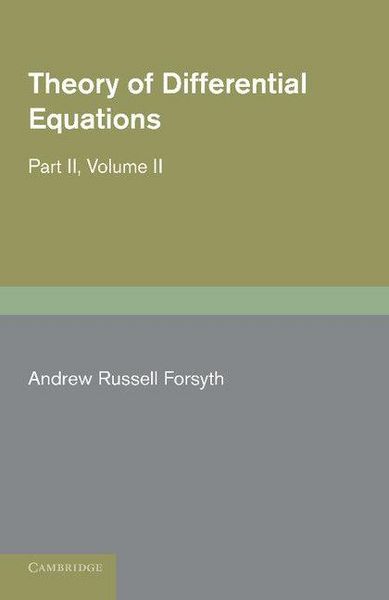
  • Produktbild: Theory of Differential Equations
  • Produktbild: Theory of Differential Equations

Theory of Differential Equations Ordinary Equations, Not Linear

65,99 €

inkl. gesetzl. MwSt., Versandkostenfrei


Beschreibung

Andrew Russell Forsyth (1858-1942) was an influential Scottish mathematician notable for incorporating the advances of Continental mathematics within the British tradition. Originally published in 1900, this book constitutes the second of six volumes in Forsyth's Theory of Differential Equations series,...

Beschreibung

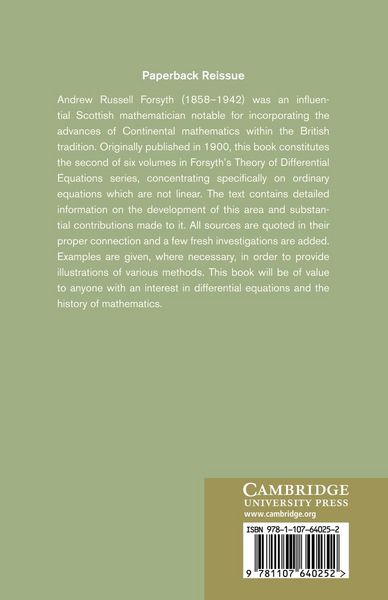
Andrew Russell Forsyth (1858-1942) was an influential Scottish mathematician notable for incorporating the advances of Continental mathematics within the British tradition. Originally published in 1900, this book constitutes the second of six volumes in Forsyth's Theory of Differential Equations series, concentrating specifically on ordinary equations which are not linear. The text contains detailed information on the development of this area and substantial contributions made to it. All sources are quoted in their proper connection and a few fresh investigations are added. Examples are given, where necessary, in order to provide illustrations of various methods. This book will be of value to anyone with an interest in differential equations and the history of mathematics.

Produktdetails

Einband

Taschenbuch

Erscheinungsdatum

15.03.2012

Verlag Cambridge Academic
Seitenzahl

358

Produktdetails

Einband

Taschenbuch

Erscheinungsdatum

15.03.2012

Verlag Cambridge Academic
Seitenzahl

358

Maße (L/B/H)

21,6/14/2,1 cm

Gewicht

460 g

Sprache

Englisch

ISBN

978-1-107-64025-2

Noch keine Bewertungen vorhanden

Verfassen Sie die erste Bewertung zu diesem Artikel

Helfen Sie anderen Kundinnen und Kunden durch Ihre Meinung.

Kundinnen und Kunden meinen

Bewertungen (0)

  • Produktbild: Theory of Differential Equations
  • Produktbild: Theory of Differential Equations
  • 1. Introductory; 2. Cauchy's theorem on the existence of regular integrals of a system of equations; 3. Classes of non-ordinary points connected with the form of the equation of the first order and first degree in the derivative; 4. Influence, upon the integral, of an accidental singularity of the first kind possessed by the equation; 5. Reduction of the differential equation to final typical forms, valid in the vicinity of an accidental singularity of the second kind; 6. The character of the integrals possessed by the respective reduced forms of the original equation in the vicinity of the accidental singularity of the second kind; 7. Effect, upon the integral, of essential singularities of the equation; 8. Branch-points of an equation of the first order and any degree, as determined by the equation: singular and particular solutions; 9. Differential equations of the first order having their integrals free from parametric branch-points; 10. Equations of first order with uniform integrals, and with algebraical integrals.