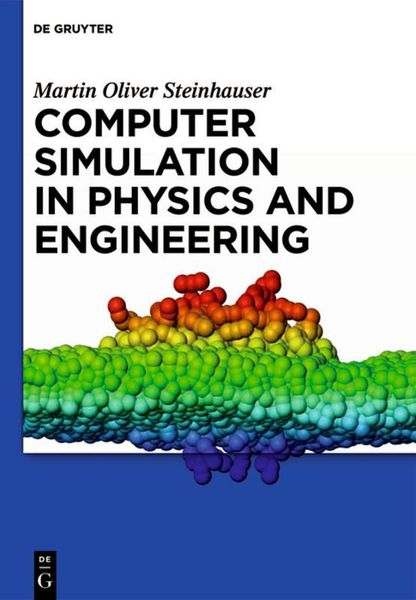
• Produktbild: Computer Simulation in Physics and Engineering
  • Produktbild: Computer Simulation in Physics and Engineering

Computer Simulation in Physics and Engineering

196,99 €

inkl. gesetzl. MwSt., Versandkostenfrei


Beschreibung

Produktdetails

Einband

Gebundene Ausgabe

Erscheinungsdatum

15.11.2012

Abbildungen

110 ill.

Verlag

De Gruyter

Seitenzahl

509

Maße (L/B/H)

24,6/17,5/3,4 cm

Gewicht

1030 g

Auflage

1

Sprache

Englisch

ISBN

978-3-11-025590-4

Beschreibung

Produktdetails

Einband

Gebundene Ausgabe

Erscheinungsdatum

15.11.2012

Abbildungen

110 ill.

Verlag

De Gruyter

Seitenzahl

509

Maße (L/B/H)

24,6/17,5/3,4 cm

Gewicht

1030 g

Auflage

1

Sprache

Englisch

ISBN

978-3-11-025590-4

Herstelleradresse

Walter de Gruyter
Genthiner Straße 13
10785 Berlin
DE

Email: productsafety@degruyterbrill.com

Noch keine Bewertungen vorhanden

Verfassen Sie die erste Bewertung zu diesem Artikel

Helfen Sie anderen Kundinnen und Kunden durch Ihre Meinung.

Kundinnen und Kunden meinen

Bewertungen (0)

  • Produktbild: Computer Simulation in Physics and Engineering
  • Produktbild: Computer Simulation in Physics and Engineering
  • Preface

    1. Introduction to Computer Simulation
    1.1 Historical Background
    1.2 Theory, Modeling and Simulation in Physics
    1.3 Reductionism in Physics
    1.4 Basics of Ordinary and Partial Differential Equations in Physics
    1.5 Numerical Solution of Differential Equations: Mesh-Based vs. Particle Methods
    1.6 The Role of Algorithms in Scientific Computing
    1.7 Remarks on Software Design
    1.8 Summary

    2. Fundamentals of Statistical Physics
    2.1 Introduction
    2.2 Elementary Statistics
    2.3 Introduction to Classical Statistical Mechanics
    2.4 Introduction to Thermodynamics
    2.5 Summary

    3. Inter- and Intramolecular Short-Range Potentials
    3.1 Introduction
    3.2 Quantum Mechanical Basis of Intermolecular Interactions
    3.2.1 Perturbation Theory
    3.3 Classical Theories of Intermolecular Interactions
    3.4 Potential Functions
    3.5 Molecular Systems
    3.6 Summary

    4. Molecular Dynamics Simulation
    4.1 Introduction
    4.2 Basic Ideas of MD
    4.3 Algorithms for Calculating Trajectories
    4.4 Link between MD and Quantum Mechanics
    4.5 Basic MD Algorithm: Implementation Details
    4.6 Boundary Conditions
    4.7 The Cutoff Radius for Short-Range Potentials
    4.8 Neighbor Lists: The Linked-Cell Algorithm
    4.9 The Method of Ghost Particles
    4.10 Implementation Details of the Ghost Particle Method
    4.11 Making Measurements
    4.12 Ensembles and Thermostats
    4.13 Case Study: Impact of Two Different Bodies
    4.14 Case Study: Rayleigh-Taylor Instability
    4.15 Case Study: Liquid-Solid Phase Transition of Argon

    5. Advanced MD Simulation
    5.1 Introduction
    5.2 Parallelization
    5.3 More Complex Potentials and Molecules
    5.4 Many Body Potentials
    5.5 Coarse Grained MD for Mesoscopic Systems

    6. Outlook on Monte Carlo Simulations
    6.1 Introduction
    6.2 The Metropolis Monte-Carlo Method
    6.2.1 Calculation of Volumina and Surfaces
    6.2.2 Percolation Theory
    6.3 Basic MC Algorithm: Implementation Details
    6.3.1 Case Study: The 2D Ising Magnet
    6.3.2 Trial Moves and Pivot Moves
    6.3.3 Case Study: Combined MD and MC for Equilibrating a Gaussian Chain
    6.3.4 Case Study: MC of Hard Disks
    6.3.5 Case Study: MC of Hard Disk Dumbbells in 2D
    6.3.6 Case Study: Equation of State for the Lennard-Jones Fluid
    6.4 Rosenbluth and Rosenbluth Method
    6.5 Bond Fluctuation Model
    6.6 Monte Carlo Simulations in Different Ensembles
    6.7 Random Numbers Are Hard to Find

    7. Applications from Soft Matter and Shock Wave Physics
    7.1 Biomembranes
    7.2 Scaling Properties of Polymers
    7.3 Polymer Melts
    7.4 Polymer Networks as a Model for the Cytoskeleton of Cells
    7.5 Shock Wave Impact in Brittle Solids

    8. Concluding Remarks

    A Appendix
    A.1 Quantum Statistics of Ideal Gases
    A.2 Maxwell-Boltzmann, Bose-Einstein- and Fermi-Dirac Statistics
    A.3 Stirling's Formula
    A.4 Useful Integrals in Statistical Physics
    A.3 Useful Conventions for Implementing Simulation Programs
    A.4 Quicksort and Heapsort Algorithms
    A.4 Selected Solutions to Exercises
    Abbreviations
    Bibliography
    Index