
KI-Beratung Beta

Gutscheinbedingungen

**Gültig bis 11.11.2026 auf Spielzeug, Schreibwaren, Filme, Geschenke & Trends, Musik, tolino eReader & Zubehör, Hörbücher und Hörbuch-Downloads, nicht preisgebundene Bücher und Kalender online auf thalia.at und in der Thalia App. Einzelne Artikel können ausgeschlossen sein. Aufgrund der Buchpreisbindung sind deutschsprachige Bücher und eBooks ausgenommen. Zusätzlich ausgenommen sind Abos & Flatrates, Games, Geschenkkarten/-boxen, Shelfies, Software, Zeitschriften sowie einzelne Artikel von tonies®. Pro Einkauf einmal einlösbar. Click & Collect nur bei Onlinevorabzahlung möglich. Keine Barauszahlung. Nicht kombinierbar mit anderen Aktionen und Gutscheinen. Gutschein wird auf max. 500€ Bestellwert angerechnet. Nicht gültig für Versandkosten und Services.

  • Produktbild: Philosophy and Cognitive Science
  • Produktbild: Philosophy and Cognitive Science
Band 2 - 13%

Philosophy and Cognitive Science Western & Eastern Studies

13% sparen

189,99 € UVP 219,99 €

inkl. gesetzl. MwSt., Versandkostenfrei


Beschreibung

The book addresses a number of recent topics at the crossroad of philosophy and cognitive science, taking advantage of both the western and the eastern perspectives and conceptions that emerged and were discussed at the PCS2011 Conference recently held in Guangzhou. The ever growing cultural exchange...

Beschreibung

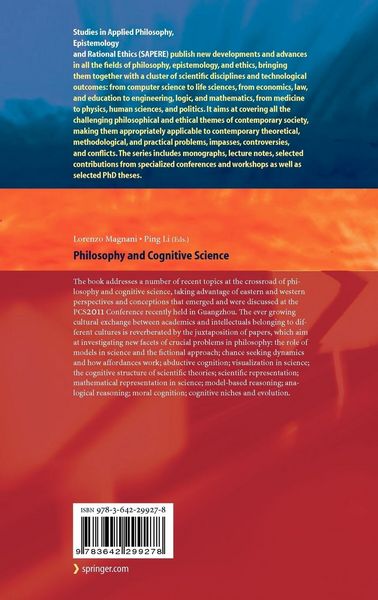
The book addresses a number of recent topics at the crossroad of philosophy and cognitive science, taking advantage of both the western and the eastern perspectives and conceptions that emerged and were discussed at the PCS2011 Conference recently held in Guangzhou. The ever growing cultural exchange between academics and intellectual belonging to different cultures is reverberated by the juxtaposition of papers, which aim at investigating new facets of crucial problems in philosophy: the role of models in science and the fictional approach; chance seeking dynamics and how affordances work; abductive cognition; visualization in science; the cognitive structure of scientific theories; scientific representation; mathematical representation in science; model-based reasoning; analogical reasoning; moral cognition; cognitive niches and evolution.

Rezension

From the reviews:


“The 14 chapters in the book are divided into two sections, ‘Models, Representation, and Cognition’ and ‘Abduction, Reasoning, and Cognition.’ … this is an interesting and important collection, well-worth consulting for a broader view of a rapidly expanding academic world.” (Ryan D. Tweney, Mind & Society, 2013)

Produktdetails

Einband

Gebundene Ausgabe

Erscheinungsdatum

14.07.2012

Abbildungen

X, 290 p.

Herausgeber Lorenzo Magnani + weitere

Produktdetails

Einband

Gebundene Ausgabe

Erscheinungsdatum

14.07.2012

Abbildungen

X, 290 p.

Herausgeber
Verlag Springer Berlin
Seitenzahl

290

Maße (L/B/H)

24,1/16/2,1 cm

Gewicht

565 g

Auflage

2012

Sprache

Englisch

ISBN

978-3-642-29927-8

Herstelleradresse

Springer-Verlag KG
Sachsenplatz 4-6
1201 Wien
AT

Email: ProductSafety@springernature.com

Noch keine Bewertungen vorhanden

Verfassen Sie die erste Bewertung zu diesem Artikel

Helfen Sie anderen Kundinnen und Kunden durch Ihre Meinung.

Kundinnen und Kunden meinen

Bewertungen (0)

  • Produktbild: Philosophy and Cognitive Science
  • Produktbild: Philosophy and Cognitive Science
  • Scientific Models Are Not Fictions. Model-Based Science as Epistemic Warfare.- An Examination of the Thesis of Models as Representations.- On Animal Cognition: Before and After the Beast-Machine Controversy.- From Mindless Modeling to Scientific Models. The Case of Emerging Models.- The Greenhouse Metaphor and the Greenhouse Effect: A Case Study of a Flawed Analogous Model.- A Study of Model and Representation Based on a Duhemian Thesis.- From The Received View to the Model-Theoretic Approach.- Cognitive Chance Discovery. From Abduction to Affordance.- A Proposal on Belief, Abduction and Interpretation.- Not by Luck Alone. The Importance of Chance-Seeking and Silent Knowledge in Abductive Cognition.- Cognitive Abduction and the Study of Visual Culture.- Understanding Scientific Inference in the Natural Sciences Based on Abductive Inference Strategies.- Moral, intuitions vs. Moral Reasoning. A Philosophical Analysis of the Explanatory Models Intuitionism Relies on.- Evolutionary Tolerance.