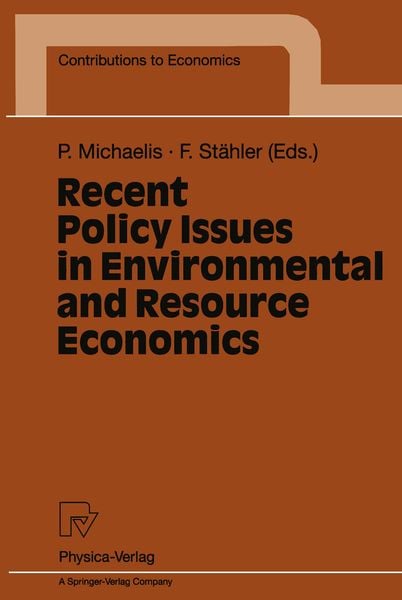
• Produktbild: Recent Policy Issues in Environmental and Resource Economics
  • Produktbild: Recent Policy Issues in Environmental and Resource Economics
- 11%

Recent Policy Issues in Environmental and Resource Economics

11% sparen

96,99 € UVP 109,99 €

inkl. gesetzl. MwSt., Versandkostenfrei


Beschreibung

Produktdetails

Einband

Taschenbuch

Erscheinungsdatum

17.09.1998

Abbildungen

VIII, 193 p.

Herausgeber

Peter Michaelis + weitere

Verlag

Physica

Seitenzahl

193

Maße (L/B/H)

22,9/15,2/1,2 cm

Gewicht

304 g

Auflage

Softcover reprint of the original 1st ed. 1998

Sprache

Englisch

ISBN

978-3-7908-1137-7

Beschreibung

Produktdetails

Einband

Taschenbuch

Erscheinungsdatum

17.09.1998

Abbildungen

VIII, 193 p.

Herausgeber

Verlag

Physica

Seitenzahl

193

Maße (L/B/H)

22,9/15,2/1,2 cm

Gewicht

304 g

Auflage

Softcover reprint of the original 1st ed. 1998

Sprache

Englisch

ISBN

978-3-7908-1137-7

Herstelleradresse

Physica Verlag
Tiergartenstr. 17
69121 Heidelberg
DE

Email: ProductSafety@springernature.com

Noch keine Bewertungen vorhanden

Verfassen Sie die erste Bewertung zu diesem Artikel

Helfen Sie anderen Kundinnen und Kunden durch Ihre Meinung.

Kundinnen und Kunden meinen

Bewertungen (0)

  • Produktbild: Recent Policy Issues in Environmental and Resource Economics
  • Produktbild: Recent Policy Issues in Environmental and Resource Economics
  • 1. Introduction.- One: Domestic Policy Issues.- 2. Some Remarks on the Double Dividend Hypothesis.- 3. Selling the Greenpeace Car. On Competition Between Firms and Non-profit Organisations.- 4. Stock-dependent Uncertainty and Optimal Resource Exploitation.- Two: International Policy Issues.- 5. Trade Implications of Environmental Taxes.- 6. The International Dimension of Sustainability Policies.- 7. Who Will Win the Ozone Game? On Building and Sustaining Cooperation in the Montreal Protocol on Substances that Deplete the Ozone Layer.- 8. On the Economics of International Environmental Agreements.- 9. Managing Global Pollution Problems by Reduction and Adaptation Policies.