KI-Beratung Beta

Produktbild: Shatterzone of Empires

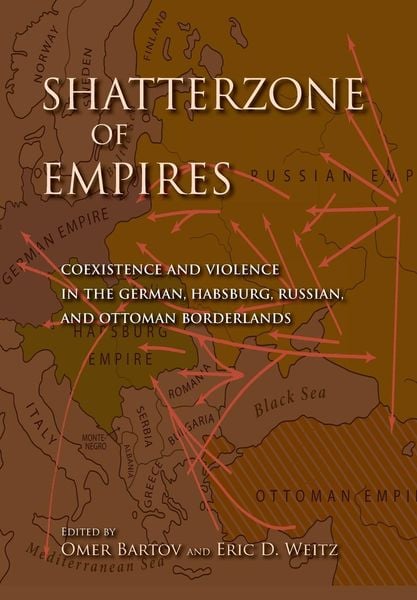
Shatterzone of Empires Coexistence and Violence in the German, Habsburg, Russian, and Ottoman Borderlands

36,99 €

inkl. gesetzl. MwSt., Versandkostenfrei


Beschreibung

Produktdetails

Einband

Taschenbuch

Erscheinungsdatum

01.10.2012

Abbildungen

2 b&w illus., 9 maps

Herausgeber

Omer Bartov + weitere

Verlag

Indiana University Press

Seitenzahl

544

Maße (L/B/H)

24,4/17/2,9 cm

Gewicht

927 g

Sprache

Englisch

ISBN

978-0-253-00635-6

Beschreibung

Rezension

"Cutting-edge scholarship on important issues of borderlands and violence that many people-and the educated public as a whole-think about. . . . A compendium of first-rate research and scholarship . . . truly impressive."-Norman M. Naimark, author of Fires of Hatred: Ethnic Cleansing in 20th-Century Europe
"It is hard to imagine that anyone in the field of central/eastern Europe will not buy this book. It will also be interesting to anyone working on the First or Second World War, or the history of violence, genocide, Judeocide. It's a big book . . . that will have a big impact."-Alison Frank, author of Oil Empire: Visions of Prosperity in Austrian Galicia
"In general, the collection is of great interest not only for historians of specific regions and countries (first of the Russian, Habsburg and Othman Islamic Empires), but also for many other representatives of the [history] profession who are interested in the newest methodological approaches.March 2015"-Ab Imperio
"Omer Bartov's and Eric Weitz's edited volume is an excellent introduction to the themes and arguments, as well as some of the significant scholars, that have made borderland history a growing field and have opened rich new lines of inquiry in existing national, imperial and regional historiographies."-European History Quarterly
"[A] fine collection . . . Omer Bartov and Eric D. Weitz, both historians of Germany and genocidal violence, have put together a collection that demonstrates that although much of the bloodshed was initiated by state actors, much was generated by ordinary people settling ethnic, social, and ideological scores.April 2015"-Austrian History Yearbook
"Anyone who studies nationalism, genocide, mass violence, or war in these regions, from the Enlightenment through the mid-twentieth century, needs to read 'Shatterzone of Empires'. The book is also highly recommended to specialists in any field of central and eastern European, Jewish, and Ottoman history during those periods. Advanced undergraduates . . .would also benefit greatly from this collection. The book's breadth, its theoretical exploration of borderlands, and its overall quality mean that the editors and authors have produced something of lasting scholarly value."-Central European History
"[This] book's quality ultimately rests with the individual contributions . . . which represent cutting-edge scholarship and interpretations.May 2014"-German Studies Review
"Shatterzone is an important contribution to an exciting conversation about mass violence and terror in the twentieth century . . . This volume is a rich contribution to several literatures: the histories of the empires and nations of eastern and southeastern Europe and the Middle East; the scholarship on nationalism and identity politics; Holocaust and genocide studies; and studies of violence and atrocities."-Slavic Review
"A valuable resource for scholars of central and eastern Europe and of the historical depth and character of nationalism. . . . Highly recommended."-Choice
"All in all, the volume testifies to the important advances that have been made over the past decade in the inter-related fields of ethnic group identification, evolving intergroup relations, and the origins of ethnic violence. By including examples of peaceful inter-ethnic coexistence before and between the two world wars, the volume offers a more nuanced picture of the European borderlands than is all too often the case."-HSozuKult
"[A]ll the essays in this collection meet the highest academic standards and levels of scholarship. Each essay includes detailed notes, and each was written by leading scholars in the area being examined. . . . . In total, Shatterzone of Empires, provides readers, of every ilk, with a deep understanding of the region and the underlaying conflicts that help mold the various empires throughout the 19th and 20th centuries."-The Jewish Eye

Produktdetails

Einband

Taschenbuch

Erscheinungsdatum

01.10.2012

Abbildungen

2 b&w illus., 9 maps

Herausgeber

Verlag

Indiana University Press

Seitenzahl

544

Maße (L/B/H)

24,4/17/2,9 cm

Gewicht

927 g

Sprache

Englisch

ISBN

978-0-253-00635-6

Herstelleradresse

Libri GmbH
Europaallee 1
36244 Bad Hersfeld
DE

Email: gpsr@libri.de

Noch keine Bewertungen vorhanden

Verfassen Sie die erste Bewertung zu diesem Artikel

Helfen Sie anderen Kundinnen und Kunden durch Ihre Meinung.

Kundinnen und Kunden meinen

Bewertungen (0)

Die Leseprobe wird geladen.
  • Produktbild: Shatterzone of Empires
  • Acknowledgements
    Introduction: Coexistence and Violence in the German, Habsburg, Russian, and Ottoman Borderlands Omer Bartov and Eric D. Weitz
    Part 1. Imagining the Borderlands
    1. The Traveler's View of Central Europe: Gradual Transitions and Degrees of Difference in European Borderlands Larry Wolff
    2. Megalomania and Angst: The Nineteenth-Century Mythicization of Germany's Eastern Borderlands Gregor Thum
    3. Between Empire and Nation State: An Outline for a European Contemporary History of the Jews, 1750-1950 Dan Diner
    4. Jews and Others in Vilna-Wino-Vilnius: Invisible Neighbors, 1831-1948 Theodore R. Weeks
    Part 2. Imperial Borderlands
    5. Our Laws, Our Taxes, and Our Administration: Citizenship in Imperial Austria Gary B. Cohen
    6. Marking National Space on the Habsburg Austrian Borderlands, 1880-1918 Pieter M. Judson
    7. Travel, Railroads, and Identity Formation in the Russian Empire Frithjof Benjamin Schenk
    8. Germany and the Ottoman Borderlands: The Entwining of Imperial Aspirations, Revolution, and Ethnic Violence Eric D. Weitz
    9. The Central State in the Borderlands: Ottoman Eastern Anatolia in the Late Nineteenth Century Elke Hartmann
    Part 3. Nationalizing the Borderlands
    10. Borderland Encounters in the Carpathian Mountains and Their Impact on Identity Formation Patrice M. Dabrowski
    11. Mapping the Hungarian Borderlands Robert Nemes
    12. A Strange Case of Antisemitism: Ivan Franko and the Jewish Issue Yaroslav Hrytsak
    13. Nation State, Ethnic Conflict, and Refugees in Lithuania, 1939-1940 Tomas Balkelis
    14. The Young Turks and the Plans for the Ethnic Homogenization of Anatolia Taner Akçam
    Part 4. Violence on the Borderlands
    15. Paving the Way for Ethnic Cleansing: Eastern Thrace during the Balkan Wars (1912-1913) and Their Aftermath Eyal Ginio
    16. "Wiping out the Bulgar Race": Hatred, Duty, and National Self-Fashioning in the Second Balkan War Keith Brown
    17. Failed Identity and the Assyrian Genocide David Gaunt
    18. Forms of Violence during the Russian Occupation of Ottoman Territory and in Northern Persia (Urmia and Astrabad), October 1914-December 1917 Peter Holquist
    19. A "Zone of Violence": The Anti-Jewish Pogroms in Eastern Galicia in 1914-1915 and 1941 Alexander V. Prusin
    20. Ethnicity and the Reporting of Mass Murder: Krakivs'ki visti, the NKVD Murders of 1941, and the Vinnytsia Exhumation John-Paul Himka
    21. Communal Genocide: Personal Accounts of the Destruction of Buczacz, Eastern Galicia, 1941-1944 Omer Bartov
    Part 5. Ritual, Symbolism, and Identity
    22. Liquid Borderland, Inelastic Sea? Mapping the Eastern Adriatic Pamela Ballinger
    23. National Modernism in Post-Revolutionary Society: The Ukrainian Renaissance and Jewish Revival, 1917-1930 Myroslav Shkandrij
    24. Carpathian Rus': Interethnic Coexistence without Violence Paul Robert Magocsi
    25. Tremors in the Shatterzone of Empires: Eastern Galicia in Summer 1941 Kai Struve
    26. Caught in Between: Border Regions in Modern Europe Philipp Ther
    List of Contributors
    Index