KI-Beratung Beta

Gutscheinbedingungen

**Gültig bis 11.11.2026 auf Spielzeug, Schreibwaren, Filme, Geschenke & Trends, Musik, tolino eReader & Zubehör, Hörbücher und Hörbuch-Downloads, nicht preisgebundene Bücher und Kalender online auf thalia.at und in der Thalia App. Einzelne Artikel können ausgeschlossen sein. Aufgrund der Buchpreisbindung sind deutschsprachige Bücher und eBooks ausgenommen. Zusätzlich ausgenommen sind Abos & Flatrates, Games, Geschenkkarten/-boxen, Shelfies, Software, Zeitschriften sowie einzelne Artikel von tonies®. Pro Einkauf einmal einlösbar. Click & Collect nur bei Onlinevorabzahlung möglich. Keine Barauszahlung. Nicht kombinierbar mit anderen Aktionen und Gutscheinen. Gutschein wird auf max. 500€ Bestellwert angerechnet. Nicht gültig für Versandkosten und Services.

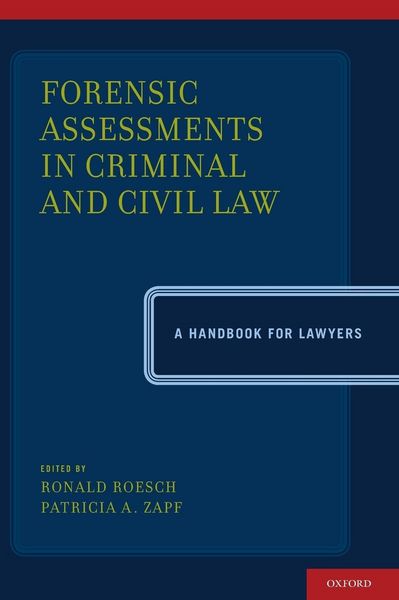
Produktbild: Forensic Assessments in Criminal and Civil Law

Forensic Assessments in Criminal and Civil Law A Handbook for Lawyers

5,99 €

inkl. gesetzl. MwSt., zzgl. Versandkosten


  • Kostenlose Lieferung ab 30 € Einkaufswert
  • Versandkostenfrei für Bonuscard-Kund*innen

Beschreibung

While the vast majority of criminal and civil lawyers must at some time come into contact with a forensic mental health evaluation, either when requested by their side or by opposing counsel, most do not know enough about the practice to be informed consumers. Forensic assessments can vary widely based...

Beschreibung

While the vast majority of criminal and civil lawyers must at some time come into contact with a forensic mental health evaluation, either when requested by their side or by opposing counsel, most do not know enough about the practice to be informed consumers. Forensic assessments can vary widely based on the assessor's personal preferences, and while there are clearly defined "best practices" for most evaluations, there is no official process by which legal professionals can guarantee these practices are being followed.
Designed to meet the specific needs of lawyers, Forensic Assessments in Criminal and Civil Law: A Handbook for Lawyers provides insight into what to expect from forensic mental health evaluations and how to navigate these assessments with skill and competence. The volume is divided into sections by evaluation type: criminal, civil, and juvenile and family evaluations. Each chapter addresses one of the most commonly requested forensic evaluations and is written by a forensic psychologist with both academic and professional experience with that type of evaluation. Specific evaluation types discussed include competence to stand trial in adults and juveniles, criminal responsibility, violence risk in adults, jury selection, eyewitness identification, personal injury claims, civil commitment, workplace disability, child custody, juveniles' risks and needs, and more. This handbook is a comprehensive, one-stop resource for lawyers, judges, and other legal professionals seeking to further their knowledge of forensic assessments.

Produktdetails

Einband

Gebundene Ausgabe

Erscheinungsdatum

01.12.2012

Herausgeber Ronald Roesch + weitere
Verlag Oxford University Press

Produktdetails

Einband

Gebundene Ausgabe

Erscheinungsdatum

01.12.2012

Herausgeber
Verlag Oxford University Press
Seitenzahl

310

Maße (L/B/H)

26/18,3/2,1 cm

Gewicht

781 g

Sprache

Englisch

ISBN

978-0-19-976685-7

Herstelleradresse

Libri GmbH
Europaallee 1
36244 Bad Hersfeld
DE

Email: gpsr@libri.de

Noch keine Bewertungen vorhanden

Verfassen Sie die erste Bewertung zu diesem Artikel

Helfen Sie anderen Kundinnen und Kunden durch Ihre Meinung.

Kundinnen und Kunden meinen

Bewertungen (0)

Die Leseprobe wird geladen.
  • Produktbild: Forensic Assessments in Criminal and Civil Law
    • Contents

    • Preface

    • About the Contributors

    • Chapter 1: Foundations of Forensic Mental Health Assessment

    • Kirk Heilbrun, Thomas Grisso, Alan M. Goldstein, and Casey LaDuke

    • Part 1: Criminal

    • Chapter 2: Evaluation of Competence to Stand Trial in Adults

    • Patricia A. Zapf and Ronald Roesch

    • Chapter 3: Evaluation of Criminal Responsibility

    • Ira K. Packer

    • Chapter 4: Evaluation of Capacity to Waive Miranda Rights

    • Alan M. Goldstein, Naomi E. Sevin Goldstein, and Heather Zelle

    • Chapter 5: Evaluation of Sex Offenders

    • Philip H. Witt and Mary Alice Conroy

    • Chapter 6: Evaluation of Violence Risk in Adults

    • Kirk Heilbrun, Stephanie Brooks Holliday, and Christopher King

    • Chapter 7: Evaluation for Jury Selection

    • Margaret Bull Kovera and Brian L. Cutler

    • Chapter 8: Evaluation for Capital Sentencing

    • Mark D. Cunningham

    • Chapter 9: Evaluation for Eyewitness Identification

    • Brian Cutler and Margaret Bull Kovera

    • Part 2: Civil

    • Chapter 10: Evaluation for Guardianship

    • Eric Y. Drogin and Curtis L. Barrett

    • Chapter 11: Evaluation for Personal Injury Claims

    • Andrew W. Kane, Erin M. Nelson, Joel A. Dvoskin, and Steven E. Pitt

    • Chapter 12: Evaluation for Civil Commitment

    • Douglas Mossman and Debra A. Pinals

    • Chapter 13: Evaluation for Harassment and Discrimination Claims

    • William Foote and Jane Goodman-Delahunty

    • Chapter 14: Evaluation of Workplace Disability

    • Lisa Drago Piechowski

    • Part 3: Juvenile and Family

    • Chapter 15: Evaluation for Child Custody

    • Geri Fuhrmann and Robert A. Zibbell

    • Chapter 16: Evaluation of Competence to Stand Trial in Juveniles

    • Ivan Kruh and Thomas Grisso

    • Chapter 17: Evaluation of Juveniles' Risks and Needs

    • Robert D. Hoge

    • Chapter 18: Evaluation for Disposition and Transfer of Juvenile Offenders

    • Randall T. Salekin, Kimberly M. Price, Kathryn E. Tant, Elizabeth W. Adams, Xinying Ang, and Jill Rosenbaum

    • Chapter 19: Evaluation of Parenting Capacity in Child Protection Matters

    • Jennifer R. Clark, Mary Connell, and Karen S. Budd